Powered by Obi Mbieri Independent Media Ltd.
$1 = ₦1,353€1 = ₦1,486£1 = ₦1,775Lagos Building Collapse Kills One, Injures Three
A quiet Lagos neighbourhood is mourning after a three-storey building crumbled into rubble. One person died and three others were injured in the collapse. This tragedy means Lagos Building Collapse Kills One, Injures Three is once again a grim headline in Nigerian news. For many families, this is mo...
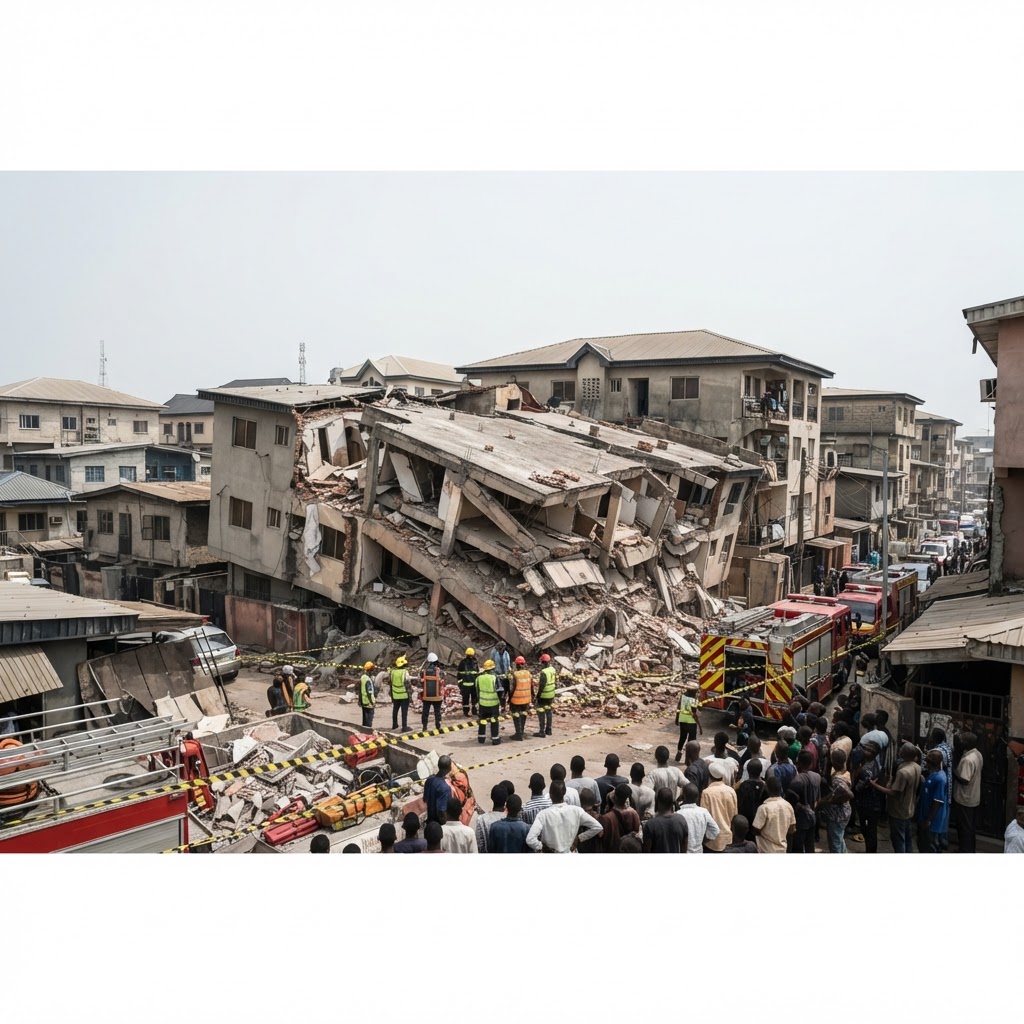
A quiet Lagos neighbourhood is mourning after a three-storey building crumbled into rubble. One person died and three others were injured in the collapse. This tragedy means Lagos Building Collapse Kills One, Injures Three is once again a grim headline in Nigerian news. For many families, this is more than a statistic. It's a reminder that safety at home can never be taken for granted. Every new building collapse adds another name to a list that should not keep growing, and every survivor's story is a warning the city cannot afford to ignore.
Why Do Lagos Buildings Collapse?
Lagos sits at the centre of Nigeria's construction crisis. According to the Punch Newspapers morning recap, building collapse remains a recurring item in the city's daily news cycle. The causes are rarely mysterious.
Substandard materials top the list. Developers often use low-grade steel rods and weak concrete blocks to cut costs. Cement is sometimes mixed with too much sand, weakening the final structure. These shortcuts save money upfront but create long-term danger that only becomes visible when a building collapse makes the news.
Unqualified labour compounds the problem. Many projects skip professional oversight entirely. Site supervisors without engineering training approve designs that should never pass inspection. Developers hire cheaper, untrained workers instead of certified builders to save money, and the resulting gap in expertise is one of the clearest predictors of a future building collapse.
The scale of the crisis is staggering. The Building Collapse Prevention Guild (BCPG) reports that Lagos accounts for over 55% of all building collapse incidents recorded in Nigeria since 1974. That is more than half a century of preventable tragedy concentrated in one city. Industry voices have repeatedly called for stricter licensing of contractors, echoing concerns raised in discussions like the Imo Assembly Backs Constitutional Amendment for State Police debate, where local enforcement capacity is central to public safety outcomes.
This enforcement gap is not isolated to construction. Similar struggles with local authority and oversight appear in State Police Bill Stalls After Limited Assembly Support, where attempts to decentralise security enforcement have repeatedly failed to gain traction. Without strong, localised enforcement bodies empowered to act quickly, both crime prevention and building collapse prevention remain reactive rather than proactive.
What Is The Human Cost?
Behind every collapse is a family forever changed. Reports from past incidents describe parents losing children in seconds, with grief that lingers for generations. These are not abstract numbers. They are neighbours, classmates, and breadwinners whose lives were cut short by a single building collapse.
The displacement figures are equally alarming. Over 6,000 households have been displaced by building collapse incidents in recent decades. Estimated property losses have reached $3.2 trillion across the same period. These losses ripple through communities, affecting savings, businesses, and school fees long after the rubble has been cleared.
Community vigilance often makes the difference between prevention and tragedy. Neighbours frequently notice cracks, leaning walls, or unusual construction speed long before officials do. Reporting these signs early can save lives. This mirrors the importance of early reporting seen in public health contexts, such as the vigilance highlighted in Nigeria Confirms Ebola Case in Abuja, 44 Contacts Identified, where fast community response limited wider harm.
Swift, decisive action after a tragedy also matters for accountability and public trust. Just as Police Arrest Suspect Over Cult-Related Killing in Owerri demonstrated that rapid law enforcement response can reassure a grieving community, similar urgency is needed after every building collapse. Families deserve to know that negligent developers and compromised officials will face consequences, not silence.
Rescue efforts, too, reveal how coordinated emergency response saves lives in the critical hours after a structure falls. The determination shown in cases like Five Arrested After Abducted NYSC Members Rescued illustrates what is possible when emergency teams act quickly and decisively — a standard that should also apply to every building collapse rescue operation.
Three patterns repeat across most collapse cases in Lagos:
- Visible cracks ignored for months before collapse
- Construction continuing despite stop-work orders
- Buildings exceeding approved floor limits without new permits
Recognising these warning signs early empowers residents to act before disaster strikes, and before another building collapse claims lives that could have been saved.
Are Safety Reforms Working?
Lagos State has not been silent on this issue. The Lagos State Building Control Agency (LASBCA) was created specifically to monitor construction standards. The State Material Testing Laboratory checks whether materials meet approved quality thresholds. On paper, these institutions should prevent most instances of building collapse.
Yet results tell a different story. Lagos recorded 13 building collapse incidents in 2024 alone. This is despite years of reforms, public awareness campaigns, and stricter permit requirements. The gap between policy and practice remains wide, and each new building collapse exposes how far enforcement still lags behind legislation.
Enforcement, not legislation, appears to be the weak link. Inspectors are sometimes bribed to overlook violations. Developers continue construction after receiving stop-work notices, betting that penalties will be minor or delayed. This pattern of weak enforcement echoes broader frustrations seen in governance debates like the NLC Maintains Two-Week Ultimatum to FG Over Petrol Prices standoff, where announced policies often struggle against ground-level implementation.
A similar story plays out in security reform efforts. State Police Bill Stalls After Limited Assembly Approval shows how even well-intentioned legislative proposals can stall when institutional buy-in is weak. The same dynamic undermines building collapse prevention in Lagos: agencies exist, rules are written, but follow-through is inconsistent.
Emergency preparedness infrastructure also matters once a building collapse has already occurred. The recent reopening described in Civil Defence and Immigration Portal Reopens October 28 is a reminder that functioning administrative systems are essential, not just for registration and documentation, but for coordinating the kind of rapid, multi-agency response that disasters like a building collapse demand.
Featured Products
Reverse Type 2 Diabetes & other associated Metabolic Issues using Dr. Jason Fung's Evidence-Based Approach— FMD program for Type 2 Diabetes
A practical fasting and fasting-mimicking programme built on Dr Jason Fung's insulin-resistance principles and ow-glycemic recipes.
₦19,950
Join NowChukwu Abiama Tee
Bold black-and-gold Igbo-pride T-shirt featuring 'Chukwu Abiama' in premium streetwear typography.
₦15,000
Buy NowỤmụ Igbo Tee
Classic black T-shirt with bold white 'Ụmụ Igbo' typography — a proud statement of Igbo heritage.
₦15,000
Buy NowNwanne Tee
Washed khaki vintage tee with a faded rust-orange 'Nwanne' stamp badge and palm leaf motif — a nod to kinship and heritage.
₦18,000
Buy NowObodo Tee
Faded denim-blue washed tee with a cream 'Obodo' stamp badge and sun motif, celebrating community roots.
₦18,000
Buy NowEkwe Heritage Tee
Deep indigo tee featuring a fine line-art illustration of a traditional Igbo ekwe drum, inspired by Igbo-Ukwu bronze artistry.
₦18,000
Buy NowIkenga Figure Tee
Forest green tee with a fine line-art illustration of a stylized Ikenga figure.
₦18,000
Buy NowIndependent organisations such as the Nigerian Institute of Building have repeatedly called for harsher penalties and faster prosecution of negligent developers. Until enforcement matches the ambition of these reforms, Lagos will likely continue leading the nation's building collapse statistics.
How Does Geography Affect Safety?
Lagos is not just a city of ambitious skylines. It is also a coastal city sinking slowly into its own foundation. Scientific studies show that parts of Lagos are experiencing land subsidence exceeding 4 mm per year. This is a measurable, ongoing geological process that directly increases the risk of building collapse in vulnerable areas.
This subsidence does not affect all areas equally. Differential subsidence means some parts of a building sink faster than others. This uneven settling places immense stress on foundations, especially in high-density areas with multiple adjoining structures. Over time, these stresses create cracks that weaken the entire structure, setting the stage for a future building collapse that may seem sudden but was years in the making.
Research published through platforms like ScienceDirect highlights how coastal cities worldwide face similar structural vulnerabilities. Lagos is not unique in this challenge, but its rapid, often unregulated urban growth makes the risk of building collapse more acute than in many comparable cities.
It is worth noting that regulatory blind spots are not confined to construction alone. Weak monitoring of under-the-radar activities has been documented in other sectors too, as seen in Why Africa's Tiny Ants Are Targeted for Wildlife Trade, where limited enforcement allowed an entire exploitative trade to flourish largely unnoticed. Just as small, overlooked details can escalate into major ecological harm, small, ignored cracks in a Lagos foundation can escalate into a devastating building collapse.
Modern construction in Lagos must account for these specific soil and environmental conditions. Soil testing before construction should be mandatory, not optional. Builders who ignore these environmental realities are essentially building on borrowed time, regardless of how strong their materials appear above ground, and the eventual result is too often another building collapse.
How Can Families Stay Safe?
Protecting your family starts before you sign a lease or purchase a property. Prospective tenants and homeowners should always verify a building's structural history. Ask how old the building is and whether it has undergone recent renovations or additions. A building with a history of unauthorised extensions is far more susceptible to building collapse than one with a clean, documented history.
Documentation matters more than appearances. A freshly painted building can still be structurally unsound. Always request the approved building permit from the landlord or developer. Structural engineering certifications should also be available upon request, confirming that qualified professionals assessed the design and reducing the likelihood of a future building collapse.
Consider these practical verification steps before moving into any property:
- Request the LASBCA-approved building permit
- Ask for structural engineering certification documents
- Inspect visible walls and ceilings for cracks or water damage
- Confirm the building has not exceeded its approved floor count
- Ask neighbours or former tenants about any history of structural issues
Community members also play a critical role as whistleblowers. If you notice suspicious construction activity, inferior materials, or work continuing after a stop-work order, report it immediately to LASBCA. Silence often enables tragedy. Speaking up, even anonymously, can prevent the next headline from reading like today's, and can stop a potential building collapse before it ever happens.
Students and young professionals entering the housing market for the first time are especially vulnerable to rushed decisions. Learning these verification habits early, much like building strong financial habits highlighted in programmes such as KoboTutor Announces ₦2.5 Million University Scholarships, builds a foundation of informed decision-making that protects both health and wealth. The same discipline that helps a student plan a scholarship application can help a young renter avoid signing a lease on a building at risk of collapse.
What Does Effective Emergency Response Look Like?
When a building collapse occurs, the first few hours determine how many lives are saved. Coordinated emergency response requires trained personnel, functioning communication systems, and clear lines of authority between agencies. Delays in any of these areas can turn a survivable incident into a fatal one.
Nigeria's broader emergency infrastructure offers useful lessons here. The administrative restoration described in Civil Defence and Immigration Portal Reopens October 28 underscores how essential functioning government systems are to disaster response readiness, from issuing permits to deploying personnel during a building collapse emergency.
Rescue operations following other crises also demonstrate what coordinated action can achieve. The successful outcome highlighted in Five Arrested After Abducted NYSC Members Rescued shows that when security and emergency teams act with urgency and precision, lives can be saved even in high-pressure situations. Lagos emergency services should be equipped and funded to respond to a building collapse with the same speed and coordination.
What Is The Path Forward?
Lasting change requires more than government action alone. A genuine Community-First approach to urban development treats residents as active participants, not passive observers. Neighbourhood associations, landlord unions, and local leaders should be formally included in safety monitoring processes designed to prevent the next building collapse before it happens.
Accountability must also extend upward. Developers who ignore safety standards need consistent, visible consequences, not occasional headline-grabbing arrests. Government officials who approve unsafe projects, whether through negligence or corruption, deserve equal scrutiny. Without this accountability, reforms will remain words on paper, and building collapse will remain an all-too-predictable outcome of inaction.
Public education remains the most sustainable long-term solution. Promoting a culture of Better Living Through Information means teaching Nigerians their legal rights to safe housing. It also means explaining, clearly and practically, why cutting corners on construction materials endangers entire families for the sake of short-term savings, and why vigilance against the warning signs of building collapse must become second nature in every neighbourhood.
Collective vigilance, informed by organisations like UN-Habitat and local bodies such as the BCPG, can shift Lagos away from its troubling collapse statistics. Every family that learns to ask the right questions, every neighbour who reports a suspicious crack, and every developer held accountable moves the city closer to safer living. This is the kind of practical prosperity that protects both health and home, strengthening entire communities one safe building at a time — and, ultimately, one prevented building collapse at a time.
Stay Informed
Get New Articles in Your Inbox
Subscribe to receive the latest community development, health, and wealth insights from Eziokwubundu.
Newsletter
Practical insights on health, wealth, and community — delivered weekly.
Community Discussion(0)
Leave a Comment
More to Read
You May Also Like

Obi-Mbieri Mourns Engr. Vitalis Opara: Questions Emerge Over Community’s Silence
Engr. Vitalis Opara is identified as President General on the signature page of the Obi-Mbieri Autonomous Community Constitution 2020 as amended.
IMSU Lecturers Protest in Owerri, Appeal to Uzodimma to End
The streets of Owerri turned into a sea of white lab coats and placards this week. Hundreds of university lecturers walked out of their offices, choosing protest over silence. The IMSU Lecturers Protest in Owerri, Appeal to Uzodimma to End Months-Long Strike has become a defining moment for Imo Stat...
JAMB Candidates Can Now Change Course and Institution Online
Admission season often brings long queues and costly transport for Nigerian families. That burden has just eased. JAMB candidates can now change their institutions and courses from home, as the board announces a new digital correction service, giving students and parents fresh control over their aca...
House Summons NAFDAC and DSS Over Fake Drug Deaths
Four people are dead, eleven more are fighting for their lives, and a federal lawmaker wants answers now. Fake Drug deaths linked to a suspicious herbal concoction have pushed the House of Representatives to move decisively, summoning NAFDAC and the DSS in a case that is no longer a distant headline...

Prevent Kidney Disease With Regular Health Checks
Kidney health rarely makes headlines until a crisis hits a family. Yet understanding Kidney Disease: Why Regular Health Checks Can Help Prevent Serious Complications can save lives, protect household income, and strengthen community wellbeing across Nigeria. Kidney Disease often develops quietly ove...

Budget-Friendly Healthy Meal Prepping for Nigerians
Modern Nigerian families face the dual pressure of rising food prices and the need for better health outcomes. Learning how Nigerian families can(/article/nigerian-family-guide-to-reversing-type-2-diabetes) use meal prepping with local ingredients to eat healthy on a tight budget is a vital skill fo...

Beyond Degrees: Bridging Nigeria's Digital Skills Gap
Nigeria's graduates are flooding the job market faster than employers can absorb them. Yet many arrive with certificates but no practical digital competence. This is the heart of Digital Skills and Youth Employment: Why Nigerian Graduates Need More Than University Certificates.—a gap that is reshapi...

Senate Sends State Police Bill to Tinubu for Approval
Nigeria's security architecture is entering a new chapter. The headline development, State Police Bill: Senate Transmits Constitutional Amendment to Tinubu for Presidential Assent, signals a historic shift toward decentralized policing. For Nigerian families, entrepreneurs, and community leaders, th...
Diabetes in Africa: Why Routine Screening Is Vital
Imagine a disease that silently damages organs for years before anyone notices. That is the reality for millions living in Africa today. According to the latest report, Diabetes: Three Out of Four Africans Living With the Condition May Be Unaware – Why Screening Matters, and this gap in knowledge is...
Tinubu Orders Release of 78 Suspects in Convoy Attack
A single Friday afternoon in Abuja turned into a national talking point. News that President Tinubu Orders Release of 78 Suspects Arrested Over Attack on His Convoy in Abuja quickly spread across radio, television, and social media. For many Nigerian families, the story raised fresh questions about ...