Powered by Obi Mbieri Independent Media Ltd · eziokwubundu.com
$1 = ₦1,329€1 = ₦1,514£1 = ₦1,760Obi Mbieri Palace Desperation: How Obi Mbieri Women were deceived and diverted to the Palace instead of Orie Ebom Market Square on Monday 24, 2026.
On Monday, August 24, 2026, what should have been a landmark gathering for the Obi Mbieri Women Wing Annual Home and Abroad meeting descended into organised confusion. Women who had travelled from across Nigeria— many bearing the cost of long journeys — were intercepted at a key tr...
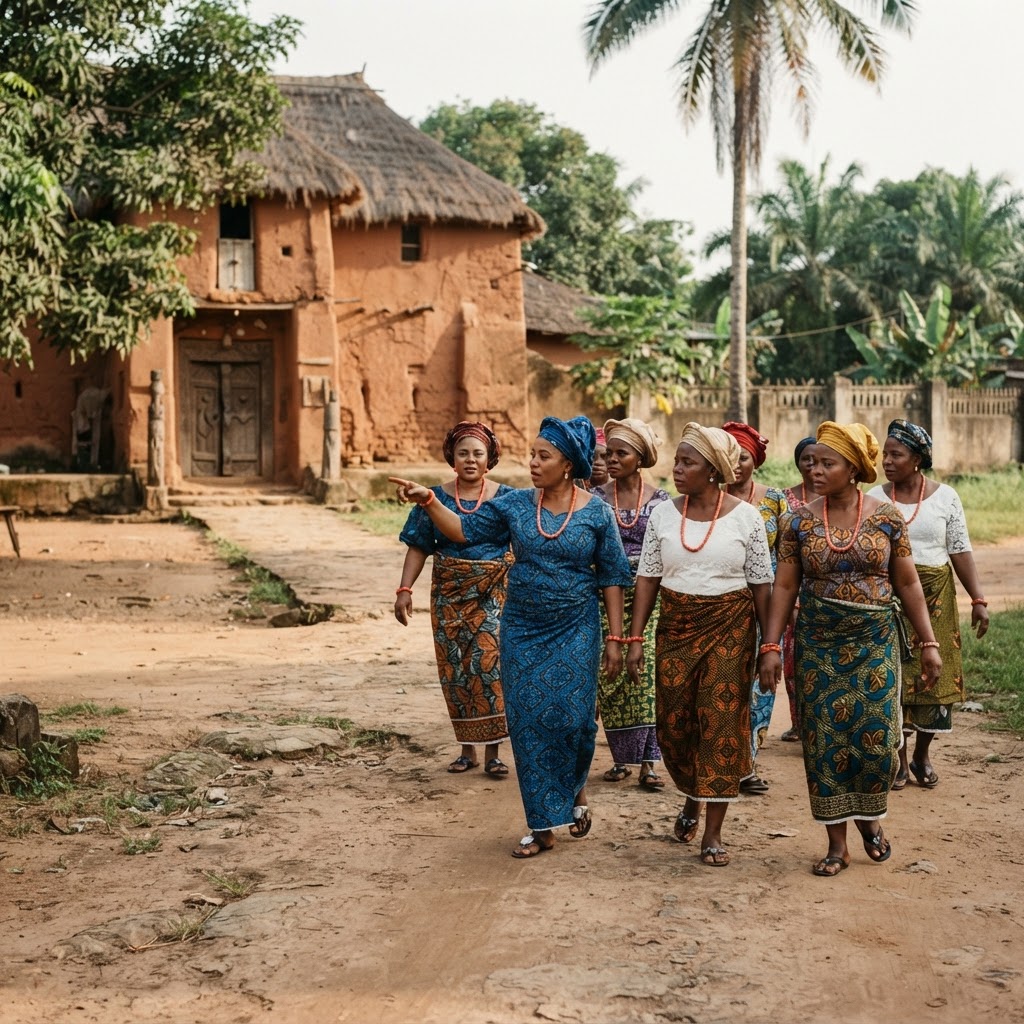
On Monday, August 24, 2026, what should have been a landmark gathering for the Obi Mbieri Women Wing Annual Home and Abroad meeting descended into organised confusion. Women who had travelled from across Nigeria, — many bearing the cost of long journeys — were intercepted at a key transit point and ferried to the wrong venue entirely. What unfolded at Nwaorieubi junction that morning was not an administrative error. According to information confirmed by the eziokwubundu.com editorial team, it was a calculated act of deception: palace-affiliated operatives deployed free buses to redirect community women away from the official venue at Orie Ebom Market Square and toward the Obi Mbieri Palace, where political speeches, not community development, awaited them.
This incident exposes a deepening crisis in Obi Mbieri — one that sits at the intersection of institutional manipulation, governance failure, and community fracture. For a traditional society that has long held its palace in the highest esteem, what happened on August 24 is not merely a logistical embarrassment. It is a symptom of dangerous desperation.
What Happened at Nwaorieubi Junction on Monday?
The Obi Mbieri Women Wing Annual Home and Abroad meeting was officially scheduled to begin at 10:00 AM at Orie Ebom Market Square — the recognised and traditional venue for this significant gathering of women from across the community and the diaspora. Women travelling from multiple villages and from other states converged on Nwaorieubi junction, a critical transit hub, to complete the final leg of their journey to Orie Ebom.
It was at this junction that the interception occurred. Persons working on behalf of the Obi Mbieri Palace had stationed a free bus at Nwaorieubi junction. When women arrived and confirmed they were attending the annual meeting, they were told the bus would take them to the venue. Trusting that assurance, they boarded. Instead of being taken to Orie Ebom Market Square, they were transported to the Obi Mbieri Palace.
The diversion effectively split the attendance of one of the community's most important annual gatherings. Women who were expecting to participate in a development-focused programme found themselves seated before a political audience they had never signed up for. The logistical confusion this created — across an event drawing women from home and abroad — was substantial, deliberate, and deeply disrespectful of the community's time and trust.
Why Were Women Taken to the Palace Instead?
The Women Wing's annual meeting carries a defined agenda: community welfare discussions, home-and-abroad coordination, progress reporting, and collective planning for the year ahead. These are practical, development-oriented conversations that matter deeply to the women who sacrifice time and money to attend. The Orie Ebom Market Square gathering was not a political forum — it was a community institution.
Yet at the Palace, according to victims who spoke to the eziokwubundu.com editorial team, the programme was dominated by political speeches with nothing relevant to the actual Women Wing meeting. The women, upon realising what had happened, were shocked. Several called contacts who confirmed that the Palace was not the scheduled venue. Many expressed deep disappointment and profound regret for making their journeys under false pretences.
The desperation of palace-affiliated actors to secure a visible audience — particularly one comprising respected women from home and state— appears to have motivated this diversion. By exploiting the trust women placed in the offer of free transport and in the implied authority of the institution, those behind the scheme chose political optics over community integrity. Replacing a welfare-driven agenda with political theatre did not merely waste the women's time — it weaponised their presence. The motivation is transparent: in the absence of legitimate community mandate, manufactured attendance becomes a substitute for genuine authority.
How Does Political Manipulation Damage Traditional Institutions?
Traditional institutions derive their power from moral authority, community trust, and the consistent application of cultural values. When those institutions — or actors operating in their name — resort to manipulation to secure an audience, that moral authority begins to dissolve. Research on politician's manipulation of traditional institutions confirms that the exploitation of customary structures for political gain is one of the most destabilising forces in community governance across West Africa.
In Obi Mbieri, the governing system has become visibly fractured. What was once a unifying cultural anchor — the palace — is now, in the eyes of many community members, a political instrument. The women who boarded those buses at Nwaorieubi junction did so based on what academics describe as "content-independent reasons for belief" — they trusted the source without verifying the destination, because the institution historically warranted that trust. As defined in analysis of manipulation in politics and public policy, manipulation bypasses rational agency by exploiting pre-existing trust relationships — precisely what occurred here.
The women were not given false information about a neutral topic. They were deceived about their physical destination, rendering them involuntary political props. This kind of desperation does not strengthen the palace — it corrodes it. Every such incident chips away at the reverence the community extends to its traditional institutions, and that damage, once sustained, is extraordinarily difficult to reverse.
Featured Products
Chukwu Abiama Tee
Bold black-and-gold Igbo-pride T-shirt featuring 'Chukwu Abiama' in premium streetwear typography.
₦15,000
Buy NowReverse Type 2 Diabetes & other associated Metabolic Issues using Dr. Jason Fung's Evidence-Based Approach— FMD program for Type 2 Diabetes
A practical fasting and fasting-mimicking programme built on Dr Jason Fung's insulin-resistance principles and ow-glycemic recipes.
₦19,950
Join NowỤmụ Igbo Tee
Classic black T-shirt with bold white 'Ụmụ Igbo' typography — a proud statement of Igbo heritage.
₦15,000
Buy NowNwanne Tee
Washed khaki vintage tee with a faded rust-orange 'Nwanne' stamp badge and palm leaf motif — a nod to kinship and heritage.
₦18,000
Buy NowObodo Tee
Faded denim-blue washed tee with a cream 'Obodo' stamp badge and sun motif, celebrating community roots.
₦18,000
Buy NowEkwe Heritage Tee
Deep indigo tee featuring a fine line-art illustration of a traditional Igbo ekwe drum, inspired by Igbo-Ukwu bronze artistry.
₦18,000
Buy NowIkenga Figure Tee
Forest green tee with a fine line-art illustration of a stylized Ikenga figure.
₦18,000
Buy NowWhy Is the Eze Vacancy Fuelling This Crisis?
The absence of a recognised Eze in Obi Mbieri — a crisis now stretching beyond six years — has created a governance vacuum that invites exactly this kind of manipulation. As documented in the Eziokwubundu report on the Umuwanji Village controversy, the community has been operating without the central traditional authority that would ordinarily arbitrate disputes, validate institutional decisions, and protect community organs like the Women Wing from interference.
Without a recognised Eze, shadow groups and palace-affiliated operatives have moved to fill the authority gap — often with agendas that serve narrow political or economic interests rather than collective community welfare. The administrative confusion generated by contested village creation further complicates efforts to hold peaceful, unified community meetings.
Underlying much of this instability is the question of oil wealth. As explored in prior reporting on Obi Mbieri's Seplat representation dispute, the control of who speaks for Obi Mbieri in negotiations with energy companies carries significant financial implications. Understanding Host Community Development Trusts and PIA fund obligations helps explain why various actors are so desperate to demonstrate community legitimacy — even through deceptive means. When resource control is at stake, the desperation to control community narratives intensifies dramatically.
What Are the Social Effects of This Deception on Women?
The psychological and social toll of this incident should not be underestimated. Many of the women who attended had travelled from far— incurring the considerable costs of distant domestic travel, accommodation, and time away from work and family. To arrive as a respected member of a community institution and be used as an involuntary audience for political speeches is a profound violation of dignity and trust.
This directly contradicts the eziokwubundu.com mission of "Community First" — the principle that individual wellbeing and collective strength are inseparable. When community members are manipulated at the institutional level, the frustration and betrayal they experience weaken family cohesion and erode participation in future community events. Research on the seductive details effect demonstrates how superficially attractive incentives — such as a free bus — can distract individuals from critical evaluation of what they are actually agreeing to, leading to a loss of agency. That is precisely what the deception at Nwaorieubi junction exploited.
For women experiencing the stress of this betrayal, prioritising mental wellness is essential. Community members should lean on trusted social networks, document their experiences through independent platforms, and channel frustration into constructive advocacy rather than withdrawal.
How Can Obi Mbieri Protect Future Meetings?
Restoring institutional integrity in Obi Mbieri demands both immediate practical action and long-term structural reform. First, the Women Wing and all recognised community organisations must establish a verified digital communication protocol. Official venue confirmations should be published on trusted platforms like eziokwubundu.com well in advance of any meeting — a standard that prevents misinformation from filling the information vacuum.
Second, the Women Wing should establish an independent transport committee, drawing on verified community members, to coordinate travel to official venues. Dependence on unverified "free" transport offered by unaccountable actors is a vulnerability that this incident has exposed with painful clarity.
Third, the community must return to the principle of "Traditional Values, Modern Progress" — holding accountable those operating the palace in the absence of a recognised Eze. The broader security implications of governance fragmentation have been recognised across Owerri's autonomous communities, as reported in Owerri's new vandalism and security crackdown framework.
Finally, grassroots journalism — the kind that the eziokwubundu.com editorial team practises — remains the most powerful safeguard available. Documenting, publishing, and amplifying incidents like the August 24 diversion ensures that the 2027 Women Wing meeting, and every gathering thereafter, cannot be hijacked without public accountability.
The Obi Mbieri Women Wing Annual meeting is a pillar of community life. The women who attend it represent the heartbeat of the community — at home and in the diaspora. What occurred at Nwaorieubi junction on Monday, August 24, 2026 was not an oversight. It was a deliberate act of institutional desperation that deceived, disrespected, and disempowered women who deserved better. For eziokwubundu.com, this is not simply a local story — it is a case study in what happens when traditional institutions abandon community service in favour of political survival. The community is watching, and the record is being kept.
Stay Informed
Get New Articles in Your Inbox
Subscribe to receive the latest community development, health, and wealth insights from Eziokwubundu.
Newsletter
Practical insights on health, wealth, and community — delivered weekly.
Community Discussion(0)
Leave a Comment
More to Read
You May Also Like
CCB Investigates Assets of 50 Top Nigerian Officials
A quiet compliance exercise inside a government agency rarely makes headlines, yet this one does. Nigerians are watching closely as the Code of Conduct Bureau digs into the Assets of the country's most powerful public servants, and the scrutiny is reshaping conversations about integrity in public of...

Owerri Hosts Interswitch TechConnect 6.0 Today
Nigeria's fintech landscape is entering a bold new phase of regional expansion. Owerri Hosts Interswitch TechConnect 6.0 Today, marking a historic milestone for South-East Nigeria's digital economy. This landmark gathering brings together innovators, policymakers, and entrepreneurs to reshape the na...

EFCC Declares Ex-Pension Boss Maina Wanted Again
The name Abdulrasheed Maina has resurfaced in Nigeria's anti-corruption headlines once again. In a fresh development that has caught public attention, EFCC Declares Ex-Pension Boss Maina Wanted Again, reigniting a saga that has spanned over a decade. For Nigerian families who depend on pension syste...

Imo Government to Support 100 More Communities
OKOBI is reshaping how everyday Imo residents build wealth from their own villages. The latest expansion, tagged OKOBI: 100 More Imo Communities Set to Receive Government Support, signals a new chapter in Governor Hope Uzodimma's push for grassroots prosperity. For Nigerian families and community le...

Osun Assembly Approves State Police Bill
The security conversation in Nigeria has taken a decisive turn. Lawmakers across the country are now voting on a reform that could reshape how communities are protected, starting from the grassroots. The Osun Assembly Approves State Police Bill, joining a growing list of states pushing for decentral...

Imo Approves Recruitment of 6,030 Teachers Across 27 LGAs
Imo State has taken a bold step toward transforming its public education system. Governor Hope Uzodimma has approved the recruitment of 6,030 teachers across the state's 27 Local Government Areas, a move many residents have awaited for years. This decision, widely reported by Vanguard(https://www.va...

CBN Cuts Interest Rate to 23%: Impact on Nigerians
Nigerians woke up to significant financial news this week. The Central Bank of Nigeria has made a bold move that could reshape household budgets and business plans alike. This shift, widely covered as CBN Cuts Interest Rate to 23% — What It Means for Nigerians and Businesses, deserves a closer look ...
65 Imo Businesses Await OKOBI Initiative Registration
Imagine 65 kindred-owned businesses across Imo State, each waiting for one final document to unlock full legal status. That single step—Corporate Affairs Commission registration—now defines the next chapter in Imo's OKOBI Initiative: 65 Community Businesses Await CAC Registration. For families, entr...
Why Nigeria Faces an Ongoing Power Supply Crisis
Nigerian households lose power multiple times a day, and the frustration never seems to fade. Behind every flickering bulb and silent refrigerator lies a deeper story about Nigeria's fragile power supply system — one that touches nearly every aspect of daily life across the country. Businesses stall...

61 Nigerian Officials Tied to $271M US Properties
Nigeria's corridors of power just faced a fresh spotlight. A newly released investigation, titled 61 Nigerian Officials Linked to $271m US Property Holdings — Report, has reignited public debate over wealth, accountability, and trust in leadership. For families budgeting daily expenses, the numbers ...