Powered by Obi Mbieri Independent Media Ltd · eziokwubundu.com
$1 = ₦1,332€1 = ₦1,498£1 = ₦1,775Auditor-General flags ₦124.12bn in contract/procurement irregularities
Nigeria's public financial management framework faces a defining credibility test. The Office of the Auditor-General for the Federation (OAuGF) has flagged ₦124.12 billion in contract and procurement irregularities across federal Ministries, Departments, and Agencies (MDAs), according to findings re...
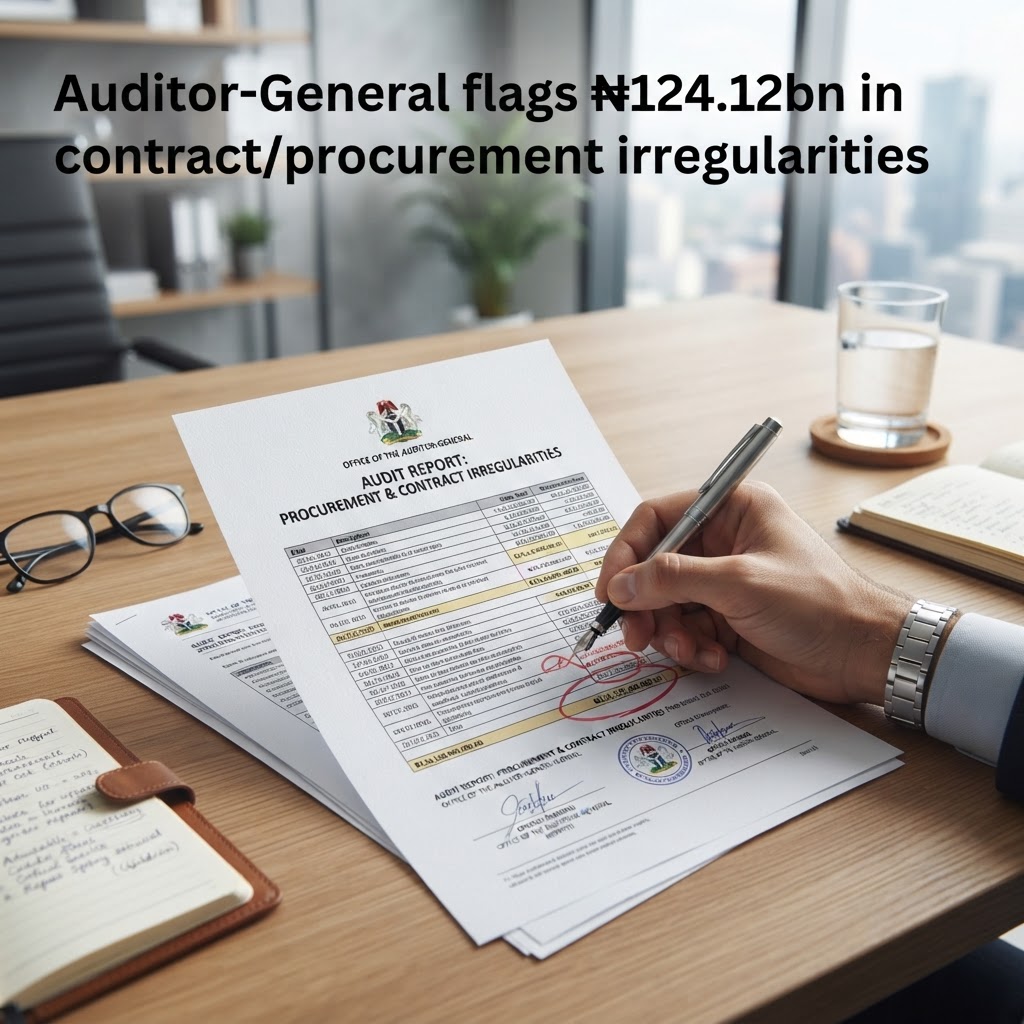
Nigeria's public financial management framework faces a defining credibility test. The Office of the Auditor-General for the Federation (OAuGF) has flagged ₦124.12 billion in contract and procurement irregularities across federal Ministries, Departments, and Agencies (MDAs), according to findings reported by Punch Newspapers. This figure is not merely a statistic — it represents hospitals that were never built, roads that were never completed, and communities whose welfare was quietly transferred into private hands through systemic abuse of public trust.
For Nigerian families, entrepreneurs, youth professionals, and community leaders, understanding what this audit exposes is both a civic duty and a survival skill. When public procurement systems haemorrhage resources at this scale, the consequences land hardest on ordinary households — in the form of degraded healthcare, collapsed infrastructure, and economic exclusion. This article deconstructs the audit findings, traces how structural failures enable repeated violations, and provides practical tools for communities to push back.
What Did the Auditor-General Uncover?
₦124.12bn in systemic MDA procurement breaches
The OAuGF's audit report identified ₦124.12 billion in irregularities spanning procurement cycles across multiple federal MDAs. The violations were neither isolated incidents nor administrative oversights — they reflected entrenched patterns of non-compliance with the Public Procurement Act 2007, the primary legal framework governing federal contracting in Nigeria.
Among the most frequently cited violations were payments made for capital works that remained uncompleted or unverified at the time of disbursement. Auditors also flagged widespread failures to remit statutory deductions — specifically Value Added Tax (VAT) and Withholding Tax (WHT) — to the Federal Inland Revenue Service, effectively stripping the government of secondary revenue streams that should have been recovered from contractors.
Extra-budgetary commitments — expenditures made outside approved appropriation lines — were another recurring theme. These represent a direct breach of fiscal discipline and circumvent the National Assembly's constitutional authority over public spending.
Perhaps most structurally damaging was the evidence that internal tenders boards within various MDAs routinely bypassed the Bureau of Public Procurement's (BPP) mandatory open competitive bidding thresholds. The BPP, established under the 2007 Act to enforce due process, requires that contracts above specified thresholds go through advertised, competitive procurement. The audit findings suggest that many agencies treated these thresholds as suggestions rather than binding mandates — awarding contracts through restricted or single-source methods that insulate favoured vendors from competitive scrutiny.
The cumulative effect is a procurement environment where rule-following is the exception, not the norm — and where ₦124.12 billion in fiscal value dissolves without commensurate public benefit.
Why Does Public Procurement Keep Bleeding Capital?
Structural gaps, weak oversight, digital failure
The persistence of procurement violations across successive audit cycles cannot be explained by accident or incompetence alone. Structural vulnerabilities within Nigeria's public administration create the conditions in which non-compliance becomes rational and risk-free.
The Brookings Institution has documented how incomplete implementation of digital procurement reforms and fragmentation between subnational and federal procurement bodies undermine systemic accountability in sub-Saharan Africa. Nigeria's experience mirrors these findings. The Nigeria Open Contracting Portal (NOCOPO) and its alignment with Open Contracting Data Standards (OCDS) were designed to make procurement data publicly accessible and machine-readable. However, agency reporting compliance remains chronically low, and many MDAs lack the technical manpower to populate and maintain these systems accurately. A transparency portal populated with incomplete data is functionally indistinguishable from no portal at all.
The culture of delayed audit reporting compounds this problem significantly. When audit findings are published 18 to 24 months after the financial year under review, the window for timely corrective action has long closed. Contractors have been paid, projects have been formally closed out, and personnel have rotated. The National Assembly's Public Accounts Committees (PAC), charged with scrutinising audit findings and summoning errant accounting officers, are frequently overwhelmed by backlogs and under-resourced for forensic-level review.
Without immediate sanctions — contract suspensions, mandatory refunds, or criminal referrals — repeated violators learn that the cost of non-compliance is a query letter at worst. Until audit findings trigger automatic, time-bound consequences, the incentive structure within MDAs will continue to reward risk-taking over compliance.
How Does Procurement Fraud Harm Communities?
The governance-to-household harm pipeline
The ₦124.12 billion flagged by the Auditor-General is not an abstraction. Each naira represents a specific public good that was promised and withheld. For Nigerian autonomous communities, particularly those in underserved states, the connection between procurement fraud and daily suffering is direct and measurable.
Primary healthcare delivery is among the most immediately affected sectors. When funds allocated for rural health centre construction or clinical supply chains are diverted or consumed by inflated contracts, communities lose access to the basic preventive and maternal care that formal health policy promises them. As documented in our Imo State Healthcare Access Guide, the gap between budgeted health infrastructure and what communities actually receive is often staggering — and procurement irregularities are a primary driver of that gap.
Featured Products
Chukwu Abiama Tee
Bold black-and-gold Igbo-pride T-shirt featuring 'Chukwu Abiama' in premium streetwear typography.
₦15,000
Buy NowReverse Type 2 Diabetes & other associated Metabolic Issues using Dr. Jason Fung's Evidence-Based Approach— FMD program for Type 2 Diabetes
A practical fasting and fasting-mimicking programme built on Dr Jason Fung's insulin-resistance principles and ow-glycemic recipes.
₦19,950
Join NowỤmụ Igbo Tee
Classic black T-shirt with bold white 'Ụmụ Igbo' typography — a proud statement of Igbo heritage.
₦15,000
Buy NowNwanne Tee
Washed khaki vintage tee with a faded rust-orange 'Nwanne' stamp badge and palm leaf motif — a nod to kinship and heritage.
₦18,000
Buy NowObodo Tee
Faded denim-blue washed tee with a cream 'Obodo' stamp badge and sun motif, celebrating community roots.
₦18,000
Buy NowEkwe Heritage Tee
Deep indigo tee featuring a fine line-art illustration of a traditional Igbo ekwe drum, inspired by Igbo-Ukwu bronze artistry.
₦18,000
Buy NowIkenga Figure Tee
Forest green tee with a fine line-art illustration of a stylized Ikenga figure.
₦18,000
Buy NowRural water access and road corridor maintenance — both critical determinants of community health and economic participation — suffer the same fate. Abandoned infrastructure projects are not neutral outcomes. They actively degrade quality of life, increase exposure to waterborne disease, isolate agricultural producers from markets, and raise household transportation costs.
For small and medium enterprises (SMEs) and local entrepreneurs, opaque and non-competitive bidding compounds economic exclusion. When contracts are directed to politically connected vendors without open competition, legitimate local businesses are denied growth opportunities. This suppresses local employment, reduces tax revenues at the community level, and deepens youth unemployment in areas already struggling with underfunded safety nets.
The mental health dimension is equally real, if less quantified. When families witness persistent abandonment of promised projects — clinics, schools, roads — the resulting loss of institutional trust generates community-level demoralisation. As explored in discussions around the Imo State Cost of Living Guide, fiscal leakages at the federal level cascade into household economic pressure that shapes physical and psychological wellbeing daily.
What Do Citizens Actually Think About Contract Fraud?
The collective action gap on procurement integrity
Public attitudes toward procurement fraud reveal a paradox that governance researchers have increasingly documented. Chatham House surveys on corruption norms in Nigeria have found that a substantial majority of ordinary citizens personally reject contract inflation and fund diversion as unacceptable. Yet the same respondents express deep pessimism about whether their peers share these values — a phenomenon known as pluralistic ignorance.
This gap is consequential. When citizens assume that tolerance for procurement fraud is the social norm — even when it is not — they become reluctant to report violations, challenge suspicious contracts, or mobilise around audit findings. The perceived futility of individual action becomes a self-fulfilling prophecy that protects entrenched interests.
Procurement personnel within MDAs face parallel pressures. Institutional cultures that reward loyalty over compliance, combined with inadequate whistleblower protection frameworks, create powerful disincentives for internal exposure of fraud. Nigeria's Freedom of Information Act 2011 theoretically empowers citizens to access contracting data, but procedural delays and non-compliance by agencies blunt its practical utility.
This is precisely where traditional community leadership structures hold untapped potential. Town unions, age grades, development committees, and autonomous community councils represent organised social capital that can be mobilised for grassroots procurement monitoring. When community leaders demand project documentation from local government liaisons, attend public procurement hearings, and coordinate with civil society organisations, they create social accountability mechanisms that supplement — and often outperform — formal institutional oversight. Understanding community development levies in Imo and how they interconnect with state capital allocations is one entry point for this kind of civic engagement.
How Can Communities Enforce Fiscal Accountability?
Practical tools for grassroots procurement oversight
Civic accountability over public contracts does not require legal expertise or political connections. It requires organised communities, accessible information, and persistent engagement with formal processes.
The first practical step for town unions, youth professionals, and diaspora groups is accessing contract award data through the Nigeria Open Contracting Portal and cross-referencing it with constituency project allocations published by the Constituency Project Tracking Group. Where data gaps exist, Freedom of Information requests submitted directly to the relevant MDA or State Ministry of Finance can compel disclosure of contract values, contractor identities, and completion certificates.
For ongoing capital projects — particularly in health and basic education — communities should document physical progress against disbursement milestones before final payments are authorised. Photographs, community testimonies, and independent quantity surveyor assessments, when formally submitted to the relevant PAC or anti-corruption agency, constitute actionable evidence. Our guide on how to verify Imo Government projects provides a replicable framework for this kind of community-led project auditing.
Diaspora organisations hold particular leverage. By funding independent technical audits of constituency projects and sharing findings with international development partners, diaspora groups can introduce external accountability pressure that domestic actors cannot easily dismiss.
At the legislative level, three reforms would structurally reduce recurring procurement violations: the establishment of independent administrative dispute mechanisms that operate outside the courts for faster resolution; automated contractor debarment triggered by audit findings without requiring separate criminal convictions; and enforceable sanction powers for the Auditor-General that allow direct financial recovery orders rather than referral-only recommendations. Civil society organisations such as the Centre for Social Justice Nigeria have consistently advocated these reforms and provide platforms for community voices to reach legislative debates.
Conclusion
The ₦124.12 billion flagged by the Auditor-General is a measure of institutional failure — but also a call to organised action. For Nigerian families, community leaders, entrepreneurs, and youth professionals, public procurement accountability is not a distant governance abstraction. It is the direct determinant of whether the clinic in your community has equipment, whether the road to your market is passable, and whether your children inherit functional public institutions.
Eziokwubundu's core conviction — that health, wealth, and community are inseparable — finds urgent expression here. Fiscal governance is community health. When public resources are protected and invested with integrity, households prosper, local economies strengthen, and communities build the resilience that no policy document alone can manufacture. The audit findings are a diagnosis. The response must be community-led, practically grounded, and relentless.
Stay Informed
Get New Articles in Your Inbox
Subscribe to receive the latest community development, health, and wealth insights from Eziokwubundu.
Newsletter
Practical insights on health, wealth, and community — delivered weekly.
Community Discussion(0)
Leave a Comment
More to Read
You May Also Like
State Police Bill Stalls After Limited Assembly Support
Nigeria's long debate over decentralized policing has hit a critical wall. The State Police Bill Stalls After Limited Assembly Support, leaving reform advocates uneasy about the road ahead. As detailed in earlier coverage of the State Police Bill Stalls After Limited Assembly Approval(/article/6ad1d...

FUTO Partners With Police to Boost Campus Security
Nigerian universities are grappling with growing security concerns, and the Federal University of Technology, Owerri (FUTO) is responding with urgency to protect its community. Campus security has become the defining priority for university leadership as recent incidents involving student safety pus...

Umuahii Day: Preserving Our Heritage, Rekindling Otu Obi
Every December, families across Imo State pause to celebrate something larger than a party. They celebrate belonging. This year, that celebration carries a clear purpose: Umuahii Day: Preserving Our Heritage, Rekindling Otu Obi invites every son and daughter of Umuahii to come home, in body or in sp...

2026 NNPC/Seplat Scholarship: Apply Now
The race for Nigeria's future workforce starts in the lecture hall, not the boardroom. If you are a Nigerian undergraduate looking for financial relief this academic year, the 2026 NNPC/Seplat Scholarship: Apply Now initiative offers a credible, well-funded pathway to ease tuition pressure and keep ...

NNPC Seeks Partnerships to Restart PH and Warri Refineries
Nigeria's refining sector is entering a decisive new chapter. As the nation searches for lasting solutions to decades-old fuel supply challenges, the news that NNPC Evaluates New Partnerships to Restart Warri and Port Harcourt Refineries signals a shift from patchwork repairs toward structured, long...

NYSC Abduction: Serving Nigeria at What Cost? Fresh Safety Questions
The Umunoha abduction of prospective NYSC members has renewed concerns over the safety of graduates travelling across Nigeria for national service.

Military Aircraft With 32 Aboard Crashes in Ondo, Rescue Underway
Igbokoda crash: Nigerian Air Force ATR-42 was travelling from Benin to Lagos when contact was lost
Nwanegwo Hands Over Mbaitoli LGA Affairs, Ends Tenure
Hon. Ifunanya Nwanegwo JP has formally handed over the affairs of Mbaitoli Local Government Area to the Director of Administration and General Services (DAGS), marking the conclusion of his tenure as Executive Chairman.
Umunoha NYSC Kidnap: Hideout Located as IED Threat Delays Rescue
Imo security agencies have located the suspected hideout of prospective NYSC members abducted along the Owerri–Onitsha Road, but an alleged improvised explosive device (IED) threat has delayed the planned rescue operation.

Mbaitoli Kidnapping: Why Is the Owerri–Onitsha Road Still Vulnerable?
The latest kidnapping incident along the Owerri–Onitsha Road in Mbaitoli Local Government Area of Imo State has renewed concerns about the safety of one of the major transportation routes connecting communities in Imo and neighbouring states.