Powered by Obi Mbieri Independent Media Ltd · eziokwubundu.com
$1 = ₦1,326€1 = ₦1,541£1 = ₦1,793Imo State Healthcare Access Guide
Accessing quality healthcare in Imo State has long been a challenge shaped by underfunding, geographic disparity, and heavy reliance on out-of-pocket spending. Yet the landscape is shifting. With the operationalization of the Imo State Health Insurance Agency (IMSHIA), renewed federal investment thr...
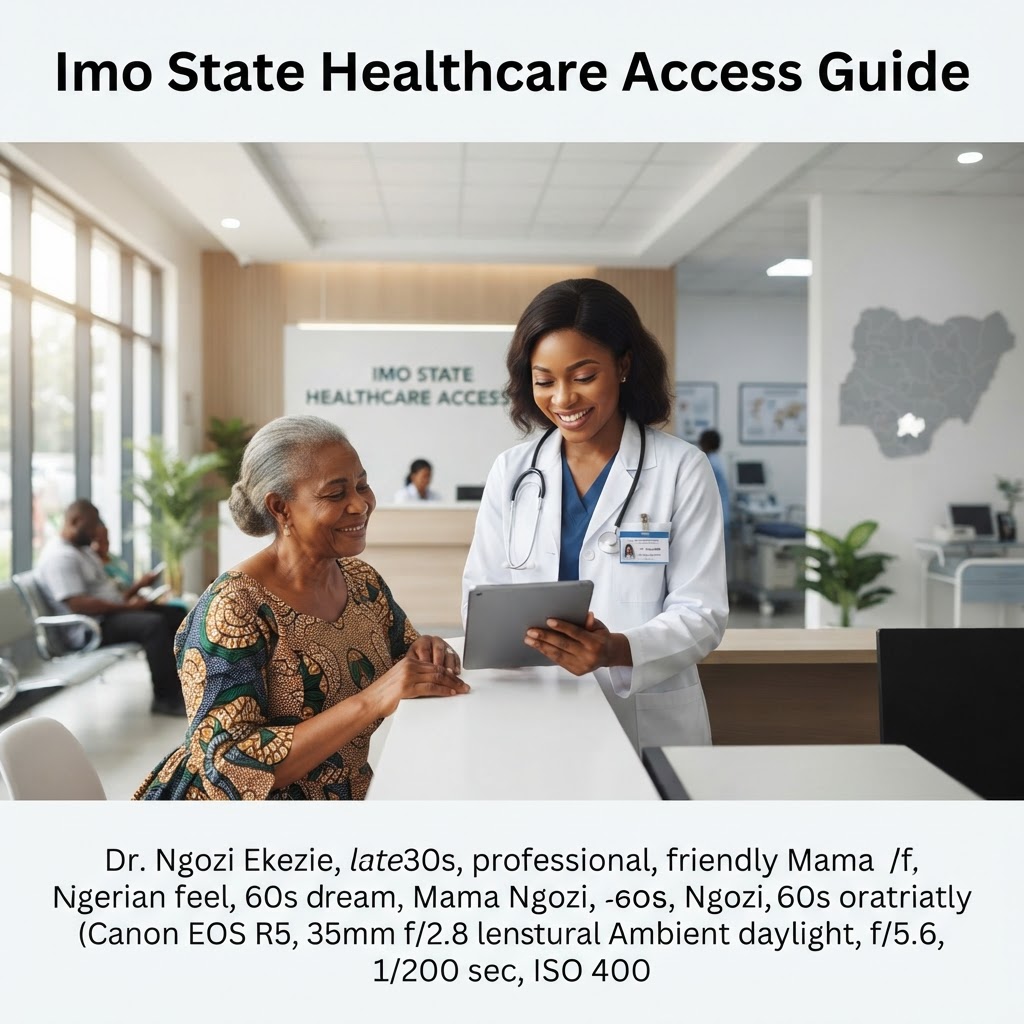
Accessing quality healthcare in Imo State has long been a challenge shaped by underfunding, geographic disparity, and heavy reliance on out-of-pocket spending. Yet the landscape is shifting. With the operationalization of the Imo State Health Insurance Agency (IMSHIA), renewed federal investment through the Basic Health Care Provision Fund (BHCPF), and a growing network of accredited facilities, Imo residents today have more structured pathways to medical security than at any previous point. This Imo State Healthcare Access Guide is designed to serve Nigerian families, community leaders, health-conscious youth professionals, and diaspora stakeholders who want practical, actionable knowledge about how the state's healthcare system works — and how to use it effectively.
How Is Imo State's Healthcare System Structured?
Governance, Tiers of Service, and Capacity
The Imo State Ministry of Health (SMOH) provides overarching governance for healthcare delivery across the state's 27 Local Government Areas. The Ministry coordinates a three-tiered service architecture: primary healthcare centers (PHCs) at the community level, secondary general hospitals at the LGA level, and tertiary referral institutions at the apex.
Primary Healthcare Centers form the backbone of frontline services, handling maternal and child health, immunisation, family planning, and disease surveillance. Over 300 PHCs are distributed across Imo, though service quality varies significantly between urban and rural communities. Secondary hospitals — including General Hospital Owerri, General Hospital Okigwe, and others — manage more complex cases that exceed PHC capacity.
At the tertiary level, the Federal Medical Centre (FMC) Owerri and the Imo State University Teaching Hospital (IMSUTH) Orlu provide specialist and surgical care, residency training, and clinical research capacity. FMC Owerri, under the Federal Ministry of Health, serves as the primary national referral anchor for the southeast zone.
Historically, Imo's health financing was fragmented and inequitable. Out-of-pocket health expenditure accounted for over 70% of total health spending in the state — a figure far above the WHO-recommended ceiling of 15–20%. This financial exposure pushed many households into catastrophic medical debt. The transition toward organized, risk-pooled purchasing systems through social health insurance now represents the most important structural reform in a generation. Understanding how to navigate it is central to every household's financial and physical wellbeing.
What Is IMSHIA and Who Qualifies?
The Agency, the Fund, and Who It Covers
The Imo State Health Insurance Agency (IMSHIA) was established under Imo State Law No. 4 of 2018, with a legislative mandate to operationalize the Social Health Insurance Scheme (SHIS) and drive the state toward Universal Health Coverage (UHC) benchmarks aligned with Nigeria's National Health Act and Sustainable Development Goal 3.
IMSHIA administers contributions, enrols beneficiaries, accredits healthcare providers, and enforces quality standards across empaneled facilities. It operates in coordination with the National Health Insurance Authority (NHIA) — formerly NHIS — and draws supplementary financing from the Basic Health Care Provision Fund (BHCPF), which pools federal allocations, donor contributions, and state government counterpart funding.
The demographic coverage of IMSHIA is meaningful and growing. As of recent operational reports, over 37,000 civil servants have been enrolled through formal payroll-based contributions. More significantly, over 84,900 indigent individuals — including vulnerable women, children under five, the elderly, and persons with disabilities — have been brought into coverage through the BHCPF grant window. Targeted student schemes are also being implemented across Imo State University (IMSU) and other state tertiary institutions.
The essential benefits package under IMSHIA covers a substantive range of services: outpatient primary consultations, routine medications on the approved formulary list, maternal health services including antenatal care and supervised delivery, and certified emergency surgical interventions at approved secondary facilities. Dental and optical care remain partially covered depending on enrolment tier.
For a broader picture of how Imo State's social programmes interconnect, see our detailed coverage of Imo State Social Investment Programs Explained, which maps the intersection of health, education, and poverty reduction initiatives.
External reference: NHIA Nigeria — Universal Health Coverage
How Can Families Enroll in Imo Health Insurance?
A Step-by-Step Enrolment Blueprint
Enrollment in IMSHIA is accessible through multiple channels designed to accommodate both formal and informal sector workers, as well as rural households. The primary digital registration portal is imshiaonline.com, where prospective enrollees can complete biographical data entry, select a preferred accredited facility, and track application status.
For those without consistent internet access, designated LGA liaison offices and accredited PHC verification desks serve as physical enrolment points. Staff at these locations can process applications, capture biometric data, and issue beneficiary identification cards on-site or within a short processing window.
For civil servants, enrolment is processed through payroll deduction coordinated by the Accountant General's office. Premiums are deducted monthly and remitted to IMSHIA. No separate registration action is typically required beyond confirming facility preference.
For informal sector workers — including artisans, market traders, mechanics, tailors, and small business operators — voluntary contribution enrolment is available. The contribution rate is structured to be income-sensitive, with the government subsidising a portion for low-income participants. This category of enrolment is particularly relevant for the millions of Imo residents outside formal employment.
Documentation requirements include a valid government-issued ID (national ID card, voter's card, or driver's licence), one recent passport photograph, proof of state residency (utility bill or LGA attestation letter), and for informal sector applicants, a completed declaration of occupation form. Upon processing, beneficiaries receive a laminated IMSHIA card that grants instant access at all empaneled clinics.
Understanding the business registration landscape can also strengthen informal entrepreneurs' access to formal systems — our Imo State Business Registration Guide provides a practical companion resource.
Where Are Accredited Health Facilities in Imo?
Facilities, Zones, and Referral Pathways
Imo State's accredited healthcare network spans three administrative zones — Owerri, Okigwe, and Orlu — each with distinct facility concentrations and referral capabilities.
Featured Products
Chukwu Abiama Tee
Bold black-and-gold Igbo-pride T-shirt featuring 'Chukwu Abiama' in premium streetwear typography.
₦15,000
Buy NowReverse Type 2 Diabetes & other associated Metabolic Issues using Dr. Jason Fung's Evidence-Based Approach— FMD program for Type 2 Diabetes
A practical fasting and fasting-mimicking programme built on Dr Jason Fung's insulin-resistance principles and ow-glycemic recipes.
₦19,950
Join NowỤmụ Igbo Tee
Classic black T-shirt with bold white 'Ụmụ Igbo' typography — a proud statement of Igbo heritage.
₦15,000
Buy NowNwanne Tee
Washed khaki vintage tee with a faded rust-orange 'Nwanne' stamp badge and palm leaf motif — a nod to kinship and heritage.
₦18,000
Buy NowObodo Tee
Faded denim-blue washed tee with a cream 'Obodo' stamp badge and sun motif, celebrating community roots.
₦18,000
Buy NowEkwe Heritage Tee
Deep indigo tee featuring a fine line-art illustration of a traditional Igbo ekwe drum, inspired by Igbo-Ukwu bronze artistry.
₦18,000
Buy NowIkenga Figure Tee
Forest green tee with a fine line-art illustration of a stylized Ikenga figure.
₦18,000
Buy NowIn the Owerri zone, the highest density of accredited public and private providers is concentrated, including FMC Owerri, the state specialist hospital, and numerous private clinics enrolled under IMSHIA. This zone handles the majority of emergency surgical cases and complex maternal care referrals from across the state.
The Orlu zone is anchored by IMSUTH, which provides teaching hospital-grade services and specialist outpatient clinics across multiple disciplines. The Okigwe zone, while historically underserved, has seen recent investments in PHC rehabilitation and community health worker deployment.
The referral pathway follows a stepped-care model: patients first present at a community PHC, where over 300 certified Lifesaving Skills (LSS) providers are trained for emergency obstetric and neonatal stabilisation. Cases requiring higher-level intervention are referred with formal documentation to secondary hospitals, and from there to tertiary centres if specialist care is required.
A critical practical note: patients should always obtain a referral letter before proceeding to higher-level facilities to avoid out-of-pocket charges at the point of service. Emergency cases are exempt from this requirement, but it remains advisable to alert the receiving facility's social welfare desk upon arrival.
External reference: WHO Nigeria — Primary Health Care
How Does Health Coverage Build Household Wealth?
Medical Security and Family Prosperity
The economic argument for health insurance is not abstract in the Nigerian context — it is immediate and measurable. A single hospitalisation episode for a serious illness can cost between ₦150,000 and ₦800,000 or more at private facilities, a sum capable of wiping out the working capital of a small retail business or depleting years of household savings. Catastrophic health expenditure — defined by the WHO as out-of-pocket health costs exceeding 10% of household consumption — affects an estimated 25–30% of Nigerian families annually.
For micro-enterprises and market traders, the economic disruption extends beyond the medical bill itself. Lost workdays, reduced productivity during recovery, and the diversion of business capital toward medical expenses compound into structural poverty traps that span generations. Land assets, livestock, and informal savings groups (ajo/esusu) are frequently liquidated to cover health emergencies.
The WHO investment case framework applied to Imo State suggests that sustained health financing, combined with effective risk-pooling, can deliver a potential 200% increase in real GDP returns over a 15-year horizon, alongside significant employment creation in the health and pharmaceutical supply chain. This is not charity — it is economic infrastructure.
Shielding micro-enterprises from medical indebtedness through IMSHIA enrolment directly enables consistent reinvestment in inventory, equipment, and skills. The Health + Wealth paradigm is central to the eziokwubundu.com mission: personal health security is inseparable from household financial resilience. For a related perspective on community-level resource mobilisation, see our guide on Community Development Levies in Imo Explained.
External reference: World Bank — Health Financing in Nigeria
How Can Communities Mobilize for Better Healthcare?
Diaspora Models, Cooperatives, and Civic Action
One of the most innovative mechanisms emerging within Imo's health financing ecosystem is the Adoption Model — a community-driven approach where town unions, diaspora associations, faith-based organisations, and prominent stakeholders fund IMSHIA annual premium payments for vulnerable rural residents who cannot afford voluntary contributions.
Several Imo communities in the diaspora — particularly in the United Kingdom, United States, and Canada — have begun channelling remittances through structured health contributions rather than informal ad hoc medical emergency payments. This shift from reactive to proactive community health financing represents a powerful application of traditional Igbo solidarity (Igwebuike) to modern institutional frameworks.
Traditional institutions and local cooperatives can also play a direct accountability role. Town union health committees, women's organisations, and youth professional networks can conduct quarterly audits of PHC service delivery — assessing drug stock availability, equipment functionality, and health worker attendance. Community scorecards have been shown to improve facility performance in comparable African health systems.
The call to action is clear: Imo's civic leaders, religious institutions, and professional associations must treat grassroots health mobilisation not as philanthropy but as community infrastructure investment. Enrolling your village's widows and youth into IMSHIA costs a fraction of what a single emergency fundraiser demands — and it builds the institutional resilience that transforms a community from vulnerable to sovereign.
For leaders seeking to align health investment with broader community development action, our guide on How to Verify Imo Government Projects offers tools for civic accountability that apply equally to health facility oversight.
External reference: BHCPF Nigeria — Federal Ministry of Health
Conclusion
The Imo State Healthcare Access Guide presented here is not a theoretical overview — it is a practical roadmap for families, entrepreneurs, community leaders, and diaspora stakeholders ready to take deliberate action. From understanding how IMSHIA works and who qualifies, to enrolling step by step, locating accredited facilities, and connecting health security to household economic stability, every section of this guide is designed to reduce the distance between Imo residents and the care they deserve.
Health is not a luxury. In the context of Imo State today, it is an accessible right — if you know how to claim it. Use the tools described here, engage your community structures, and build the kind of collective health security that strengthens not just individual families, but entire communities for generations to come.
Stay Informed
Get New Articles in Your Inbox
Subscribe to receive the latest community development, health, and wealth insights from Eziokwubundu.
Newsletter
Practical insights on health, wealth, and community — delivered weekly.