Powered by Obi Mbieri Independent Media Ltd · eziokwubundu.com
$1 = ₦1,326€1 = ₦1,541£1 = ₦1,793How to Verify Imo Government Projects
Every budget cycle, the Imo State Government announces hundreds of capital projects — road rehabilitations, primary healthcare centre upgrades, school renovations, rural water schemes, and community development grants. Yet a persistent gap exists between what is announced and what is delivered on th...
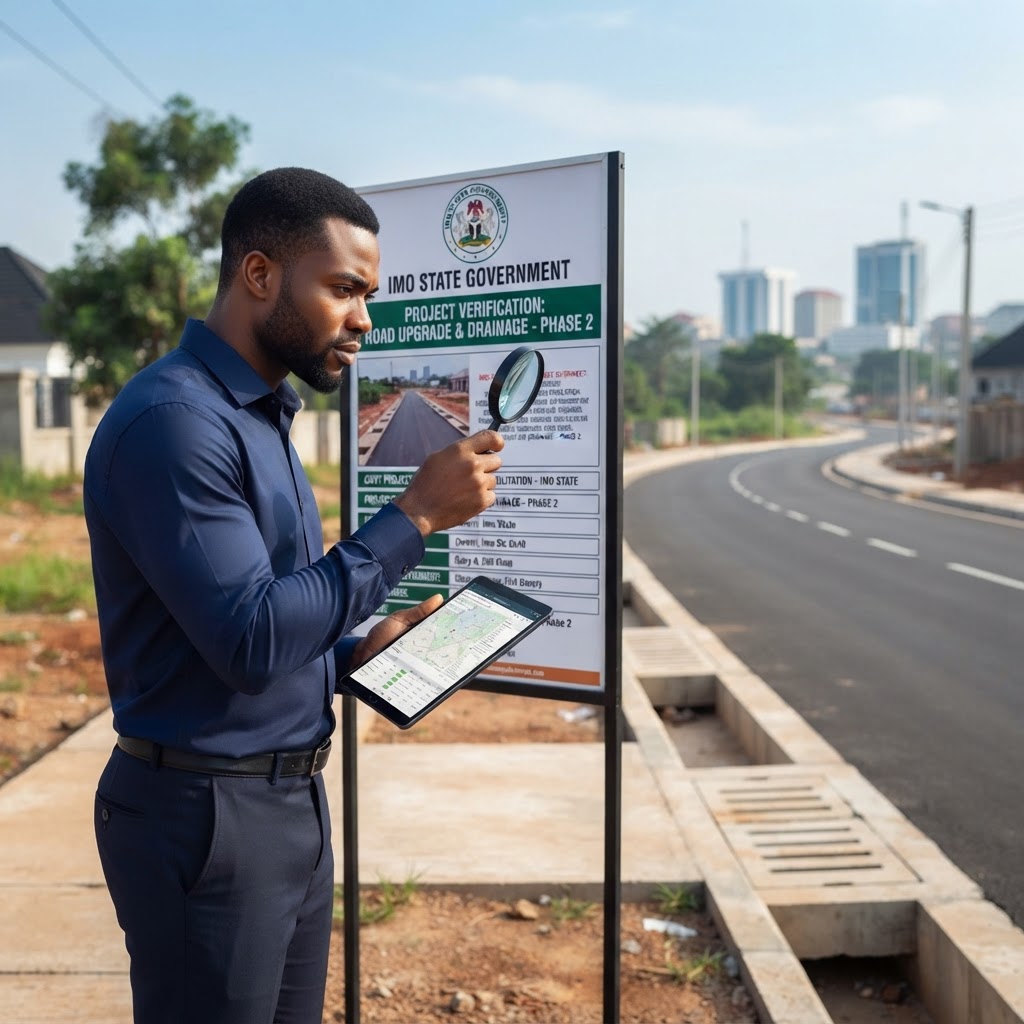
Every budget cycle, the Imo State Government announces hundreds of capital projects — road rehabilitations, primary healthcare centre upgrades, school renovations, rural water schemes, and community development grants. Yet a persistent gap exists between what is announced and what is delivered on the ground. For Nigerian families in Owerri, Orlu, Okigwe, and across the 27 local government areas, that gap is not merely a fiscal abstraction. It translates into flooded roads that destroy farm produce, non-functional boreholes in rural clinics, and abandoned school blocks that force children to study under deteriorating structures.
This guide is a practical, step-by-step resource for community stakeholders, town union leaders, youth professionals, diaspora Nigerians, and civic journalists who want to move beyond frustration and into informed action. Knowing how to verify Imo government projects is not a technical luxury reserved for accountants or lawyers — it is a foundational civic skill that protects public health, preserves community wealth, and reinforces the collective values that hold Imo communities together.
Why Does Project Verification Matter for Communities?
Understanding the direct link between fiscal transparency, public health, and local economic prosperity is the starting point for any serious accountability effort in Imo State.
When a road network in Mbaitoli or Mbaise remains unmaintained for years despite budget allocations, the consequences are compounded and systemic. Farmers cannot efficiently move goods to market, increasing post-harvest losses and depressing household incomes. Ambulances cannot reach rural health facilities promptly. School attendance drops during the rainy season when untarred roads become impassable. These outcomes are not random misfortunes — they are the direct, measurable cost of unverified and unaccountable public expenditure.
The connection between infrastructure delivery and public health is well-documented. According to the World Bank, poor road infrastructure in sub-Saharan Africa increases the cost of accessing healthcare by as much as 40 percent in rural areas. In Imo State, where primary healthcare coverage remains structurally uneven, delayed or substandard clinic rehabilitation projects directly degrade health outcomes for the most vulnerable families.
Civic vigilance closes this accountability deficit. When communities shift from passive recipients of government press statements to active evaluators of public expenditure, they create a monitoring environment that deters contractor abandonment and procurement fraud. Political press releases announce groundbreakings and project commissions — but only independent ground-level verification can confirm whether concrete was actually poured, whether the borehole actually pumps clean water, and whether the contract timeline was respected.
For a platform like eziokwubundu.com, grounded in the conviction that community-first journalism strengthens collective prosperity, project verification is inseparable from the broader mission of practical, African-centred empowerment. Individual health and family wealth cannot be secured in isolation from the quality of the public infrastructure that surrounds them.
What Official Portals Track Imo Capital Expenditure?
Navigating open budget data, procurement platforms, and state government repositories is the essential first digital step in any verification exercise.
The Imo State Government Portal at https://www.imostate.gov.ng hosts several e-governance modules relevant to project tracking. Citizens should specifically look for the "Track a Project" feature, which — when functional — allows users to search by project name, Ministry, Department, and Agency (MDA), and contractor identity. The "Track a Contractor" module enables cross-referencing of a specific company's portfolio of state contracts, helping identify patterns of abandonment or underperformance. The "Track the Budget" dashboard, linked to the Imo State Budget Office, provides capital budget lines by administrative unit.
For broader, comparative budget data, Open Nigeria States at https://www.openstates.ng aggregates subnational budget documents from multiple states, including Imo. Citizens can download the annual Imo State Approved Budget as a PDF or spreadsheet, then filter by programme code across key MDAs:
- Ministry of Works and Transport — road and bridge capital projects
- Ministry of Health — primary healthcare centre construction and rehabilitation
- Bureau for Local Government and Chieftaincy Affairs — community self-help and rural infrastructure grants
- Ministry of Education — school renovation capital lines
Within each budget document, readers should identify four critical columns: the budgeted allocation, the actual release figure, the contractor name, and the completion timeline. A project with ₦150 million budgeted but only ₦30 million released as of Q3 is a red flag for contractor mobilisation failure or internal diversion.
The Nigeria Procurement Journal and the Bureau of Public Procurement (BPP) database at https://www.bpp.gov.ng also carry federal-state joint procurement records for constituency projects and SURE-P legacy infrastructure that may affect Imo communities. Cross-referencing these sources with the state portal creates a multi-layer verification baseline that is far harder to manipulate than a single official announcement.
Understanding how to read these documents connects directly to broader economic literacy. Our Imo State Social Investment Programs Explained resource provides complementary context on how social spending intersects with capital infrastructure budgeting.
How Do You Conduct an On-Site Project Audit?
A step-by-step physical verification framework for town unions, youth leaders, and local stakeholders transforms digital data into ground-truth accountability.
Step 1 — Establish the baseline from digital sources. Before visiting any site, compile the project billboard data you expect to find: project name, contract ID, supervising MDA, executing contractor, contract sum, and completion timeline. This information should come from the Imo State Portal or BPP records. Any discrepancy between the billboard and official records is itself a reportable finding.
Step 2 — Inspect the project billboard on arrival. Nigerian public works guidelines require contractors to erect project identification boards at all sites. Note whether the board is present, legible, and matches your pre-compiled data. Photograph it with a geotagged timestamp using your smartphone. Missing or falsified billboards are a common early indicator of procurement irregularity.
Featured Products
Chukwu Abiama Tee
Bold black-and-gold Igbo-pride T-shirt featuring 'Chukwu Abiama' in premium streetwear typography.
₦15,000
Buy NowReverse Type 2 Diabetes & other associated Metabolic Issues using Dr. Jason Fung's Evidence-Based Approach— FMD program for Type 2 Diabetes
A practical fasting and fasting-mimicking programme built on Dr Jason Fung's insulin-resistance principles and ow-glycemic recipes.
₦19,950
Join NowỤmụ Igbo Tee
Classic black T-shirt with bold white 'Ụmụ Igbo' typography — a proud statement of Igbo heritage.
₦15,000
Buy NowNwanne Tee
Washed khaki vintage tee with a faded rust-orange 'Nwanne' stamp badge and palm leaf motif — a nod to kinship and heritage.
₦18,000
Buy NowObodo Tee
Faded denim-blue washed tee with a cream 'Obodo' stamp badge and sun motif, celebrating community roots.
₦18,000
Buy NowEkwe Heritage Tee
Deep indigo tee featuring a fine line-art illustration of a traditional Igbo ekwe drum, inspired by Igbo-Ukwu bronze artistry.
₦18,000
Buy NowIkenga Figure Tee
Forest green tee with a fine line-art illustration of a stylized Ikenga figure.
₦18,000
Buy NowStep 3 — Apply a structured physical checklist. For road projects, assess road width against contract specifications, drainage channel depth and concrete lining quality, culvert thickness, and surface course material. For healthcare centre rehabilitations, check roofing integrity, borehole functionality, toilet facility completion, and equipment installation status. For school projects, assess classroom structural soundness, window installation, and furniture delivery. Document every observation with photographs and brief written notes.
Step 4 — Record empirical evidence systematically. Use a simple spreadsheet or the CoST Infrastructure Transparency Initiative methodology (available at https://infrastructuretransparency.org) to organise your findings. CoST provides open-access disclosure frameworks that community auditors can adapt for Nigerian subnational contexts.
Step 5 — Observe safety and procedural protocols. Community auditors should operate in groups of at least three, carry formal letters of introduction from their town union or community-based organisation, and engage contractors or site supervisors courteously and non-confrontationally. The objective is data gathering, not confrontation. Cooperative reporting alongside autonomous community structures produces more durable accountability outcomes than adversarial standoffs.
How Can Traditional Institutions Drive Project Accountability?
Leveraging autonomous community governance to safeguard public funds and infrastructure is both culturally grounded and constitutionally supported in Imo State.
Traditional Rulers — Ezes — hold significant moral and political authority in Imo communities. Their formal endorsement of project oversight activities signals to contractors and MDAs that community monitoring is institutionalised, not episodic. President Generals (PGs) of Town Unions are often the most operationally positioned actors for sustained oversight, given their direct electoral accountability to community members and their established channels of communication with local government chairmen and state legislators.
Women's Wings of Town Unions bring a critical dimension to project verification — they are often the primary users of healthcare facilities and water infrastructure, and their testimony about borehole functionality or clinic usability carries specific evidential weight that generic technical reports cannot replicate.
The Bureau for Local Government and Chieftaincy Affairs in Imo State maintains formal oversight of community self-help projects and the Imo Community Charter of Plans, a framework that links community development aspirations to state capital budgeting. Town unions that have formally submitted charter proposals are entitled to request progress reports on corresponding capital releases. This is an underutilised but legally grounded mechanism.
Practically, town union leaders should establish standing project oversight committees — sub-committees with defined membership, quarterly audit schedules, and written reporting obligations to the general assembly. These committees should maintain a register of all government projects in the community, their contract values, and their current physical status. The Obi-Mbieri Town Union: Full List of the 2026 Executive Council illustrates how structured community governance creates the institutional foundation for exactly this kind of sustained oversight. Communities with active, organised leadership are far better positioned to protect public infrastructure from premature decay or contractor abandonment.
What Legal Channels Exist to Report Failed Projects?
Escalating discrepancies through statutory frameworks, legislative oversight, and investigative civic platforms converts documented findings into enforceable accountability.
The first formal escalation pathway is the Imo State House of Assembly Committee on Public Accounts and Petitions. Citizens and town unions can file written petitions supported by photographic evidence, budget data, and site inspection reports. Legislative committees have the constitutional power to summon MDAs, request contractor records, and refer matters for further investigation. This channel is most effective when the petition is jointly signed by multiple community stakeholders, demonstrating organised civic pressure rather than individual complaint.
Where procurement fraud is suspected — including evidence of contract inflation, payment for unexecuted work, or contractor identity fraud — complaints can be filed with the Independent Corrupt Practices and Other Related Offences Commission (ICPC) at https://www.icpc.gov.ng or the Economic and Financial Crimes Commission (EFCC). Both agencies accept online complaints and have state-level offices in Owerri. The Imo State Fiscal Responsibility Commission is also a statutory body empowered to audit compliance with the state's Fiscal Responsibility Law.
The Freedom of Information (FOI) Act 2011 grants every Nigerian citizen the right to request public records from government institutions within seven days. Town unions and civic journalists can use FOI requests to compel MDAs to release contract documents, payment certificates, and project completion reports. Templates for FOI requests are available through the Socio-Economic Rights and Accountability Project (SERAP) at https://www.serap-nigeria.org.
Civic media platforms like eziokwubundu.com play a critical complementary role. Public reporting on abandoned health facilities and school rehabilitations creates reputational pressure that formal legal processes alone cannot generate. For diaspora Nigerians and youth professionals seeking to understand how community advocacy intersects with broader economic development, our article on Youth unemployment solutions in Southeastern Nigeria provides important parallel context on how accountability in public spending directly shapes employment and entrepreneurship environments.
The escalation roadmap is clear: document digitally, verify physically, mobilise through traditional institutions, and report through statutory and civic channels. Each layer reinforces the others. When public reporting leads to a stalled clinic resuming construction or a road contractor returning to site, taxpayers' resources are recovered and community health outcomes improve — demonstrating that civic knowledge, applied practically, is one of the most powerful instruments of African community prosperity.
Conclusion
Knowing how to verify Imo government projects is not a passive civic curiosity — it is an active investment in the health, wealth, and collective dignity of Imo communities. From navigating the Imo State Government Portal and Open Nigeria States budget data, to conducting structured on-site audits and mobilising town unions into standing oversight committees, every step in this framework is accessible to ordinary citizens with ordinary tools.
The accountability infrastructure exists: official portals, FOI laws, legislative petition channels, anti-graft agencies, and community governance structures. What transforms these tools into outcomes is organised, informed, persistent civic action — the kind of community-first approach that eziokwubundu.com exists to support and amplify. Your community's roads, clinics, schools, and water systems are public assets. Verifying that they are delivered as promised is not just your right — it is your responsibility.
Stay Informed
Get New Articles in Your Inbox
Subscribe to receive the latest community development, health, and wealth insights from Eziokwubundu.
Newsletter
Practical insights on health, wealth, and community — delivered weekly.