Powered by Obi Mbieri Independent Media Ltd · eziokwubundu.com
Obi-Mbieri Traditional Leadership: The History, Controversies and Questions About Community Governance
Traditional governance in Southeastern Nigeria is rarely simple. In Obi-Mbieri Autonomous Community, located within the Mbaitoli Local Government Area of Imo State, the layers of history, cultural identity, contested authority, and resource politics have combined to create one of the most complex go...
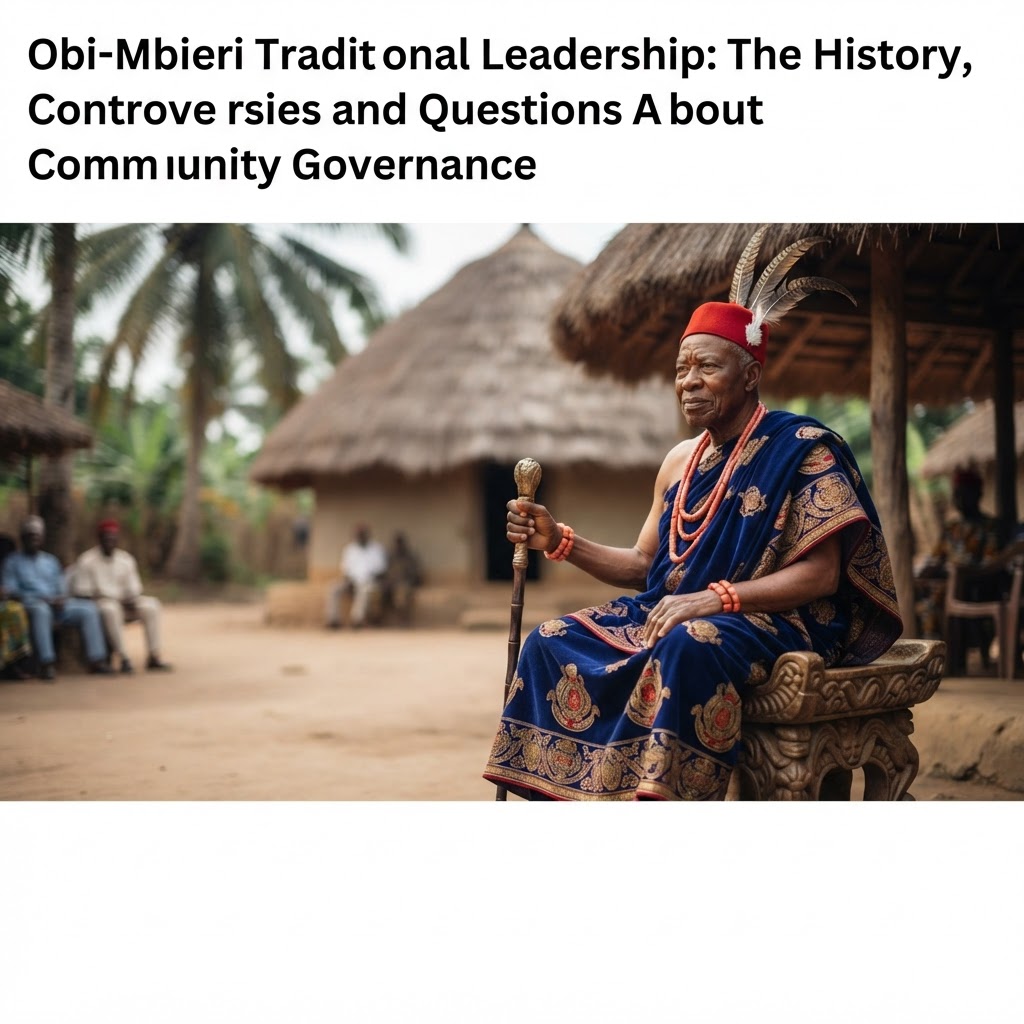
Traditional governance in Southeastern Nigeria is rarely simple. In Obi-Mbieri Autonomous Community, located within the Mbaitoli Local Government Area of Imo State, the layers of history, cultural identity, contested authority, and resource politics have combined to create one of the most complex governance narratives in the region. What began as a community united by a proud development ethos has, over the past decade, found itself entangled in succession disputes, village creation controversies, alleged oil revenue diversions, and a six-year recognition crisis that has tested the resilience of its traditional institutions.
This article draws on documented reports, community accounts, and public records to examine the full arc of Obi-Mbieri's traditional leadership story — from its historical roots to its present-day challenges and the path forward.
What Is the Historical Foundation of Obi-Mbieri Traditional Leadership?
Tracing the Roots of the Mbieri Development Spirit
Obi-Mbieri Autonomous Community has long anchored its collective identity in what stakeholders describe as the "Mbieri development spirit" — a philosophy that binds community progress to unity, mutual responsibility, and socio-economic enhancement. This spirit is not merely rhetorical. It is embedded in the practical ways the community has historically approached development: through collective action, shared resources, and a deeply held belief that the welfare of the individual is inseparable from the welfare of the group. You can explore more background in the detailed History of Obi-Mbieri, Imo State.
At the apex of formal traditional governance sits the Mbieri Supreme Council of Ndi-Eze, an institution recognised as the custodian of cultural values and local interests across the Mbieri axis. This council functions not only as a ceremonial authority but as a practical governance body that arbitrates disputes, preserves customs, and ideally provides the moral framework within which community decisions are made.
Crucially, this philosophy aligns with Section 24(d) of the 1999 Constitution of the Federal Republic of Nigeria, which places a civic obligation on every citizen to contribute to community advancement. In Obi-Mbieri, this constitutional principle has historically been interpreted as both a legal and moral mandate — making the current governance crisis all the more jarring, given how sharply present realities diverge from those founding ideals. For broader regional context, the History of Mbaitoli LGA, Imo State: Origins, Communities and Development provides essential background.
Who Are the Key Figures in Obi-Mbieri's Current Leadership?
The Role of the Eze and the Nwaotuoke Union
The current traditional stool of Obi-Mbieri is occupied by Eze Dr. (Elder) J.N. Osuji, who has been recognised as a grand patron of the Imo State Towns Development Association. Publicly, Eze Osuji has framed his tenure in terms of providing what he describes as "robust and purposeful leadership" — a commitment to community cohesion and development that he has repeatedly reaffirmed despite significant internal opposition. His commendations to loyal subjects, as reported by The Sun Nigeria, reflect a leadership style that seeks affirmation through public goodwill even as controversy swirls around the recognition of his stool.
Alongside the traditional ruler, the Mbieri Nwaotuoke Union, particularly its Youth Wing, plays a significant intermediary role. This body coordinates community events, channels youth participation into governance processes, and serves as a generational bridge between the traditional stool and younger demographics who are increasingly vocal about accountability and development outcomes. The Union's engagement is particularly important in a community where youth disillusionment, if left unaddressed, can deepen divisions.
The diaspora dimension adds another layer of complexity. Groups such as the Ohohia Diaspora delegation have travelled to Obi-Mbieri specifically to reaffirm confidence in local leadership and maintain cultural ties, demonstrating that community allegiance extends well beyond geographic boundaries. For Nigerians in the diaspora, traditional institutions remain powerful symbols of identity — but also potential sources of anxiety when those institutions are seen as dysfunctional.
Why Has the Obi-Mbieri Throne Faced a Six-Year Recognition Crisis?
The Tsunami of Controversy and Leadership Vacuums
Perhaps the most serious governance challenge facing Obi-Mbieri is the protracted recognition crisis at the level of its traditional stool. According to reports documented by Eziokwubundu, the community went over six years without a formally recognised Eze, creating a leadership vacuum that destabilised administrative processes and opened the door to what observers have characterised as "tsunami-like" waves of controversy.
The absence of a state-recognised traditional ruler is not a minor bureaucratic inconvenience in the Nigerian context. It means that formal interactions with state institutions — ranging from land administration to security coordination and development project allocation — lack a clear traditional counterpart. This vacuum is fertile ground for opportunism, factionalism, and the manipulation of community processes by those who stand to benefit from the ambiguity.
Reports from Nigerian News Point have pointed to friction generated by "disgruntled individuals" within the community, as well as allegations of external interference and claims that the monarch's immediate family exerted disproportionate influence over community affairs — concerns that, if substantiated, would represent a serious breach of traditional governance norms, according to Chief Godson Onuoha (aka Ashok) in the report.
Legal disputes have further complicated the picture. In 2023, some community voices have called for all pending court cases between Obi-Mbieri factions to be withdrawn from the state judiciary and resolved internally through traditional mechanisms — a call that reflects deep frustration with the pace and impartiality of formal legal processes, but also raises legitimate questions about the capacity of weakened traditional institutions to deliver fair outcomes.
The six-year recognition crisis is therefore not merely a dispute about one man's right to wear a crown. It is a systemic failure with tangible consequences for development, security, and community cohesion.
How Did the Creation of Umuwanji Village Spark Administrative Conflict?
The Clash Between Local Expansion and State Regulation
The case of Umuwanji village illustrates how governance vacuums translate into on-the-ground administrative chaos. The village was created by community actors despite explicit official warnings from the Imo State Government — a unilateral act that directly challenged the state's authority over community reorganisation processes. According to reporting on Eziokwubundu, the creation of Umuwanji and similar entities proceeded regardless of regulatory objections, reflecting either a confidence in local impunity or a breakdown in the communication channels between the community and state authorities.
The government's response was unambiguous. The Imo State Government formally declared the newly created villages null and void, effectively stripping them of any administrative legitimacy. However, the declaration of nullity does not automatically undo the social realities that have formed around these new groupings. People have reorganised, loyalties have shifted, and boundaries that were once clear have become contested.
For a community with multiple existing villages, the unauthorised addition of new units creates compounding problems: resource allocation disputes, confusion over representation in community councils, and the dilution of traditional authority structures that depend on clearly delineated territorial units. These are not abstract governance issues — they affect access to land, water, communal facilities, and eventually the distribution of any economic benefits, including oil revenue. See the List of Autonomous Communities in Mbaitoli LGA for comparative context.
Where Is the Oil Wealth of Obi-Mbieri Being Diverted?
Accountability, Seplat Energy, and the 'Great Oil Heist'
The economic dimension of Obi-Mbieri's governance crisis has come into sharp focus with allegations centred on what has been termed the "Great Obi Mbieri Oil Heist." Investigative reporting by Grassroot Reporters has surfaced claims that oil revenues accruing from the community's status as an energy host community are being quietly diverted, with Seplat Energy — a major Nigerian oil and gas producer — cited in connection with these allegations. Community members have specifically questioned whether those representing Obi-Mbieri to Seplat Energy are doing so with legitimate mandates and whether revenues are being distributed equitably.
The issue connects directly to Nigeria's Petroleum Industry Act (PIA) 2021, which established the framework for Host Community Development Trusts (HCDTs). Under this framework, oil companies are legally obligated to contribute a percentage of their annual operating expenditure to host community trusts — funds intended to finance development projects directly benefiting affected communities. In Achi Mbieri, residents have publicly demanded accountability over oil revenue, raising questions about whether HCDT funds are reaching their intended beneficiaries or being captured by a narrow group of community representatives.
As analysed on Eziokwubundu, the legal obligations of Seplat Energy to its host communities are well-defined on paper — but enforcement and transparency remain major challenges. When community leadership is contested and representation is unclear, it becomes far easier for external actors to engage selectively with factional representatives, potentially bypassing the broader community in revenue distribution processes. This is the intersection where governance failure and economic exploitation become mutually reinforcing.
How Can Traditional Leadership Address the Infrastructure Crisis?
Erosion Control and the SOS to the Federal Government
Beyond the political and financial controversies, Obi-Mbieri faces a severe and worsening environmental threat. Devastating gully erosion has ravaged significant portions of the community, prompting an emergency SOS to both the Federal Government and the Imo State Governor, as reported by The Sun Nigeria. The erosion, a persistent ecological challenge across Southeastern Nigeria, threatens homes, farmland, and critical community infrastructure.
The capacity of any community to attract and retain government intervention for environmental and infrastructure projects is directly linked to the stability and legitimacy of its traditional governance structures. A community with a contested throne and unresolved internal disputes presents a fragmented face to government agencies and development partners — making it harder to secure funding for roads, erosion control, healthcare facilities, and electricity infrastructure. A traditional ruler urging the state government to extend its development plan to Mbieri carries far more weight when that ruler speaks with unified community backing.
Political representatives have signalled willingness to help bridge the gap. The "olive branch" extended by Hon. Engr. Innocent Ikpamezie to internal factions — calling for a cessation of hostilities and a collective focus on development — represents precisely the kind of intervention that could unlock the community's access to government resources. Whether community leaders on all sides are prepared to accept such overtures remains an open question. You can find broader governance context in the Complete Guide to Mbaitoli Local Government Area Imo State.
What Is the Future of Governance in Obi-Mbieri?
Bridging Traditional Values with Modern Accountability
The path forward for Obi-Mbieri requires a deliberate synthesis of traditional governance strengths with modern demands for transparency, democratic accountability, and evidence-based development planning. Research published by IntechOpen on Traditional Leadership and Local Governance underscores that traditional institutions in Africa remain critically important to sustainable development — but only when they operate in ways that command broad legitimacy and align with the expectations of younger, more educated community members.
For Obi-Mbieri specifically, a viable roadmap must begin with resolving the Eze recognition crisis through dialogue rather than litigation. The Mbieri Supreme Council of Ndi-Eze, the Nwaotuoke Youth Union, and diaspora stakeholders must find a shared platform — potentially through a structured community reconciliation process — to establish governance rules that all factions respect. This is not merely a political exercise; it is a prerequisite for accessing the oil revenues, government development funds, and private investment that could transform community welfare.
The natural wealth beneath Obi-Mbieri's soil is significant. If properly channelled through transparent HCDT mechanisms, enforced under the PIA 2021 framework, those resources could fund the erosion control projects, healthcare infrastructure, and youth employment initiatives that the community desperately needs. Achieving that outcome demands a functional traditional leadership structure that can credibly represent all community voices — not just factional interests.
The dignity of the Obi-Mbieri traditional stool is not an abstract cultural concern. It is the governance foundation upon which the community's entire future prosperity rests. Resolving the recognition crisis, ending unauthorised village creations, demanding oil revenue accountability, and facing environmental threats together — these are not separate problems. They are one interconnected challenge requiring one united community response, rooted in the Mbieri development spirit that has always defined this community at its best.
Eziokwubundu is committed to providing community-first journalism that connects governance accountability with personal and collective prosperity for Nigerian families everywhere.
Stay Informed
Get New Articles in Your Inbox
Subscribe to receive the latest community development, health, and wealth insights from Eziokwubundu.
Newsletter
Practical insights on health, wealth, and community — delivered weekly.