Powered by Obi Mbieri Independent Media Ltd · eziokwubundu.com
$1 = ₦1,332€1 = ₦1,498£1 = ₦1,775IMSU ASUU Crisis Deepens: Why Students May Be the Biggest Losers as Lecturers Threaten Exam Boycott
The examination hall should be a place of culmination — the point where months of academic labour translate into documented achievement. For thousands of students at Imo State University (IMSU), Owerri, that promise has been placed under serious threat. As the Academic Staff Union of Universities (A...
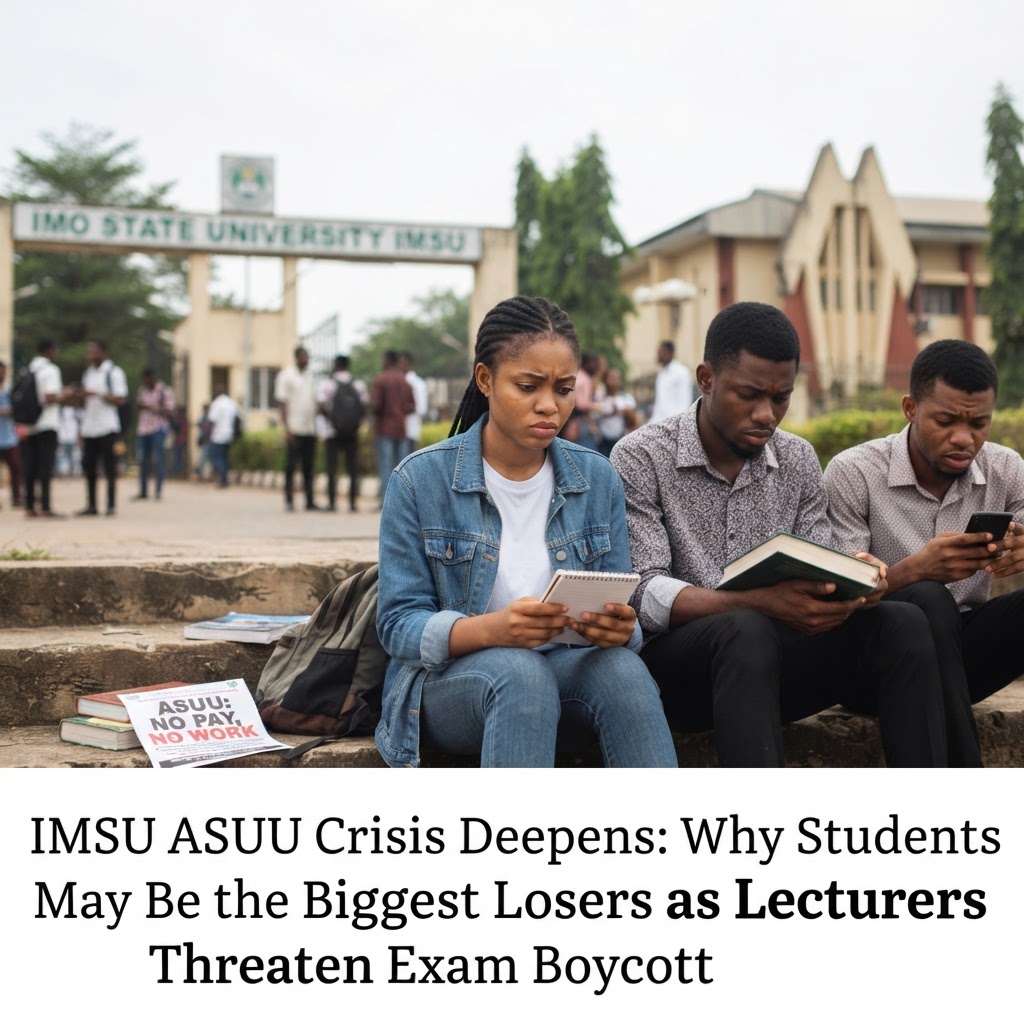
The examination hall should be a place of culmination — the point where months of academic labour translate into documented achievement. For thousands of students at Imo State University (IMSU), Owerri, that promise has been placed under serious threat. As the Academic Staff Union of Universities (ASUU), IMSU branch, escalates its industrial action to include a potential examination boycott, an already fragile academic calendar risks complete collapse. The casualty at the centre of this standoff is not management, nor the union — it is the student, whose fees have been paid, whose time is running out, and whose future hangs on certificates that may not arrive on schedule.
This crisis did not emerge overnight. It reflects a deeper, systemic failure of governance at the intersection of public university funding, state fiscal management, and labour relations. Understanding its causes, consequences, and possible remedies is essential not just for IMSU stakeholders, but for every Nigerian family investing in tertiary education as a pathway to prosperity.
Why Are IMSU Lecturers Threatening an Exam Boycott?
Root Causes of Industrial Friction in Owerri
According to regional reporting by Imo Trumpeta, the ASUU-IMSU branch has identified several unresolved welfare issues as the primary triggers for the escalating industrial action. Chief among these are unpaid promotion arrears that some academic staff allege have gone unaddressed for several years, withheld check-off dues that should legally be deducted from salaries and remitted directly to the union, and the persistent non-payment of Earned Academic Allowances (EAA) — a nationally negotiated entitlement that recognises the intellectual and research contributions of university lecturers.
Beyond these immediate financial grievances, the union has raised structural concerns about the Treasury Single Account (TSA) mandate. While the TSA was designed to consolidate government revenue and reduce financial leakages across federal and state institutions, ASUU-IMSU argues that its application at the university level has compromised administrative financial autonomy and introduced bureaucratic delays that slow salary disbursements and undermine operational independence. This tension between fiscal centralisation and institutional autonomy is not unique to IMSU.
A comparative look at peer state-owned universities across Nigeria reveals a troubling divergence. In some states, partial implementation of ASUU-Federal Government agreements has been achieved through dedicated education intervention funds and negotiated payment schedules. In Imo State, however, compliance appears stalled, with no publicly verified timeline for resolving outstanding EAA payments or promotion arrear clearance. This domestic non-compliance, against a backdrop of nationally renegotiated agreements, has emboldened the IMSU chapter to move beyond warnings toward active disruption — with examination boycotts now forming the most visible pressure point.
For further context on how state fiscal decisions affect education and welfare delivery in Imo, see our earlier analysis: Imo's ₦1.47 Trillion Budget: Where Did the Money Go in the First Half of 2026?
How Does the Stand-Off Harm Students?
Contradictory Orders and the Human Cost on Campus
The most disorienting aspect of the current crisis for IMSU students is the collision of contradictory institutional communications. University management has reportedly directed students to proceed with scheduled examinations, with some circulars suggesting academic penalties for non-attendance. Simultaneously, ASUU members enforcing the boycott have withdrawn from examination supervision, leaving students in a bureaucratic and practical no-man's land — physically present, examination scripts in hand, with no invigilator prepared to administer the session.
This contradiction is not merely inconvenient; it is psychologically destabilising. Students who have spent weeks preparing for examinations, travelling from distant local government areas or neighbouring states, arrive on campus only to face locked examination halls or chaotic, aborted sessions. The resulting performance anxiety, compounded by pre-existing academic pressure, constitutes a measurable mental health burden. Burnout — the clinical exhaustion arising from sustained effort without reward — is a well-documented consequence of disrupted academic environments, and the IMSU situation exhibits all its preconditions: high stakes, loss of control, and institutional unpredictability.
Transport logistics alone represent a significant financial and emotional drain. Students who have pre-booked travel, arranged childcare, or temporarily relocated to be closer to campus face wasted expenditure and logistical reversal. For those from rural communities in Imo, Abia, or Rivers State who may have travelled hours to sit examinations, the disruption is not a minor inconvenience — it is a compounding trauma.
At the governance level, the standoff signals a deeper breakdown. When students cannot trust that management directives reflect actual campus conditions, or that faculty communications are aligned with institutional policy, the foundational compact of university life — that effort and attendance will be acknowledged — begins to fracture. This erosion of trust between the student body, faculty leadership, and state authorities is itself an institutional injury that outlasts any single strike.
This is not the first time IMSU students have faced this kind of uncertainty. Our earlier coverage documents how the crisis began: IMSU ASUU Crisis: Lecturers Threaten to Withhold Students' Results.
What Are the Financial Costs for Nigerian Families?
Compounding Economic Burdens in a High-Inflation Environment
Nigeria's current inflation environment — with the Consumer Price Index recording food inflation above 40% in recent quarters according to the National Bureau of Statistics — means that every additional month a student remains in limbo carries a real and escalating financial cost. For middle-class families already stretched by school fees, accommodation, and feeding allowances, the IMSU crisis is not an abstract policy failure. It is a direct drain on household savings.
Off-campus hostel rents in Owerri are typically paid in advance on a semester or annual basis. When examinations are postponed or disrupted, students remain in rented accommodation beyond the originally budgeted period, forcing families to either extend leases at current market rates or risk losing the accommodation entirely. Food and daily subsistence allowances, meanwhile, continue to accrue with no corresponding academic progress.
The career-stage consequences are equally sobering. A student whose final examinations are delayed by even one semester risks missing the National Youth Service Corps (NYSC) mobilisation batch for which they had planned. In Nigeria's highly structured post-graduation pathway, missing an NYSC batch by weeks can translate into a six-month to one-year delay in service completion — which in turn delays eligibility for full-time employment in both the public and private sectors. Many corporate entry-level recruitment windows, particularly in banking, oil and gas, and the civil service, carry strict age cut-offs, typically capping candidates at 26 to 28 years old. For a student whose graduation is involuntarily delayed, these windows can close permanently.
For students tracking NYSC eligibility timelines, our guide on NYSC matters: IMSU and other institution uploads senate list for NYSC registration provides critical procedural context.
Featured Products
Chukwu Abiama Tee
Bold black-and-gold Igbo-pride T-shirt featuring 'Chukwu Abiama' in premium streetwear typography.
₦15,000
Buy NowReverse Type 2 Diabetes & other associated Metabolic Issues using Dr. Jason Fung's Evidence-Based Approach— FMD program for Type 2 Diabetes
A practical fasting and fasting-mimicking programme built on Dr Jason Fung's insulin-resistance principles and ow-glycemic recipes.
₦19,950
Join NowỤmụ Igbo Tee
Classic black T-shirt with bold white 'Ụmụ Igbo' typography — a proud statement of Igbo heritage.
₦15,000
Buy NowNwanne Tee
Washed khaki vintage tee with a faded rust-orange 'Nwanne' stamp badge and palm leaf motif — a nod to kinship and heritage.
₦18,000
Buy NowObodo Tee
Faded denim-blue washed tee with a cream 'Obodo' stamp badge and sun motif, celebrating community roots.
₦18,000
Buy NowEkwe Heritage Tee
Deep indigo tee featuring a fine line-art illustration of a traditional Igbo ekwe drum, inspired by Igbo-Ukwu bronze artistry.
₦18,000
Buy NowIkenga Figure Tee
Forest green tee with a fine line-art illustration of a stylized Ikenga figure.
₦18,000
Buy NowThe broader economic productivity argument is equally significant. Every year that thousands of educated young Nigerians remain in educational stasis rather than entering the workforce or launching entrepreneurial ventures represents a measurable drag on national human capital formation. The World Bank's Nigeria Human Capital Index consistently identifies educational disruption as a key risk factor in youth economic integration.
How Does Disruption Impact Student Mental Health?
Strikes, Idle Youth, and Community Safety Risks
The intersection of prolonged academic disruption and student mental health is an underdiscussed dimension of the IMSU crisis. Research published in the African Journal of Psychiatry and corroborated by Nigerian counselling professionals identifies chronic depressive symptoms, anxiety disorders, and sustained loss of academic self-efficacy as predictable outcomes of extended university shutdowns. For students already navigating Nigeria's high-pressure academic culture — where a single examination failure can reshape career trajectories — forced idleness is not rest. It is anxiety deferred.
The community-level consequences extend beyond the campus perimeter. Owerri, as a university city, has an economic and social ecosystem calibrated around active student populations. When thousands of students are displaced — neither studying nor working — the surrounding autonomous communities absorb the social spillover. Community safety indicators in university host towns historically show measurable deterioration during extended academic shutdowns, with petty crime, substance abuse, and youth radicalisation identified as recurring downstream effects in Nigerian policy literature.
Public tertiary education, viewed through the lens of community wellness that anchors the editorial mission of eziokwubundu.com, is not merely a private investment in individual credentials. It is a community infrastructure — as essential to social cohesion as functional healthcare facilities or secure roads. When universities cease to function as stable developmental environments, the wellness deficit does not stay within the institution. It radiates outward into families, communities, and local governance systems.
What Can IMSU Students Do During the Stoppage?
Practical Prosperity Steps to Protect Your Future
Uncertainty at the institutional level does not have to mean paralysis at the individual level. IMSU students navigating the current disruption have a meaningful opportunity to convert downtime into developmental capital — provided they approach it with intentionality and structure.
The first priority should be digital skill acquisition. Platforms such as Coursera, Google's Digital Skills for Africa, and the ALX Africa programme offer accredited, employer-recognised certifications in data analysis, digital marketing, project management, and software development. Many are free or low-cost. Completing even one such certification during a disruption period transforms idle time into a documented competency that strengthens any post-graduation employment application.
Vocational and entrepreneurial engagement represents a second tier of productive activity. Imo State's local economy offers apprenticeship opportunities in agro-processing, logistics, fashion, and artisanal trades that can generate immediate income while building practical business literacy. Students with access to family-supported micro-enterprise networks should consider leveraging this period to test business models, develop client relationships, or build a professional portfolio.
Academic retention requires deliberate strategy during periods of campus inactivity. Community study circles — small, peer-led groups meeting regularly to review course content — have been shown to maintain knowledge retention and reduce re-learning burden when examinations eventually resume. Supplementing these circles with structured use of Nigerian universities' eLearning platforms and open-access academic repositories preserves academic momentum.
Students should also explore formal financial support options. Our detailed guide on how to apply for Imo State scholarships in 2026 outlines pathways to funding that can offset the financial losses incurred during disruption periods.
How Can Leaders Break the Impasse?
Community-First Mediation and Sustainable Solutions
Resolving the IMSU ASUU crisis requires more than a management-union negotiation. It demands the kind of structured, community-anchored mediation that Imo State's rich tradition of conflict resolution can provide. Traditional rulers, Eze councils, and religious institutions across Imo State carry significant moral authority that neither state government nor union leadership can easily dismiss. Engaging these institutions as non-partisan arbiters — not merely as ceremonial observers — creates a socially legitimate pressure for resolution that formal legal channels alone cannot replicate. The relevance of traditional Igbo conflict resolution methods to contemporary institutional disputes is both culturally grounded and practically demonstrated.
On the fiscal side, the state government's office of the Visitor to the university must develop a credible, time-bound payment plan for outstanding check-off dues, promotion arrears, and EAA obligations. Vague commitments without fiscal backing have repeatedly failed to de-escalate ASUU actions nationally. Structured, monthly installment frameworks — similar to those negotiated in several southwestern states — offer a realistic pathway that preserves budget discipline without indefinitely deferring legitimate entitlements.
Permanently, Imo State should establish a tripartite academic welfare committee comprising representatives from the student union, the faculty, and the State Ministry of Education. This standing body should be empowered to flag unresolved welfare disputes before they reach examination-cycle flashpoints — converting a reactive crisis management model into a proactive governance framework.
Conclusion
The IMSU ASUU examination boycott threat is, at its core, a governance failure with a human face. Behind every disrupted exam session is a student who prepared diligently, a family that sacrificed financially, and a community that invested in the promise of education as a route to collective advancement. The lecturers' grievances — unpaid arrears, withheld dues, unfulfilled national agreements — are legitimate and documented. But the mechanism of examination boycott, whatever its tactical justification, transfers the cost of that legitimacy onto the least powerful actors in the system: the students.
Resolving this crisis demands fiscal accountability from the Imo State Government, institutional good faith from university management, responsible restraint from ASUU-IMSU leadership, and community-level mediation from traditional and religious institutions. For students caught in the interim, the path forward lies in harnessing downtime productively, protecting their mental wellness, and holding all institutional actors publicly accountable through every legitimate channel available.
At eziokwubundu.com, our commitment is to equip Nigerian families, students, and communities with the knowledge to navigate exactly these kinds of systemic challenges — because better information, applied practically, is the foundation of genuine prosperity.
Stay Informed
Get New Articles in Your Inbox
Subscribe to receive the latest community development, health, and wealth insights from Eziokwubundu.
Newsletter
Practical insights on health, wealth, and community — delivered weekly.
Community Discussion(0)
Leave a Comment
More to Read
You May Also Like
State Police Bill Stalls After Limited Assembly Support
Nigeria's long debate over decentralized policing has hit a critical wall. The State Police Bill Stalls After Limited Assembly Support, leaving reform advocates uneasy about the road ahead. As detailed in earlier coverage of the State Police Bill Stalls After Limited Assembly Approval(/article/6ad1d...
FUTO Partners With Police to Boost Campus Security
Nigerian universities are grappling with growing security concerns, and the Federal University of Technology, Owerri (FUTO) is responding with urgency to protect its community. Campus security has become the defining priority for university leadership as recent incidents involving student safety pus...

Umuahii Day: Preserving Our Heritage, Rekindling Otu Obi
Every December, families across Imo State pause to celebrate something larger than a party. They celebrate belonging. This year, that celebration carries a clear purpose: Umuahii Day: Preserving Our Heritage, Rekindling Otu Obi invites every son and daughter of Umuahii to come home, in body or in sp...

2026 NNPC/Seplat Scholarship: Apply Now
The race for Nigeria's future workforce starts in the lecture hall, not the boardroom. If you are a Nigerian undergraduate looking for financial relief this academic year, the 2026 NNPC/Seplat Scholarship: Apply Now initiative offers a credible, well-funded pathway to ease tuition pressure and keep ...

NNPC Seeks Partnerships to Restart PH and Warri Refineries
Nigeria's refining sector is entering a decisive new chapter. As the nation searches for lasting solutions to decades-old fuel supply challenges, the news that NNPC Evaluates New Partnerships to Restart Warri and Port Harcourt Refineries signals a shift from patchwork repairs toward structured, long...

NYSC Abduction: Serving Nigeria at What Cost? Fresh Safety Questions
The Umunoha abduction of prospective NYSC members has renewed concerns over the safety of graduates travelling across Nigeria for national service.

Military Aircraft With 32 Aboard Crashes in Ondo, Rescue Underway
Igbokoda crash: Nigerian Air Force ATR-42 was travelling from Benin to Lagos when contact was lost
Nwanegwo Hands Over Mbaitoli LGA Affairs, Ends Tenure
Hon. Ifunanya Nwanegwo JP has formally handed over the affairs of Mbaitoli Local Government Area to the Director of Administration and General Services (DAGS), marking the conclusion of his tenure as Executive Chairman.
Umunoha NYSC Kidnap: Hideout Located as IED Threat Delays Rescue
Imo security agencies have located the suspected hideout of prospective NYSC members abducted along the Owerri–Onitsha Road, but an alleged improvised explosive device (IED) threat has delayed the planned rescue operation.

Mbaitoli Kidnapping: Why Is the Owerri–Onitsha Road Still Vulnerable?
The latest kidnapping incident along the Owerri–Onitsha Road in Mbaitoli Local Government Area of Imo State has renewed concerns about the safety of one of the major transportation routes connecting communities in Imo and neighbouring states.