Powered by Obi Mbieri Independent Media Ltd · eziokwubundu.com
$1 = ₦1,322€1 = ₦1,535£1 = ₦1,787IMSU ASUU Crisis: Lecturers Threaten to Withhold Students’ Results
The academic calendar at Imo State University (IMSU) is once again under severe threat. In a declaration that has sent shockwaves through student communities, families, and education stakeholders across the Southeast, the Academic Staff Union of Universities (ASUU) at IMSU has announced a total and ...
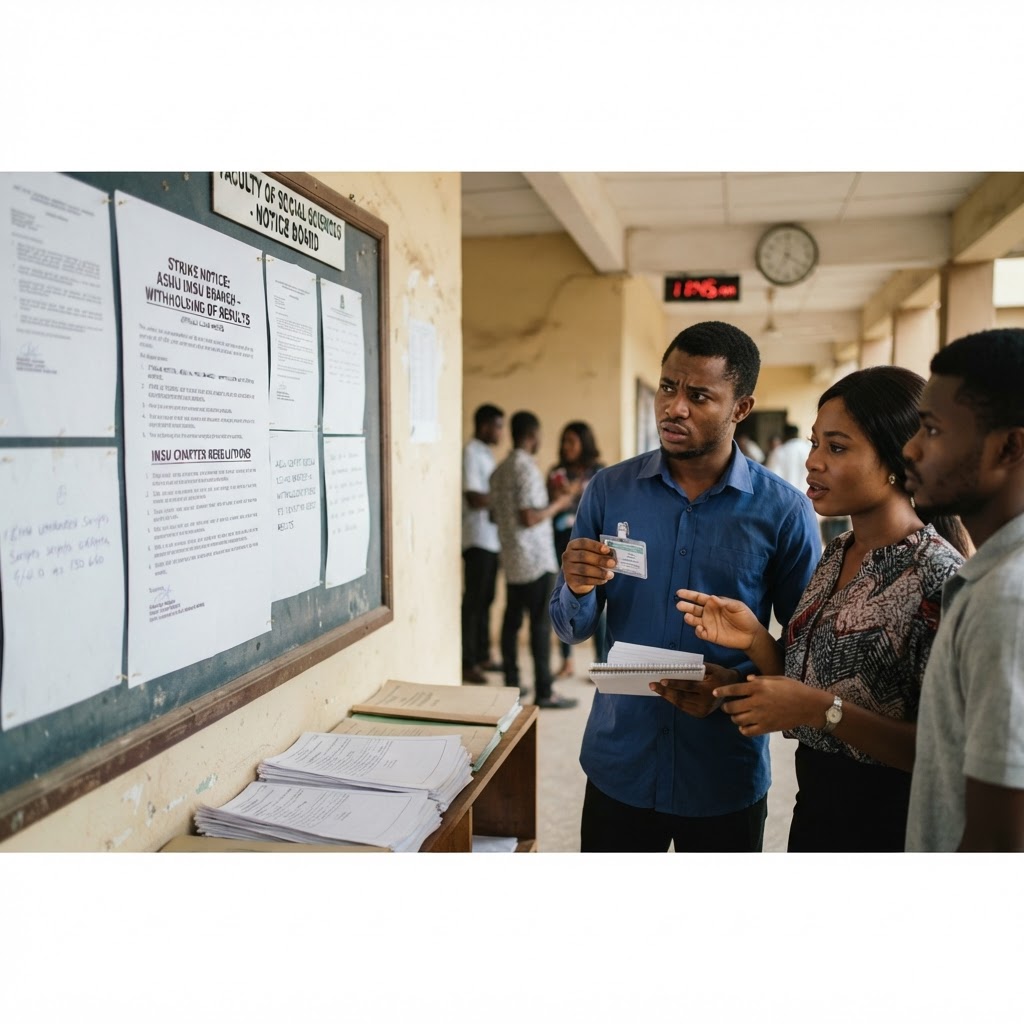
The academic calendar at Imo State University (IMSU) is once again under severe threat. In a declaration that has sent shockwaves through student communities, families, and education stakeholders across the Southeast, the Academic Staff Union of Universities (ASUU) at IMSU has announced a total and indefinite strike alongside a firm resolve to withhold student examination results. This is not merely an industrial dispute between employers and employees — it is a cascading institutional failure with devastating consequences for thousands of young Nigerians whose futures hang in the balance.
For parents who have sacrificed enormously to keep their children in school, for students who have endured repeated disruptions, and for communities that depend on IMSU graduates to drive local development, this crisis demands immediate attention, structured intervention, and lasting solutions. At eziokwubundu.com, where we believe in the inseparable connection between community health, personal prosperity, and educational empowerment, we examine this unfolding crisis with the seriousness it deserves.
What Sparked the IMSU ASUU Crisis?
Deconstructing the Breakdown Between Academic Staff and IMSU Management
According to reporting by the Daily Post, the ASUU branch at Imo State University declared a total and indefinite strike, with lecturers vowing to neither grade examination scripts nor release student results until their longstanding grievances are addressed. The immediate trigger is a compound failure of institutional trust: the Imo State University management and the Imo State Government have repeatedly failed to honour commitments made to academic staff.
At the centre of the dispute is the non-implementation of the December 2025 ASUU-FGN renegotiated agreement, which was scheduled for activation in January 2026. The union argues that its members were patient, gave authorities sufficient runway, and received nothing but silence and deflection in return.
The grievances, however, extend far deeper than a single unimplemented agreement. Promotion arrears dating back to 2016 — a full decade of unpaid career advancement entitlements — represent one of the most glaring injustices. Lecturers who earned promotions through merit and years of service have been denied the financial recognition that those promotions carry, creating a demoralised faculty.
Perhaps most staggering is the non-payment of Earned Academic Allowances (EAA) since 2009. For over fifteen years, lecturers have been denied allowances that are not perks but contractually and institutionally mandated compensation. Compounding this is the withholding of 21 months of union check-off dues — money deducted from salaries but never remitted to the union — alongside months of unpaid salaries. Faced with this accumulation of unresolved betrayals, ASUU's decision to withhold assessment services reflects not a sudden escalation but the exhaustion of patience by a workforce that has been systematically shortchanged.
Why Are Lecturers Resisting the Treasury Single Account?
Autonomy vs. State Fiscal Centralization at IMSU
One of the most structurally significant grievances animating the IMSU ASUU crisis is the Imo State Government's continued retention of the university within the Treasury Single Account (TSA) framework. While the TSA was designed nationally as a fiscal transparency mechanism, its application to IMSU has, according to lecturers and union leadership, fundamentally crippled the university's ability to govern itself financially.
University autonomy — a principle enshrined in the statutes establishing Nigerian universities — requires that institutions have sufficient control over internally generated revenue to meet operational needs, pay staff promptly, and respond to emerging academic demands. When all revenue flows through a state-controlled central account, the university's executive becomes dependent on bureaucratic approvals for expenditures that should be routine. The result is a paralysis of institutional agility that affects everything from salary processing to infrastructure maintenance.
What makes this particularly indefensible is the comparative picture across Nigeria. Several state-owned universities in Bauchi, Ekiti, Ogun, Osun, and Sokoto have successfully resolved local ASUU disputes and implemented renegotiated agreements within their own operational frameworks. These institutions demonstrate that state governments that prioritise education governance can find workable solutions. Imo's inability or unwillingness to do the same raises legitimate questions about political will and budget prioritisation — questions we have explored in our investigation of Imo's ₦1.47 Trillion Budget: Where Did the Money Go in the First Half of 2026?.
The union's current hardline stance — withholding results as leverage — is also a direct consequence of broken promises made during the 2024 industrial action. That strike was suspended following assurances from management and state officials. Those assurances were not honoured. Having suspended action once in good faith only to be disappointed, the union now views the withholding of results as the most potent tool remaining in their negotiation arsenal. It is, in essence, the cost of repeated institutional betrayal.
How Does Withholding Results Harm Students' Health and Careers?
Academic Bottlenecks and Psychological Strain on Undergraduates
The human cost of this crisis falls most heavily on students — particularly final-year undergraduates — who face a cascade of consequences that extend far beyond academic inconvenience. When results are withheld, the administrative chain required to complete a degree is broken. Without certified results, students cannot be mobilised for the National Youth Service Corps (NYSC), a mandatory programme that gates entry into Nigeria's formal employment market. Every month of delay means a missed NYSC batch, which in turn means months added to the timeline before a young graduate can legally compete for most corporate and public sector positions.
For students who have secured postgraduate scholarships abroad — in the United Kingdom, Canada, the European Union, or other destinations — the consequences can be irreversible. Scholarship offers come with firm commencement deadlines. A result withheld for an industrial dispute does not earn sympathy from international admissions offices. Forfeited scholarships represent not just lost opportunity for individual students but a blow to Nigeria's human capital development at the national level.
The economic cost is also measured in lost entry-level job offers. Many Nigerian corporations and financial institutions run graduate recruitment cycles tied to specific graduation cohorts. A candidate who cannot prove completion because their institution is locked in a labour dispute is quietly passed over, their position filled by candidates from institutions unaffected by strikes.
Featured Products
Chukwu Abiama Tee
Bold black-and-gold Igbo-pride T-shirt featuring 'Chukwu Abiama' in premium streetwear typography.
₦15,000
Buy NowReverse Type 2 Diabetes & other associated Metabolic Issues using Dr. Jason Fung's Evidence-Based Approach— FMD program for Type 2 Diabetes
A practical fasting and fasting-mimicking programme built on Dr Jason Fung's insulin-resistance principles and ow-glycemic recipes.
₦19,950
Join NowỤmụ Igbo Tee
Classic black T-shirt with bold white 'Ụmụ Igbo' typography — a proud statement of Igbo heritage.
₦15,000
Buy NowNwanne Tee
Washed khaki vintage tee with a faded rust-orange 'Nwanne' stamp badge and palm leaf motif — a nod to kinship and heritage.
₦18,000
Buy NowObodo Tee
Faded denim-blue washed tee with a cream 'Obodo' stamp badge and sun motif, celebrating community roots.
₦18,000
Buy NowEkwe Heritage Tee
Deep indigo tee featuring a fine line-art illustration of a traditional Igbo ekwe drum, inspired by Igbo-Ukwu bronze artistry.
₦18,000
Buy NowIkenga Figure Tee
Forest green tee with a fine line-art illustration of a stylized Ikenga figure.
₦18,000
Buy NowBeyond career and economic harm lies a public health emergency that is rarely discussed with sufficient gravity. Research on educational disruption consistently links prolonged academic uncertainty to clinically significant increases in depressive symptoms, generalised anxiety disorder, and acute stress responses among young adults. In Nigeria, where mental health infrastructure is critically underfunded and stigma remains a barrier to help-seeking, these pressures compound silently. Students whose life milestones — graduation, employment, marriage, financial independence — are indefinitely stalled experience a profound erosion of self-efficacy and social identity. At eziokwubundu.com, we hold firmly that psychosocial wellbeing is not separate from physical health; forced campus idleness and unresolved academic futures are active threats to the mental wellness of an entire generation of young Nigerians.
What Are the Economic Repercussions for Nigerian Families?
Financial Drag on Parents and the Owerri Campus Economy
The economic damage radiating from the IMSU ASUU crisis extends far beyond the university gates, touching middle-class Nigerian families who are already navigating one of the most punishing inflation environments in recent Nigerian history. As of mid-2026, Nigeria's inflationary pressures continue to erode household purchasing power, and families with students in limbo at IMSU are absorbing double financial burdens.
Parents are paying for off-campus housing and living allowances for students who are not actively in school. In Owerri, where rental markets have tightened considerably due to urban expansion and infrastructure constraints — issues we have examined alongside broader governance questions in our piece on Mbieri Infrastructure Gap: Roads, Water and Public Projects Under Scrutiny — sustaining a child in accommodation during a strike is an expenditure with no academic return. For families who took microfinance loans or drew down savings to fund education, each idle month deepens financial vulnerability.
The ripple effects on Owerri's local micro-economy are equally significant. The university campus and its surrounding ecosystem sustain an intricate web of economic activity: food vendors, commercial motorcycle and tricycle operators, off-campus lodge proprietors, printing and photocopying centres, bookshops, and informal service providers all depend on the rhythm of academic activity — students moving, buying, printing, and living — to generate their daily income. When that rhythm stops, the economic contraction is immediate and severe for livelihoods that operate on razor-thin margins with no savings buffer.
Perhaps the most overlooked long-term cost is the disruption to family capital deployment cycles. In many Nigerian middle-class and entrepreneurial households, the graduation of a child is a strategic inflection point — the moment parents expect to redirect education spending into family businesses, agricultural investments, or community development activities. When graduation is indefinitely delayed, family wealth-building timelines are stretched, compounding across multiple households and weakening the very economic base that communities in Imo State need to grow.
How Can Traditional Leaders and Civil Society Resolve This?
Grassroots Mediation and Sustainable Policy Solutions
ASUU-IMSU has not limited its appeal to management and government alone. The union has explicitly called on Imo State traditional rulers, religious institutions, civil society organisations, and parent-student bodies to intervene directly with the University Visitor — a constitutional role held by the state governor — to compel meaningful resolution. This appeal to traditional and civic authority reflects a deeply Nigerian understanding of how lasting institutional change is achieved: not through formal bureaucratic channels alone, but through the mobilisation of community moral authority.
Imo's traditional rulers hold significant social capital. When paramount rulers and community leaders speak with one voice on matters affecting education and youth, their counsel carries weight that press releases and union communiqués cannot match. Religious institutions, particularly in a region as spiritually oriented as the Southeast, have historically served as effective mediators in disputes that affect public welfare. Their intervention would not only apply moral pressure but could provide a framework for structured, good-faith negotiation.
A sustainable resolution requires more than an emergency meeting. It demands a structured community-first negotiation roadmap that blends cultural governance mediation with concrete fiscal commitments. Specifically, the Imo State Government must commit to a transparent, time-bound schedule for clearing salary arrears, promotion entitlements, and EAA obligations — with independent monitoring by civil society representatives. The university must be removed from the TSA framework and given a legally protected operational fund that guarantees payroll continuity regardless of state budget cycles.
More broadly, Imo State must reform its approach to tertiary education funding through performance-oriented budget allocations that ring-fence education spending from political discretion. Imo's ₦350 Million NBA Controversy demonstrated the dangers of opacity in state expenditure; education funding deserves the same rigorous public accountability. Peer institutions across Africa have demonstrated that autonomous university funding models, backed by transparent governance frameworks, are achievable — as the UN-backed acknowledgement of Africa's actual resource and institutional capacity increasingly affirms.
The IMSU ASUU crisis is ultimately a symptom of a deeper governance failure: the persistent undervaluation of education as a driver of community prosperity. Resolving it will require not just political will but the organised, sustained voice of every stakeholder — parents, students, traditional leaders, civil society — demanding that the Imo State Government treats IMSU as the strategic asset it is, not an administrative afterthought.
Conclusion: Education Cannot Be the Price of Governance Failure
The IMSU ASUU crisis is a crisis of broken promises, institutional neglect, and misaligned priorities. Lecturers who have gone without salaries, promotions, and allowances for years have not acted rashly — they have acted after exhausting every available channel of redress. Students, however, must not become the permanent casualties of a dispute they did not create.
For Nigerian families, this moment reinforces an urgent truth: the health and wealth of communities are inseparable from the integrity of their educational institutions. An IMSU that cannot pay its lecturers, cannot guarantee academic calendars, and cannot protect student futures is not serving Imo State — it is failing it. Every family whose child is trapped in this limbo, every vendor whose income has collapsed, and every community whose graduates are delayed represents a measurable cost to Nigeria's human capital and economic future.
Stakeholders at every level — government, traditional institutions, civil society, and the diaspora — must act with urgency. The solutions are known. The resources, as our reporting on Nigeria's Reserves Surge to $54.08bn suggests, are not entirely absent at the national level. What is required now is the political courage and community solidarity to demand that education in Imo State receives the investment, the respect, and the governance integrity it deserves.
For more grassroots coverage of governance, community development, and the issues shaping Nigerian lives, continue following eziokwubundu.com — your integrated platform for health, wealth, and community empowerment.
Stay Informed
Get New Articles in Your Inbox
Subscribe to receive the latest community development, health, and wealth insights from Eziokwubundu.
Newsletter
Practical insights on health, wealth, and community — delivered weekly.