Powered by Obi Mbieri Independent Media Ltd · eziokwubundu.com
$1 = ₦1,328€1 = ₦1,521£1 = ₦1,773Obi-Mbieri Oil Dispute: Constitution Raises Fresh Questions Over Seplat Negotiations
The controversy surrounding petroleum activities in Obi-Mbieri Autonomous Community in Imo State has crossed a critical threshold. What began as allegations of a quiet diversion of community oil wealth has now evolved into a sharp constitutional debate — one that goes far beyond personal accusations...
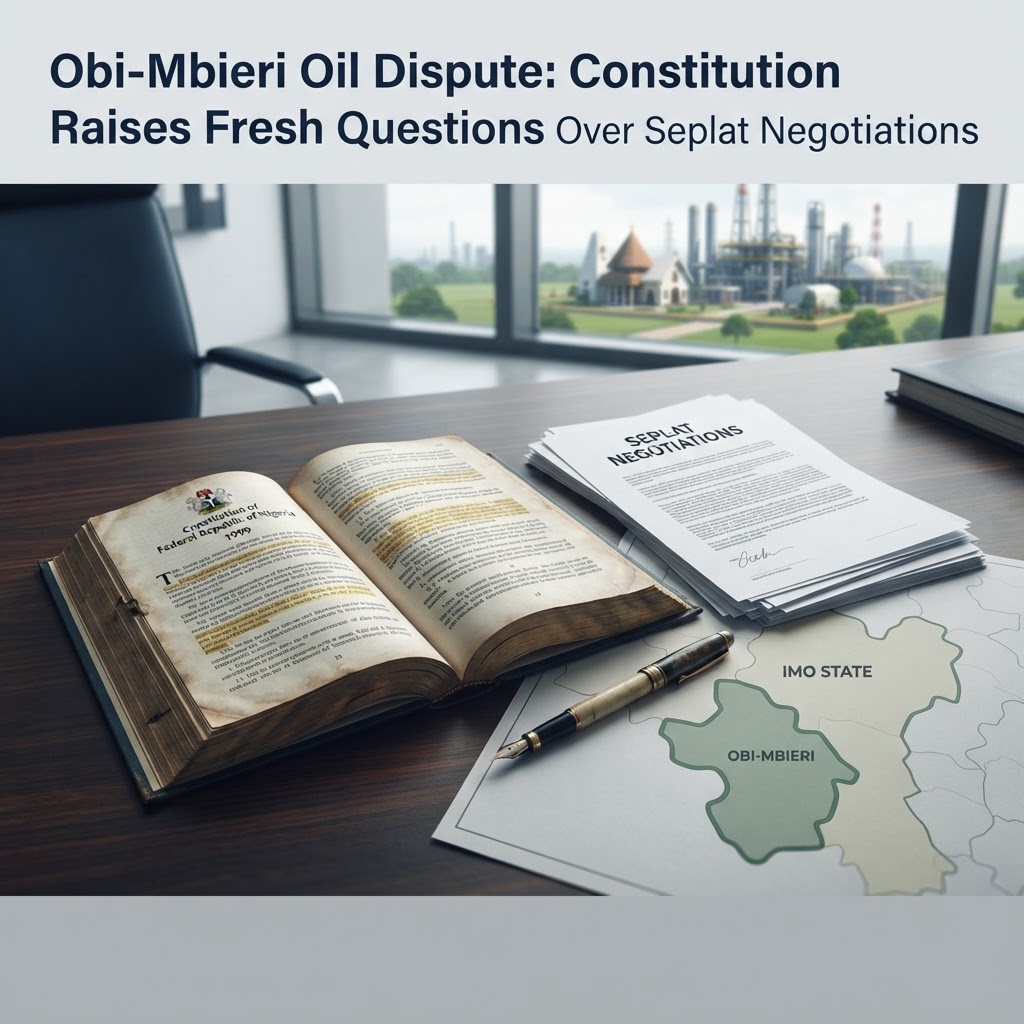
The controversy surrounding petroleum activities in Obi-Mbieri Autonomous Community in Imo State has crossed a critical threshold. What began as allegations of a quiet diversion of community oil wealth has now evolved into a sharp constitutional debate — one that goes far beyond personal accusations and party politics. At its centre is a foundational document that few have paused to read carefully: the Great Obi-Mbieri Constitution. As competing public statements from different factions continue to circulate, a close reading of that Constitution raises questions that neither side has fully answered. The core issue is no longer simply who is negotiating with Seplat Energy — it is whether anyone currently at the table has the constitutional authority to be there at all.
Why Is the Constitution Now Central to the Seplat Row?
The public controversy became impossible to ignore following the publication of The Great Obi-Mbieri Oil Heist: How a Community's Natural Wealth Is Being Quietly Diverted, Seplat Energy Fingered, a report that accused unnamed community actors of positioning themselves to control oil-related benefits without a clear mandate from the broader Obi-Mbieri citizenry. A rejoinder published on August 18 responded by asserting that Seplat Energy was engaging the recognised Town Union leadership, implying that such recognition settled the question of authority. A second rejoinder on August 24 pushed back harder, demanding documentary evidence of any mandate granted to the current negotiating parties.
What changed the nature of the debate is the text of the Obi-Mbieri Constitution itself. Section 1 is unambiguous: the Constitution is supreme and binding on all towns, villages, kindreds, and persons throughout the Autonomous Community. Crucially, it further states that no person or group may assume control of the government or traditional Ezeship institution except in accordance with the Constitution. That single provision transforms the entire controversy. State-level recognition of a Town Union is a statutory matter. Constitutional authority within the community is a separate and higher question. The August 18 rejoinder's reliance on external recognition, as noted in RE: "The Great Obi-Mbieri Oil Heist" — Setting the Records Straight, does not automatically satisfy the internal constitutional requirement. The constitutional framework now demands scrutiny — and that scrutiny begins with understanding the community's two-pronged institutional structure.
How Does the Constitution Split Ezeship from the Development Union?
One of the most consequential — and least discussed — provisions in the Obi-Mbieri Constitution is its deliberate separation of two distinct institutional pillars within the Autonomous Community. The document defines the community as being composed of two bodies: the Ezeship Institution and the Obi-Mbieri Autonomous Community Government, otherwise known as the Obi-Mbieri Development Union. This is not merely a taxonomic exercise. It is a structural design with direct implications for who can speak, decide, and bind the community on matters of consequence.
The conflation of "Town Union" with "the community" — a rhetorical move that has appeared repeatedly in the public discourse — is therefore a constitutional oversimplification. The Town Union, operating as the Development Union, is only one half of the Autonomous Community's governance architecture. The other half is the Ezeship Institution, and Section 6 is explicit about its place in the hierarchy: the supreme authority of the Autonomous Community lies in the General Meeting, and the Eze of the Autonomous Community shall be its Chairman.
Section 12 further elaborates the Eze's institutional weight. The Traditional Ruler holds powers over the appointment of advisers, the Palace Secretary, the Traditional Prime Minister, and officers of the Town Union in the absence of an election. The constitution as says that the Traditional Prime Minister once appointed by the Eze, have the same qualification as the Eze. This also implies that the Traditional Prime Minister have the same disqualification as the Eze. The Eze is also designated as the chief patron and trustee of the community — a role that is far from ceremonial. Where the Eze is unavailable or incapacitated for a prolonged period, the Constitution provides for the Traditional Prime Minister to step into that function.
This means that any claim that the Town Union alone speaks for Obi-Mbieri on a matter as significant as petroleum resource management requires a much stronger constitutional foundation than has yet been publicly offered. The constitutional architecture demands that both institutions be accounted for — and that any binding decision trace its authority through the chain the document itself establishes.
Where Is the General Meeting Resolution Authorising the Seplat Talks?
Section 6 of the Obi-Mbieri Constitution does not merely describe the General Meeting as an important body. It designates it as the seat of supreme authority within the community. This is the provision that should be at the centre of every conversation about the Seplat engagement. The critical and so far unanswered question is straightforward: Was a General Meeting ever convened, and did it pass a formal resolution authorising the current negotiations with Seplat Energy?
Section 11 supplies the answer to why this question matters so much for the President-General's role. Under that provision, the President-General holds significant executive powers — he heads the executive, presides over meetings, and directs their summoning. But the operative phrase that constrains those powers is precise: the President-General acts with his executive "to carry out the decisions of the General Meeting." The language is not permissive of independent action on community-defining matters. It is explicitly derivative — the executive implements what the General Meeting decides.
This creates what can be described as a documentary test for accountability. Any stakeholder — community member, diaspora Nigerian, journalist, or legal practitioner — should be in a position to demand the following specific records: General Meeting minutes authorising petroleum engagement; executive meeting minutes implementing that General Meeting decision; a formal resolution naming the individuals authorised to represent Obi-Mbieri before Seplat; the date and scope of that authorisation; and any agreement subsequently signed. The absence of any item in that chain is not merely an administrative gap. Under Section 1, it raises the question of whether what occurred was constitutionally valid at all. For more on how resource governance failures affect oil-producing communities in Imo State more broadly, see this analysis of Nigeria's oil output and what it means for Imo's oil-producing communities.
What Are the Legal Risks for Seplat in This Situation?
Seplat Energy is a publicly listed company with sophisticated governance obligations. Its stakeholder engagement framework commits the company to meaningful consultation with host communities through structures including Global Memorandums of Understanding (GMoUs). These instruments are designed precisely to formalise community consent and protect Seplat from the legal and reputational exposure that has historically plagued petroleum companies operating in the Niger Delta and South-East.
Featured Products
Chukwu Abiama Tee
Bold black-and-gold Igbo-pride T-shirt featuring 'Chukwu Abiama' in premium streetwear typography.
₦15,000
Buy NowReverse Type 2 Diabetes & other associated Metabolic Issues using Dr. Jason Fung's Evidence-Based Approach— FMD program for Type 2 Diabetes
A practical fasting and fasting-mimicking programme built on Dr Jason Fung's insulin-resistance principles and ow-glycemic recipes.
₦19,950
Join NowỤmụ Igbo Tee
Classic black T-shirt with bold white 'Ụmụ Igbo' typography — a proud statement of Igbo heritage.
₦15,000
Buy NowNwanne Tee
Washed khaki vintage tee with a faded rust-orange 'Nwanne' stamp badge and palm leaf motif — a nod to kinship and heritage.
₦18,000
Buy NowObodo Tee
Faded denim-blue washed tee with a cream 'Obodo' stamp badge and sun motif, celebrating community roots.
₦18,000
Buy NowEkwe Heritage Tee
Deep indigo tee featuring a fine line-art illustration of a traditional Igbo ekwe drum, inspired by Igbo-Ukwu bronze artistry.
₦18,000
Buy NowIkenga Figure Tee
Forest green tee with a fine line-art illustration of a stylized Ikenga figure.
₦18,000
Buy NowHowever, a GMoU or any similar instrument is only as strong as the authority of the parties who signed it. If the Obi-Mbieri Constitution places supreme decision-making authority in the General Meeting, and if there is no documented resolution authorising the individuals who engaged Seplat, then those agreements may have been executed by parties who lacked constitutional standing to bind the community. The implications of that scenario are not hypothetical — they are well-documented in Nigerian petroleum law. Disputes over wrongful representation have delayed and derailed projects worth hundreds of millions of dollars. The protracted negotiations surrounding the ExxonMobil–NNPC dispute and the knock-on effects for Seplat's $1.6 billion acquisition serve as a reminder of how community and institutional governance disputes can freeze otherwise commercially viable petroleum transactions.
Equally important is what the Obi-Mbieri Constitution does not say. A careful reading of the document reveals no specific petroleum clause — no provision that expressly designates the President-General, the Town Union, or any named individual as the community's authorised representative in oil negotiations. Authority must therefore be derived from general governance provisions and tested against the General Meeting requirement. A company that proceeds on the assumption that Town Union recognition alone satisfies its community engagement obligations may be building on a constitutionally uncertain foundation — one that opponents of any eventual agreement could challenge in court.
How Does Village Equality Affect Host-Community Benefits?
The Obi-Mbieri Constitution contains a provision that has received almost no attention in the current public debate, yet it may have the most direct bearing on how oil revenues and benefits are ultimately distributed. The document establishes that all villages within the Autonomous Community shall be treated on the basis of equality in all matters. This principle of internal equality is not aspirational language — it is a governance rule.
Umuagwu has been identified in some accounts as a host village to the petroleum activity, given the geographical location of the relevant oil field. The constitutional question that follows is significant: Does Umuagwu's status as a host village grant it or its leaders independent authority to negotiate on behalf of the community? Or does its membership in the wider Obi-Mbieri Autonomous Community mean that any negotiation must engage the full constitutional structure, and that benefits must flow equitably to all villages? The Constitution's equality provision strongly suggests the latter. A single village negotiating independently — or receiving a disproportionate share of community resource benefits — would be constitutionally suspect under that provision.
This connects directly to the mission of eziokwubundu.com: that community development must be pursued collectively, with structures of accountability that prevent oil wealth from creating new fault lines between villages that have historically coexisted. The Umuahia–Obi-Mbieri Road project illustrates how infrastructure benefits can strengthen a wider area when properly channelled — an example the community's oil negotiations should follow.
What Steps Can Stakeholders Take to Ensure Transparency?
The constitutional questions raised in this investigation are not merely academic. They have a practical resolution pathway, and it begins with what can reasonably be called a Constitutional Audit. Community stakeholders — including elders, village representatives, youth professionals, and diaspora Nigerians — should collectively demand that all existing agreements or memoranda of understanding between the Town Union and Seplat Energy be reviewed against the requirements of Section 1 and Section 6. The question is not hostile to any particular faction. It is a neutral constitutional demand that protects every Obi-Mbieri citizen.
Beyond the audit, diaspora Nigerians and youth professionals have a specific role to play. They represent the generation that will either inherit the prosperity generated by these oil activities or inherit the legal disputes that follow poorly executed agreements. Demanding the convening of a formal General Meeting — with proper notice, documented attendance, and recorded resolutions — is not obstructionism. It is constitutional compliance. Traditional values of collective decision-making and community consensus find their modern expression precisely in constitutional processes of this kind. For context on how Nigeria's broader fiscal decisions affect communities like Obi-Mbieri, the questions raised about Nigeria's $5bn Abu Dhabi loan offer a useful national-level parallel.
Community leaders should also insist that any future petroleum engagement include explicit commitments on environmental health, land remediation timelines, employment quotas for community residents, and long-term development fund structures — not one-time cash disbursements that dissolve without lasting impact.
Can the Traditional Prime Minister Lead During the Eze's Absence?
This question has moved from the margins of the Obi-Mbieri dispute to its centre, and the Constitution provides a framework — for resolving it. Where the Eze is unavailable or incapacitated for a prolonged period, the Traditional Prime Minister assumes the functions of that office within the Ezeship Institution. This succession arrangement is not a loophole or an emergency measure. It is a deliberate constitutional provision designed to ensure continuity of the institution that chairs the community's supreme authority.
The status of the Traditional Prime Minister has become a flashpoint in the Seplat controversy precisely because both factions understand what it means for the legitimacy of any negotiations. If the Ezeship Institution must be represented at the level of supreme authority, and if the Eze is absent, then the TPM's institutional standing is not a peripheral matter — it is central to whether the General Meeting can be properly constituted and whether its resolutions carry constitutional weight. The traditional structure is emphatically not ceremonial. It is a constitutional check on the administrative power of the Development Union, and any settlement of the Seplat question will need to account for it honestly.
Conclusion
The Obi-Mbieri oil dispute has arrived at a moment of constitutional reckoning. The public exchanges of August 18 and August 24 were, in their own way, a rehearsal for a more rigorous debate that the community's foundational document now compels. The Obi-Mbieri Constitution is clear on several counts: it is supreme, it separates the Ezeship Institution from the Development Union, it places supreme authority in the General Meeting under the Eze's chairmanship, and it limits the President-General to implementing decisions the General Meeting has already made. None of these provisions are hostile to progress. Together, they describe a community governance model sophisticated enough to manage a petroleum engagement — provided that model is respected.
The question that now demands a public answer is not whether Seplat Energy is a legitimate petroleum operator. It is whether the people who engaged Seplat on behalf of Obi-Mbieri did so with the constitutional authority the community's own document requires. Until that question is answered with documents — not assertions — the controversy will persist, and the community's long-term interests in its own natural resources will remain at risk.
Stay Informed
Get New Articles in Your Inbox
Subscribe to receive the latest community development, health, and wealth insights from Eziokwubundu.
Newsletter
Practical insights on health, wealth, and community — delivered weekly.
Community Discussion(0)
Leave a Comment
More to Read
You May Also Like

How Rising Petrol Prices Impact Nigerian Households and SMEs
Petrol prices have crossed a psychological line that many Nigerians once thought impossible. At ₦1,400 per litre in several states, rising petrol prices are reshaping how households spend, how businesses operate, and how communities survive. What was once an occasional headline about fuel scarcity h...

48 Months Without Full Pension Payments: Imo Pensioners
Retirement should bring peace, not financial anxiety. Yet across Imo State, thousands of elderly civil servants say their golden years have turned into a struggle for survival. The situation described in "48 Months Without Full Pension Payments: Imo Pensioners Demand Answers" reflects a deepening cr...

How Igbo communities fund development projects
Across southeastern Nigeria, roads are tarred, schools are built, and boreholes are sunk — not by government contractors, but by communities pooling resources together. This phenomenon is neither accidental nor recent. It is the product of centuries-old cultural philosophy, refined institutional str...

Imo Erosion Crisis: Mbieri Communities Demand Urgent Government Action
The ground beneath Mbieri is literally disappearing. In Mbaitoli Local Government Area of Imo State, advancing gullies are swallowing roads, threatening homes, and pushing one of southeastern Nigeria's most resilient communities toward an environmental breaking point. Residents are no longer waiting...

Imo State Emergency Contacts Directory
Emergencies do not send advance notice. Whether it is a road traffic accident along the Owerri-Onitsha expressway, a fire outbreak in a densely populated neighbourhood, or a sudden medical crisis in one of Imo State's rural local government areas, the difference between life and death often comes do...

Imo Waste Collection Services Compared
Waste management sits at the intersection of public health, economic productivity, and community dignity. For residents of Imo State, particularly those living in the expanding urban corridors of Owerri, the question of who collects refuse — and how reliably they do it — is not a minor administrativ...

KoboTutor: How a Nigerian EdTech Platform Is Bringing Personalised Learning to Students
Nigeria's education sector stands at a crossroads. With over 13 million out-of-school children and chronic underfunding in public education, the pressure on students who do attend school is immense. For the millions sitting JAMB, WAEC, and NECO examinations each year, the stakes could not be higher....