Powered by Obi Mbieri Independent Media Ltd · eziokwubundu.com
KoboTutor: How a Nigerian EdTech Platform Is Bringing Personalised Learning to Students
Nigeria's education sector stands at a crossroads. With over 13 million out-of-school children and chronic underfunding in public education, the pressure on students who do attend school is immense. For the millions sitting JAMB, WAEC, and NECO examinations each year, the stakes could not be higher....
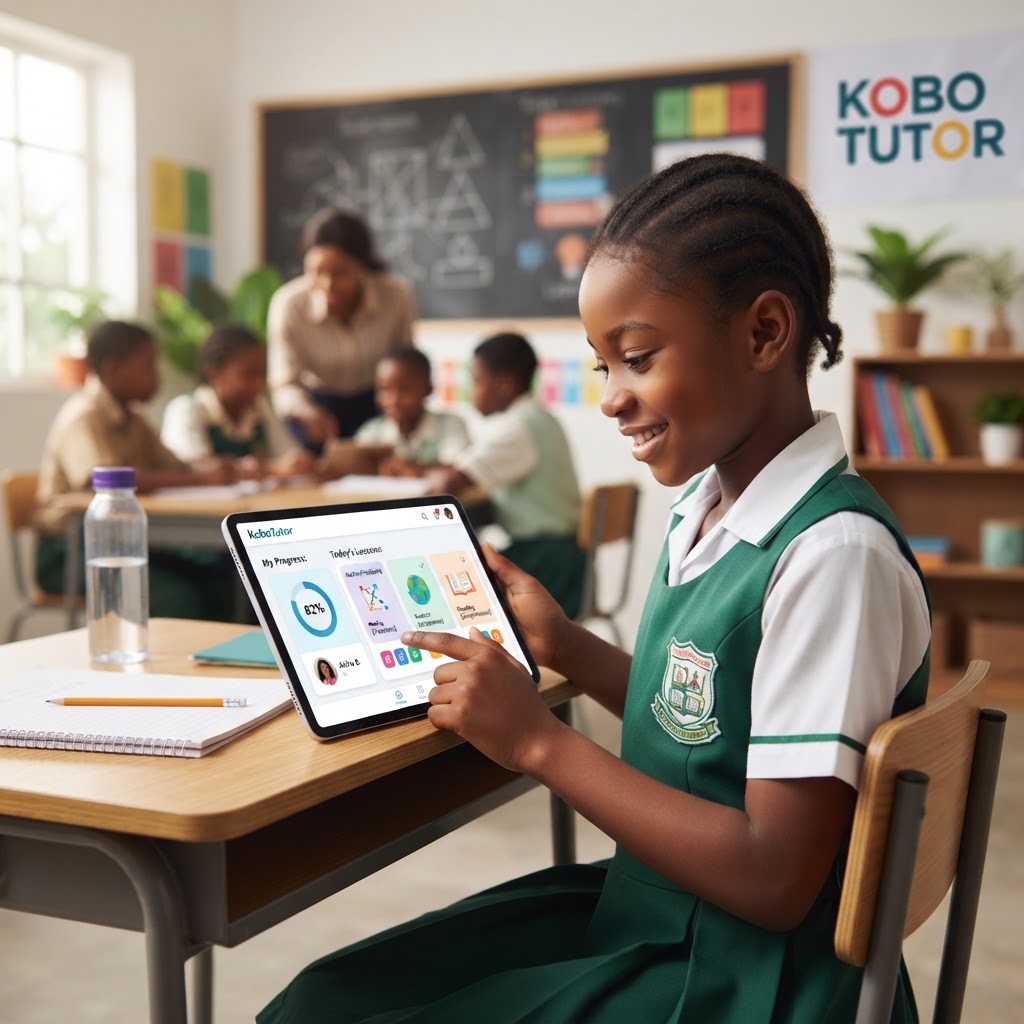
Nigeria's education sector stands at a crossroads. With over 13 million out-of-school children and chronic underfunding in public education, the pressure on students who do attend school is immense. For the millions sitting JAMB, WAEC, and NECO examinations each year, the stakes could not be higher. Yet the tools available to most students remain stubbornly traditional — overcrowded classrooms, overstretched teachers, and a one-size-fits-all curriculum that leaves too many learners behind. KoboTutor is among a new generation of Nigerian EdTech platforms challenging that reality, using personalised, curriculum-aligned digital learning to give students something the conventional system rarely offers: an education that adapts to them.
Why Is Nigerian Education Shifting to Personalised Learning?
The limitations of the traditional Nigerian classroom are well documented. With student-to-teacher ratios frequently exceeding 50:1 in public secondary schools — and sometimes reaching 80:1 in urban centres — individual attention is a luxury most students never receive. A teacher managing a class of that size cannot realistically diagnose why one student struggles with quadratic equations while another excels, nor can they slow down for those who have not yet mastered foundational concepts before the syllabus moves on. The result is a system where academic gaps compound over time, and students arrive at high-stakes examinations carrying years of unaddressed weaknesses.
This structural pressure has accelerated Nigeria's appetite for digital education. Platforms like HiPrep have already demonstrated the direction of travel, transitioning to fully online models in direct response to demand from students and families who need flexible, accessible learning tools beyond the school gate. The broader African EdTech market, valued at over $800 million in 2022 according to GSV Ventures, is projected to grow substantially as internet penetration deepens across the continent.
Research consistently supports what many Nigerian educators have observed in practice: personalised learning — in which students progress according to their individual pace and performance data — produces measurably stronger outcomes. A 2019 study published in the Journal of Educational Technology & Society found that adaptive learning environments improved student performance by up to 30% compared with traditional instruction alone. For a country where 112 Federal Unity Colleges have faced possible shutdown due to funding crises, scalable digital alternatives are not simply convenient — they are increasingly necessary.
What Is KoboTutor and How Does It Work?
KoboTutor is a Nigerian EdTech platform built with a singular purpose: to close the gap between a student's academic potential and the quality of learning resources they can actually access. Developed with the Nigerian curriculum at its core, the platform delivers structured, subject-specific content aligned to the syllabi of the West African Examinations Council (WAEC), the National Examinations Council (NECO), and the Joint Admissions and Matriculation Board (JAMB). This alignment is not incidental — it is the foundation of the platform's utility.
In terms of architecture, KoboTutor operates through a structured content delivery system that organises material by subject, topic, and difficulty level. Students are guided through learning pathways that mirror the progression of academic syllabi while incorporating formative checkpoints to assess retention before advancing. This approach shares conceptual DNA with established platforms like PrepClass, which demonstrated that Nigerian students respond strongly to structured digital tutoring when it is relevant, affordable, and accessible on mobile devices.
The user experience is deliberately straightforward. Nigeria's digital infrastructure remains uneven, with smartphone penetration higher than fixed broadband in most households. KoboTutor's interface is optimised for mobile use, requiring minimal data consumption — a practical consideration for middle-class Nigerian families managing connectivity costs. Students log in, select their subject and examination target, and begin working through content modules that combine explanatory lessons, worked examples, and practice questions.
What differentiates KoboTutor from a simple question bank is its attempt to replicate the diagnostic function of a good teacher. Rather than presenting content uniformly, the platform uses student response data to surface areas of weakness and prioritise those in subsequent sessions. According to the World Bank's Education Global Practice, this kind of formative feedback loop — when well implemented — is among the most effective interventions available to resource-constrained education systems. For Nigerian students operating in precisely such a system, that capability has real value.
How Does KoboTutor Personalise Learning for Students?
The mechanics of personalised learning on KoboTutor begin with assessment. When a student engages with the platform, their responses to practice questions generate a performance profile — a map of what they know, what they partially understand, and where their knowledge has significant gaps. This diagnostic function operates continuously, updating the student's profile with every session rather than relying on a single baseline test administered at enrolment.
This formative assessment model is grounded in established educational research. Benjamin Bloom's concept of mastery learning, developed in the 1960s and consistently validated by subsequent research, holds that students who are required to demonstrate mastery of a concept before advancing achieve significantly better long-term outcomes than those who are moved forward on a fixed time schedule. KoboTutor's adaptive sequencing reflects this principle: a student who cannot yet correctly solve problems involving simultaneous equations will not be advanced to topics that depend on that skill until mastery is demonstrated.
The pacing mechanism is particularly significant in the Nigerian context. In a conventional classroom, the curriculum timeline is dictated by institutional schedules, not individual readiness. A student who was absent for two weeks due to illness, or who simply did not grasp a topic when it was first taught, is rarely given structured opportunity to return and consolidate that learning. KoboTutor removes that constraint by allowing students to revisit foundational material as many times as necessary, without judgment and without falling behind peers.
Equally important is the platform's indigenous content design. Educational materials that reference unfamiliar cultural contexts — economic examples drawn from Western markets, historical narratives centred on non-African experiences — create unnecessary cognitive friction for Nigerian students. KoboTutor's content is built around the Nigerian academic context, using locally relevant examples and framing that makes abstract concepts more immediately accessible. This cultural grounding is not a cosmetic feature; research from UNESCO's Institute for Statistics consistently shows that culturally relevant pedagogy improves both engagement and comprehension among secondary school learners in sub-Saharan Africa.
The combined effect of adaptive sequencing, continuous formative assessment, and culturally relevant content positions KoboTutor as more than a revision tool. It functions as a dynamic tutor — one that learns alongside the student and adjusts its instruction accordingly.
What Role Does KoboTutor Play in Exam Preparation?
For most Nigerian secondary school students, the ultimate test of their academic preparation comes in three examinations: JAMB, WAEC, and NECO. These are high-stakes assessments in the truest sense — they determine university admission, career pathways, and in many families, a student's entire economic trajectory. The pressure they generate is enormous, and inadequate preparation remains one of the most significant drivers of poor performance nationally.
KoboTutor addresses this directly through a suite of examination preparation tools. The platform provides access to extensive past question archives drawn from previous JAMB, WAEC, and NECO papers, presented in a simulated computer-based test (CBT) environment. This simulation feature is particularly valuable given that JAMB now administers its Unified Tertiary Matriculation Examination (UTME) exclusively in CBT format. Students who have never encountered that environment before examination day face a compounded disadvantage — managing both subject knowledge and an unfamiliar interface simultaneously. Regular practice on KoboTutor's CBT simulator removes that obstacle.
The platform also applies data-driven study prioritisation. Rather than asking students to work through every past question with equal weight, KoboTutor analyses topic recurrence patterns across multiple examination years to identify high-frequency areas. A student preparing for WAEC Biology, for instance, can quickly identify that topics such as cell biology, genetics, and ecology have appeared with significantly greater frequency than others, and allocate their limited study time accordingly.
This efficiency matters enormously. Many Nigerian students preparing for these examinations are simultaneously managing school attendance, domestic responsibilities, and in some cases part-time work. Time is their scarcest resource. A platform that helps them concentrate effort where it is most likely to produce results is not simply a convenience — it is a genuine equity tool.
Beyond content, KoboTutor's consistent practice environment helps reduce examination anxiety. Familiarity with question formats, timing constraints, and digital navigation builds the procedural confidence that allows students to perform closer to their actual capability on examination day.
How Can Parents and Teachers Use KoboTutor Effectively?
The benefits of KoboTutor extend meaningfully beyond the individual student. For parents — particularly the middle-class Nigerian families who invest heavily in their children's education despite significant economic pressures — the platform offers something traditional tutoring arrangements rarely provide: visibility. Parents can monitor their child's progress through the platform, identifying which subjects are advancing well and where persistent gaps remain. This data transforms parent-teacher conversations from anecdote-based exchanges into evidence-informed discussions about targeted intervention.
This parental engagement capability aligns with the community-first philosophy that underpins effective Nigerian education. Just as strong community institutions reinforce individual wellbeing — a principle explored across eziokwubundu.com's coverage of community development — strong home-school communication reinforces student outcomes. KoboTutor serves as a bridge between those two environments, giving parents meaningful agency in their child's academic journey without requiring specialist educational expertise.
For teachers, the platform functions as a high-quality supplementary resource that can reclaim valuable classroom time. When students use KoboTutor to consolidate foundational content and practice core skills outside school hours, teachers are freed to focus on higher-order learning — critical analysis, classroom discussion, mentorship, and the relational dimensions of teaching that no digital platform can replicate. In an environment where teacher workloads are substantial and resources are stretched, this division of labour has practical value.
The broader ecosystem that KoboTutor supports — connecting students, parents, and educators through shared data and shared purpose — reflects the same collaborative logic that drives community health initiatives. Just as community-level healthcare programmes improve outcomes that individual clinical interventions alone cannot achieve, a coordinated approach to education that engages all stakeholders produces results that isolated study cannot.
Conclusion
KoboTutor represents a serious and timely response to one of Nigeria's most pressing development challenges. By delivering personalised, curriculum-aligned learning through an accessible digital platform, it addresses structural limitations that have constrained Nigerian student achievement for decades. Its diagnostic tools, adaptive pacing, examination preparation suite, and culturally grounded content combine to offer something genuinely valuable: an educational experience that sees each student as an individual, not a number in a classroom ratio.
For Nigerian families, community stakeholders, and educators committed to raising the next generation's prospects, platforms like KoboTutor are not peripheral to that mission — they are central to it. The question is no longer whether technology has a role in Nigerian education. It is how quickly, and how equitably, that technology can reach the students who need it most. This article is the first in a dedicated series on KoboTutor and Nigerian EdTech. Subsequent pieces will explore how the platform's technology works in depth, its specific utility for JAMB and WAEC preparation, and practical guidance for parents and schools looking to integrate digital learning tools effectively.
Stay Informed
Get New Articles in Your Inbox
Subscribe to receive the latest community development, health, and wealth insights from Eziokwubundu.
Newsletter
Practical insights on health, wealth, and community — delivered weekly.