Powered by Obi Mbieri Independent Media Ltd · eziokwubundu.com
$1 = ₦1,326€1 = ₦1,541£1 = ₦1,793Imo State Social Investment Programs Explained
Social protection in Imo State has moved beyond the era of sporadic food distribution at political rallies. What exists today is a layered, institutionally anchored network of programs designed to lift vulnerable households, equip young people with marketable skills, and extend healthcare to those w...
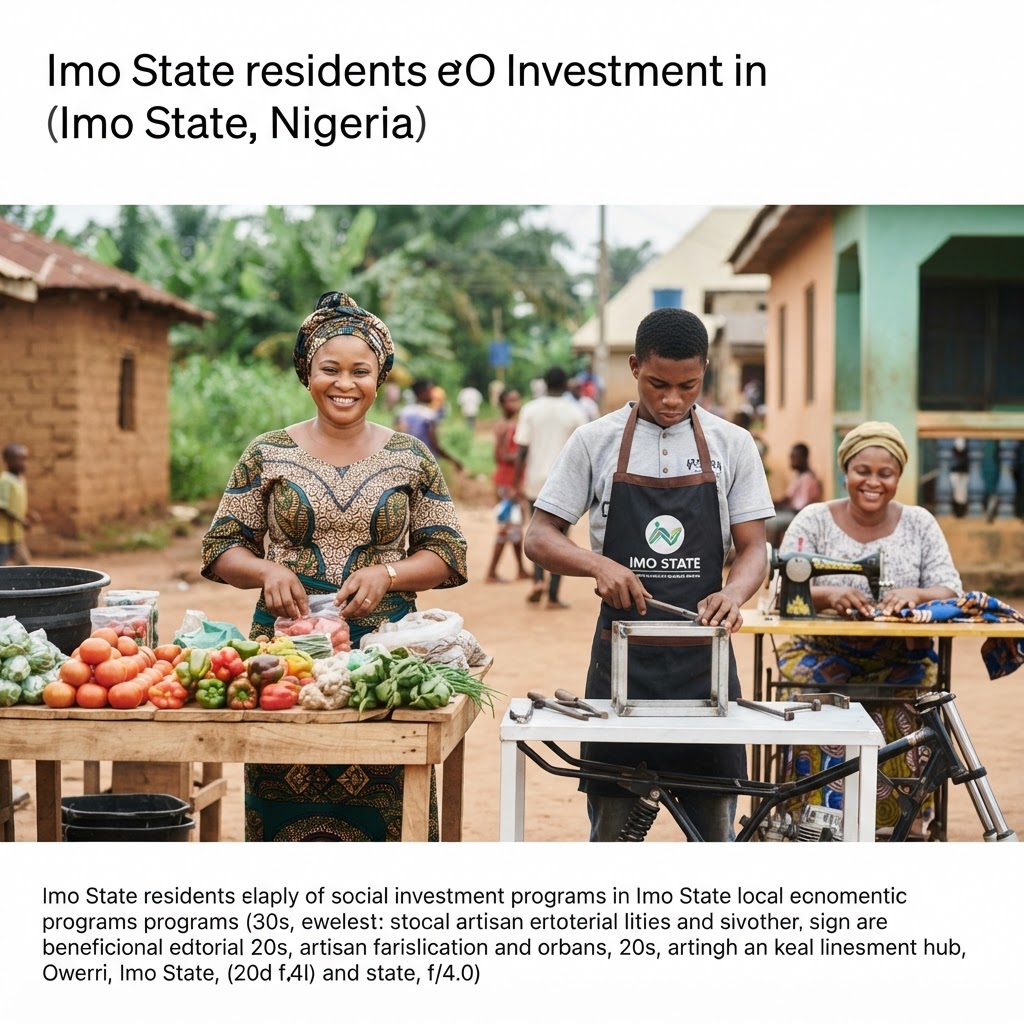
Social protection in Imo State has moved beyond the era of sporadic food distribution at political rallies. What exists today is a layered, institutionally anchored network of programs designed to lift vulnerable households, equip young people with marketable skills, and extend healthcare to those who would otherwise fall through the cracks. For Nigerian families, community stakeholders, and diaspora Nigerians tracking developments back home, understanding the architecture of these interventions is essential — not just as a civic matter, but as a practical wealth and health strategy.
This article breaks down the Imo State Social Investment Programs, explaining who qualifies, how money moves, what institutions are involved, and how individuals and communities can access these benefits. Whether you are a market trader in Orlu, a youth professional in Owerri, or a community leader in the diaspora, this guide offers the clarity and actionable detail you need.
What Are Imo State Social Investment Programs?
Policy Architecture and Institutional Framework
Imo State's social investment framework is anchored in the state government's 3R agenda — Reconstruction, Rehabilitation, and Recovery — which aligns closely with the mandate of the Federal Ministry of Humanitarian Affairs and Poverty Reduction. Rather than operating as isolated interventions, these programs are coordinated through a shared institutional logic: systematic identification of the poor, data-driven disbursement, and measurable outcomes.
The most important structural shift in recent years has been the movement away from ad hoc palliative distribution toward formalized, data-driven social safety nets. Central to this transition is the National Social Register (NSR), a unified national database that captures verified vulnerable households across all 27 Local Government Areas in Imo State. The NSR ensures that beneficiaries are selected through community-based targeting rather than political patronage, making the system — at least in design — far more equitable and transparent.
From the perspective of eziokwubundu.com's Health + Wealth + Community framework, institutionalized social safety nets serve a dual function. First, they act as preventive public health mechanisms: households with stable income buffers make better nutritional decisions, access healthcare earlier, and are less likely to experience the mental health toll of chronic poverty. Second, they serve as grassroots economic stabilizers, injecting liquidity at the base of the local economy where it generates the highest multiplier effect. Understanding these programs, therefore, is as much a wellness strategy as it is a financial one.
How Do Cash Transfers Support Vulnerable Households?
The HoPE-CT Programme Across 27 LGAs
The flagship cash transfer initiative in Imo State is the Household Prosperity and Empowerment Cash Transfer Programme (HoPE-CT), which represents one of the most substantial social spending commitments in the state's recent history. According to official figures, over N6.6 billion has been disbursed to more than 278,000 verified beneficiaries across all 27 LGAs — a scale that places Imo among the more active states in Nigeria's federal social protection ecosystem.
The financial mechanics are worth examining closely. Each qualifying household receives a N75,000 direct payout, structured in three tranches to smooth household consumption over time rather than encouraging lump-sum spending. Critically, disbursements are processed through direct bank account deposits tied to biometric National Identification Number (NIN) validation. This architecture is designed to eliminate the intermediary leakage — ghost beneficiaries, diverted funds, and political gatekeeping — that plagued earlier cash transfer models across Nigeria.
The real-world impact of these transfers at the household level is instructive. In rural LGAs such as Mbaitoli and Ikeduru, female-headed households have used successive tranches to restock subsistence farm inputs — seeds, fertilizer, and basic irrigation equipment — creating small but meaningful improvements in family nutrition and income security. Market women in semi-urban areas have reported using the capital to replenish inventory after seasonal downturns, building a thin but vital layer of micro-retail resilience. These outcomes echo findings from the World Bank's broader assessment of Nigeria's National Social Safety Nets Project, which consistently shows that unconditional cash transfers generate positive spillovers in nutrition, education enrollment, and local market activity.
The HoPE-CT model reflects a growing consensus in development economics: predictable, verified cash transfers outperform in-kind distributions in nearly every welfare metric. For Imo families, this is not abstract policy — it is money in an account, food on the table, and a foundation on which wider prosperity can be built.
How Is Digital Innovation Driving Youth Wealth Creation?
The Imo Digital City Hub and Global Partnerships
Youth underemployment remains one of the most pressing structural challenges in Southeastern Nigeria. Imo State's response has been to invest aggressively in digital and vocational upskilling through the Imo Digital City Hub, which has facilitated the graduation of over 65,000 young Imo residents in technology-driven vocations including software development, data analytics, UI/UX design, digital marketing, and e-commerce operations.
What distinguishes this initiative from generic government training programs is the caliber of institutional partnerships behind it. Collaborations involving UC Berkeley, the United Nations Development Programme (UNDP), and the World Bank have introduced internationally benchmarked curricula and certification pathways that carry weight in the global freelance and remote work marketplace. A graduate of a UNDP-backed digital skills cohort in Owerri can, in principle, compete for remote contracts on platforms serving clients in London, Toronto, or Lagos's Lekki corridor.
This direct link between digital literacy and personal financial security has measurable wellness implications. Research published by the International Labour Organization on youth employment in Sub-Saharan Africa consistently shows that economically idle young people face elevated rates of anxiety, depression, and vulnerability to criminal recruitment. By creating pathways to remote income and digital entrepreneurship, Imo's digital investment programs function simultaneously as mental health interventions and economic development tools.
Featured Products
Chukwu Abiama Tee
Bold black-and-gold Igbo-pride T-shirt featuring 'Chukwu Abiama' in premium streetwear typography.
₦15,000
Buy NowReverse Type 2 Diabetes & other associated Metabolic Issues using Dr. Jason Fung's Evidence-Based Approach— FMD program for Type 2 Diabetes
A practical fasting and fasting-mimicking programme built on Dr Jason Fung's insulin-resistance principles and ow-glycemic recipes.
₦19,950
Join NowỤmụ Igbo Tee
Classic black T-shirt with bold white 'Ụmụ Igbo' typography — a proud statement of Igbo heritage.
₦15,000
Buy NowNwanne Tee
Washed khaki vintage tee with a faded rust-orange 'Nwanne' stamp badge and palm leaf motif — a nod to kinship and heritage.
₦18,000
Buy NowObodo Tee
Faded denim-blue washed tee with a cream 'Obodo' stamp badge and sun motif, celebrating community roots.
₦18,000
Buy NowEkwe Heritage Tee
Deep indigo tee featuring a fine line-art illustration of a traditional Igbo ekwe drum, inspired by Igbo-Ukwu bronze artistry.
₦18,000
Buy NowIkenga Figure Tee
Forest green tee with a fine line-art illustration of a stylized Ikenga figure.
₦18,000
Buy NowFor youth professionals and students seeking to connect with these opportunities, resources on youth unemployment solutions in Southeastern Nigeria provide complementary guidance on navigating the regional labor market. The intersection of digital empowerment and community stability is one of the defining themes of practical prosperity in modern Imo.
What Enterprise and Agricultural Safety Nets Exist?
Microfinance, GEEP, and Rural Agricultural Support
Beyond direct cash transfers, Imo State's social investment framework includes enterprise-level support targeted at the base of the economic pyramid. The Government Enterprise and Empowerment Program (GEEP) — a federal initiative implemented at the state level — extends interest-free or low-interest credit facilities to petty traders, artisans, market women, and informal sector operators who lack access to conventional banking products. The program operates through a conditional loan model, disbursing between N10,000 and N100,000 depending on business category and repayment history.
On the agricultural side, a combination of state-funded subsidies and NDDC-partnered agro-allied programs provides extension services, improved seed distribution, and post-harvest storage support to smallholder farmers. These interventions are designed to stabilize rural food supply chains and reduce the seasonal price volatility that undermines household dietary diversity. Farms like those documented in our coverage of agricultural enterprise in Mbieri illustrate the transformative potential when institutional support meets entrepreneurial ambition in Imo's agro-economy.
There is also a deliberate effort to bridge traditional community financial structures — specifically the Isusu rotating savings system deeply embedded in Igbo economic culture — with formalized grant mechanisms and credit lines. By layering modern grant architecture on top of existing community trust frameworks, program designers are leveraging social capital that formal financial systems have historically ignored. This represents genuine cultural intelligence in policy design, blending traditional values with modern economic tools in a way that resonates with how real communities actually function.
How Do Healthcare Interventions Intersect With Safety Nets?
Health Insurance, Primary Care, and Family Wealth Protection
The social investment framework in Imo State explicitly recognizes that health vulnerability and economic vulnerability are inseparable. The Imo State Health Insurance Agency (IMSHIA) operates equity fund schemes that subsidize maternal care, child health services, and geriatric care for indigent citizens who cannot afford even the reduced premiums of the standard insurance product. These schemes are not supplementary — they are a core component of the poverty reduction architecture.
The wealth protection logic here is compelling. According to data from the Nigerian National Health Insurance Authority, uninsured medical emergencies remain one of the leading triggers of catastrophic household debt in Nigeria. A single hospital admission for a complicated childbirth or a surgical emergency can erase months of accumulated savings or transfer income. By subsidizing healthcare access for the most vulnerable, IMSHIA is, in effect, preserving the financial gains delivered by programs like HoPE-CT.
At the community delivery level, the HOPE-PHC initiative deploys primary healthcare center revitalization across autonomous communities, integrating nutritional screening, health education, and immunization outreach into the same community touchpoints used for social register enrollment. This convergence of health and social protection delivery at the community level reflects the community-first philosophy that eziokwubundu.com consistently champions: personal health and family wealth are not separate pursuits but mutually reinforcing dimensions of the same goal.
How Can Citizens Access These Programs?
Registration, Verification, and Community Advocacy
Accessing Imo State's social investment programs requires navigating a structured onboarding process. The entry point is Community-Based Targeting (CBT), through which Community Facilitators conduct household enumeration at the ward and community level. Verified data is then integrated with the individual's NIN and uploaded into the State Social Register, from which beneficiary lists for specific programs are drawn.
Traditional institutions play a critical role here. Town union executives, community development committees, and autonomous community leaders — such as those documented in resources like the Obi-Mbieri Town Union Executive Council listing — serve as the social connective tissue between government enumeration processes and households that might otherwise be overlooked. Diaspora stakeholders can support this process by funding community advocacy efforts, paying for NIN enrollment assistance, and liaising with ward-level facilitators to ensure elderly, disabled, or politically marginalized community members are included in the register.
For those already enrolled, the strategic priority is converting emergency capital into long-term prosperity. This means combining cash transfer receipts with GEEP credit facilities, reinvesting digital training certificates into freelance income streams, and using IMSHIA coverage to protect household savings from health shocks. Every intervention, taken individually, offers partial relief. Taken together, they represent a genuine foundation for intergenerational wealth — if families approach them with intention and information.
Conclusion
The Imo State Social Investment Programs, taken as a whole, represent the most comprehensive attempt in the state's recent history to build a structured, data-anchored social protection system. From the N6.6 billion disbursed through HoPE-CT to the 65,000 youth upskilled through the Digital City Hub, from GEEP microfinance for market traders to IMSHIA health equity funds for indigent mothers — these are not isolated projects. They form a system, imperfect and still maturing, but directionally significant.
For eziokwubundu.com's readers — whether you are a community leader in Owerri, a diaspora professional in Houston, or a young entrepreneur in Okigwe — the message is clear: knowing these programs exist is the first step; knowing how to access, combine, and leverage them is where practical prosperity begins. The intersection of health, wealth, and community has never been more institutionally supported in Imo State. The opportunity now belongs to informed citizens who choose to act on it.
For further reading on related community governance and local development, see the Duruojije Digital Election coverage in Ogwa, which illustrates how digital tools are reshaping community decision-making across Imo State.
Stay Informed
Get New Articles in Your Inbox
Subscribe to receive the latest community development, health, and wealth insights from Eziokwubundu.
Newsletter
Practical insights on health, wealth, and community — delivered weekly.