Powered by Obi Mbieri Independent Media Ltd · eziokwubundu.com
Duruojije Digital Election — Ogwa
When the town union of Ogwa in Mbaitoli Local Government Area, Imo State, conducted its landmark digital election, it quietly made history. In an era where grassroots governance across Nigeria is frequently paralysed by ballot disputes, exclusion of diaspora members, and entrenched administrative op...
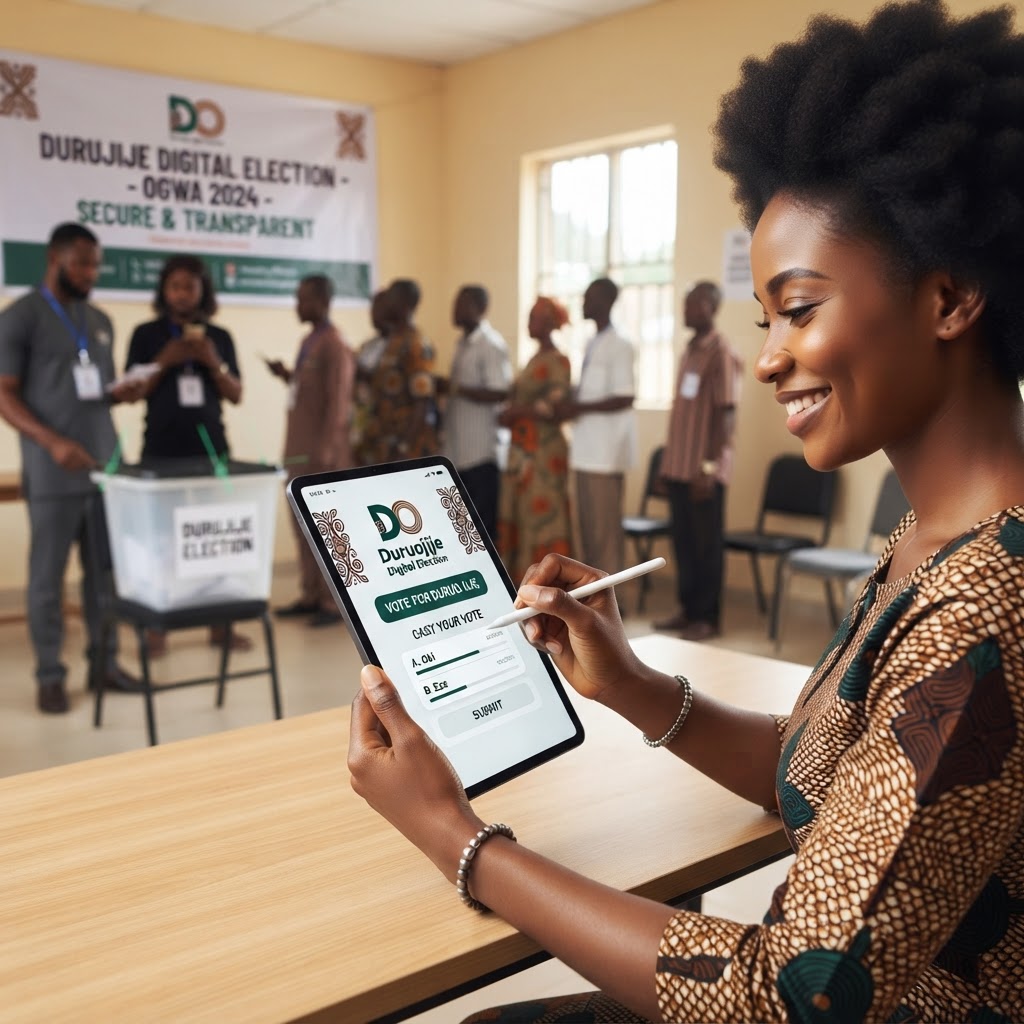
When the town union of Ogwa in Mbaitoli Local Government Area, Imo State, conducted its landmark digital election, it quietly made history. In an era where grassroots governance across Nigeria is frequently paralysed by ballot disputes, exclusion of diaspora members, and entrenched administrative opacity, Ogwa's structured digital electoral process offered a compelling counter-narrative. This event — now documented by Nigeria News Point — signals a decisive shift in how autonomous communities can govern themselves: transparently, inclusively, and efficiently. For Nigerian families, community stakeholders, and diaspora indigenes watching from abroad, the Duruojije digital election in Ogwa is not merely local news. It is a democratic model worth studying, replicating, and building upon.
What Happened During The Duruojije Digital Election?
A Landmark Electoral Milestone For Community Leadership
The Duruojije digital election in Ogwa represents one of the most significant moments in grassroots governance in recent Imo State history. According to reporting by Nigeria News Point, incumbent Chairman Udechukwu secured a return mandate as chair of the Duruojije community, pledging to consolidate on the socio-economic and developmental achievements recorded during his previous tenure. The election was notable not only for its outcome but for its method — a structured, digitally administered balloting process that replaced the chaotic, paper-dependent procedures that have historically undermined community union credibility in southeastern Nigeria.
What made this election a genuine milestone was the administrative architecture behind it. Instead of relying on handwritten tallies vulnerable to manipulation, the process incorporated a digital ballot management system that introduced both efficiency and auditability into the proceedings. Voters were registered through a verified intake process, and results were documented through traceable digital records rather than informal announcements prone to contestation.
This transition is particularly significant when viewed against the broader governance landscape of Mbaitoli LGA. In a region where questions about resource transparency and electoral legitimacy have become recurring concerns — as evidenced by ongoing conversations around Mbaitoli 2027: who is positioning, who is waiting, and who could surprise the political establishment — Ogwa's community has chosen a different path. Rather than waiting for formal government structures to validate grassroots democracy, the community embedded trustworthy mechanisms directly into its own electoral process.
The Ogwa precedent is also culturally resonant. Duruojije is a traditional community unit, and the willingness of elders, youth associations, and returnee diaspora members to collectively adopt digital electoral tools demonstrates that traditional community structures in Igboland are not resistant to innovation — they are capable of leading it. This intersection of ancestral governance frameworks with contemporary civic technology is precisely the kind of development that could set a transformative precedent for town union democracy across Imo State and the wider South-East geopolitical zone.
Why Is Digital Voting Vital For Grassroots Communities?
Bridging The Diaspora Divide And Securing Democratic Legitimacy
One of the most pressing structural problems in Nigerian community union elections has always been exclusion. For Ogwa indigenes living in Lagos, Abuja, Port Harcourt, or in the United Kingdom, United States, and other parts of the diaspora, returning home to cast a ballot in a town union election is often economically prohibitive and logistically hazardous. The result, historically, has been that community decisions are made by whoever happens to be physically present — a demographic that often skews toward older, less formally educated residents while excluding the financially productive diaspora whose remittances substantially fund community projects.
Digital voting systems directly resolve this structural exclusion. By enabling remote participation through verified voter authentication — including biometric pre-registration, unique voter identification codes, and time-stamped digital receipts — platforms used in elections like Duruojije allow every entitled indigene to participate regardless of geography. Research by the International Institute for Democracy and Electoral Assistance (IDEA) consistently demonstrates that inclusive electoral architecture increases both voter participation rates and post-election satisfaction with outcomes, reducing the frequency of disputes that can paralyse communities for months or years.
It is important to distinguish between different tiers of digital voting technology. Basic electronic balloting — simply replacing paper with a digital form — offers minimal security improvement on its own. End-to-end digital auditing adds a critical layer, creating verified, tamper-evident logs of every vote cast, every session opened, and every administrative action taken. Cloud-based voting platforms go further still, using encrypted data storage and geographically distributed server redundancy to make unauthorised interference computationally impractical.
For communities like Ogwa, even a mid-tier digital system dramatically outperforms conventional paper ballots on the metrics that matter most: verifiability, dispute resolution, and voter confidence. Historically, Nigerian local elections at community level have suffered from a well-documented pattern of ballot stuffing, result alterations after counting, and intimidation-driven voter apathy. The introduction of audit trails and remote participation options fundamentally disrupts these patterns.
The legitimacy created by transparent digital voting also has downstream effects on governance quality. A chairman who wins a verified digital election carries a mandate that is harder to delegitimise, enabling faster and more confident decision-making on community development priorities.
How Does Accountable Leadership Impact Local Health And Prosperity?
The Practical Synergy Of Health, Wealth, And Community Progress
The relationship between electoral legitimacy and community health outcomes is often underappreciated in Nigerian public discourse. Yet the evidence from community development research is clear: when local leadership is chosen through transparent, inclusive processes, the resulting executives are both more accountable and more capable of mobilising collective resources toward tangible welfare outcomes.
For Ogwa specifically, Chairman Udechukwu's stated commitment to consolidating developmental achievements opens a practical pathway toward improving primary healthcare access, clean water provision, and maternal health services. These are not abstract policy aspirations. Across rural Imo State, communities with functional, trusted executives have successfully coordinated primary healthcare outreach programmes in partnership with government agencies and NGOs — while communities mired in electoral disputes have watched similar opportunities expire. The connection to infrastructure is equally direct; reliable community governance is frequently a prerequisite for external partnerships, including electrification projects like the Orashi project that delivered constant power to a pioneering Imo community.
The economic dimension of stable, legitimate governance is equally compelling. Local entrepreneurs — market traders, artisans, small-scale farmers, and digital service providers — consistently cite community stability and transparent leadership as critical factors in their willingness to invest and expand. Diaspora remittances, which are a vital economic lifeline for many southeastern communities, are more likely to be channelled into productive community development funds when donors trust that funds will be managed with accountability. Conversely, factional disputes and disputed elections create precisely the conditions that freeze diaspora investment and suppress local entrepreneurship.
Perhaps least discussed but equally important is the psychological welfare dimension. Prolonged community factional conflict generates chronic communal stress that manifests in individual and family health outcomes — elevated anxiety, disrupted sleep patterns, increased substance use, and avoidance of community participation among youth. By contrast, a clearly legitimate, accountable leadership creates the psychological safety that enables families to focus energy on self-improvement, economic productivity, and health-conscious living. This is the health-wealth-community triangle operating at its most fundamental grassroots level.
Featured Products
Chukwu Abiama Tee
Bold black-and-gold Igbo-pride T-shirt featuring 'Chukwu Abiama' in premium streetwear typography.
₦15,000
Buy NowReverse Type 2 Diabetes & other associated Metabolic Issues using Dr. Jason Fung's Evidence-Based Approach— FMD program for Type 2 Diabetes
A practical fasting and fasting-mimicking programme built on Dr Jason Fung's insulin-resistance principles and ow-glycemic recipes.
₦19,950
Join NowỤmụ Igbo Tee
Classic black T-shirt with bold white 'Ụmụ Igbo' typography — a proud statement of Igbo heritage.
₦15,000
Buy NowNwanne Tee
Washed khaki vintage tee with a faded rust-orange 'Nwanne' stamp badge and palm leaf motif — a nod to kinship and heritage.
₦18,000
Buy NowObodo Tee
Faded denim-blue washed tee with a cream 'Obodo' stamp badge and sun motif, celebrating community roots.
₦18,000
Buy NowEkwe Heritage Tee
Deep indigo tee featuring a fine line-art illustration of a traditional Igbo ekwe drum, inspired by Igbo-Ukwu bronze artistry.
₦18,000
Buy NowIkenga Figure Tee
Forest green tee with a fine line-art illustration of a stylized Ikenga figure.
₦18,000
Buy NowWhat Obstacles Must Rural Communities Overcome In Digital Balloting?
Infrastructure, Cybersecurity, And The Digital Literacy Gap
Despite the compelling case for digital community elections, substantial obstacles remain — and honest engagement with these challenges is essential for communities considering replication of the Duruojije model.
The most immediate systemic hurdle in rural southeastern Nigeria is infrastructure. Broadband internet penetration outside major urban centres remains uneven, with rural communities frequently relying on intermittent 3G mobile networks. Power instability compounds this challenge significantly; without reliable electricity, digital voting terminals cannot operate, and candidates for digital election administration must factor in solar-powered or generator-backed infrastructure as a baseline requirement. Mobile device ownership among elderly community elders — often the most respected voices in communal decision-making — remains lower than among younger demographics, creating a potential equity gap that must be proactively addressed.
On the cybersecurity front, the security requirements for a credible digital community election include tamper-evident database structures that log every access event, dual-factor voter verification combining unique voter IDs with biometric or SMS-based authentication, and independent oversight by non-partisan observers capable of reading and validating digital audit logs. Communities that deploy inadequate platforms risk not merely technical failure but the active erosion of public trust — an outcome that could set back digital adoption in grassroots governance by years. Researchers at organisations such as Verified Voting Foundation have documented extensively how poor implementation of electronic voting systems generates more distrust than paper alternatives when failures occur.
Community-level solutions to these challenges are practical and replicable. Digital literacy workshops conducted in Igbo and tailored to different age cohorts can substantially increase voter confidence and technical competence before election day. Native-language voting interfaces reduce intimidation for less formally educated participants. Solar-powered polling hubs — a concept already gaining traction in renewable energy-conscious communities — can decouple voting access from national grid instability. These solutions require upfront investment but generate durable civic infrastructure that serves communities across multiple electoral cycles.
How Can Autonomous Communities Replicate The Duruojije Model?
A Pragmatic Blueprint For Traditional Values And Modern Progress
For town unions, traditional councils, and community development associations across Imo State and beyond, the Duruojije digital election provides an actionable framework. Replication does not require advanced technical expertise or significant external funding — it requires structured preparation, community consensus, and the right sequencing of steps.
Step One: Establish a Non-Partisan Electoral Committee. The committee should comprise respected community elders, representatives from youth associations, and at least one technically literate individual capable of evaluating digital platforms. Critically, no committee member should be affiliated with any candidate. Drawing on the Umunna (patrilineal kinship) network and age-grade structures to populate this committee gives it immediate cultural legitimacy.
Step Two: Select and Audit a Secure Digital Platform. Shortlisted platforms should be evaluated against four criteria: voter authentication robustness, audit log accessibility, offline resilience (in case of network disruption), and language localisation support. Open-source platforms with third-party security audits are preferable to proprietary black-box systems.
Step Three: Conduct Pre-Election Voter Verification. Every entitled voter — including diaspora members — should be verified against community membership records at least thirty days before election day, enabling dispute resolution before voting begins rather than after.
Step Four: Run a Pilot and Debrief. A simulated election using dummy candidates conducted two weeks before the actual event identifies technical vulnerabilities and builds voter familiarity with the process.
The integration of traditional community values into this framework is not merely symbolic. When Umunna networks validate voter eligibility and age-grade structures serve as local polling officials, the digital system gains the community trust that purely technocratic implementations often lack. This synthesis of ancestral governance and modern software is the sustainable core of the Duruojije model.
For youth professionals, student associations, and diaspora stakeholders, the call to action is direct: champion civic technology within your community, volunteer for electoral committees, and invest in digital literacy for elders. Given the financial governance questions raised by issues like the ₦33.75bn cash transfer scandal, communities that build transparent internal systems are better positioned to protect their members' interests at every level.
Conclusion
The Duruojije digital election in Ogwa is more than a community news story. It is a proof of concept for a better model of grassroots democracy in Nigeria — one that honours traditional institutions while embracing the accountability tools that modern civic technology provides. Chairman Udechukwu's return as chair, validated through a transparent digital process, creates the legitimate leadership platform from which genuine community health, economic, and social development can be pursued and sustained.
For Nigerian families, entrepreneurs, diaspora indigenes, and community leaders watching developments in Imo State, the lesson is actionable: inclusive, technology-assisted elections produce verified mandates that empower communities to demand and deliver better outcomes. As IDEA's global research on civic participation confirms, the communities that invest in electoral integrity today build the governance foundations for prosperity tomorrow. Ogwa has demonstrated that path. The question now is how many other autonomous communities across Nigeria will follow it.
Stay Informed
Get New Articles in Your Inbox
Subscribe to receive the latest community development, health, and wealth insights from Eziokwubundu.
Newsletter
Practical insights on health, wealth, and community — delivered weekly.