Powered by Obi Mbieri Independent Media Ltd · eziokwubundu.com
$1 = ₦1,322€1 = ₦1,537£1 = ₦1,790FUTO Security Crisis: Police Move to Protect Students After Abductions and Death
The Federal University of Technology, Owerri (FUTO) is one of Nigeria's most respected tertiary institutions, a cornerstone of southeastern Nigeria's intellectual and economic life. Yet in recent months, the university's environs have become a zone of fear. Students are being abducted. Lives have be...
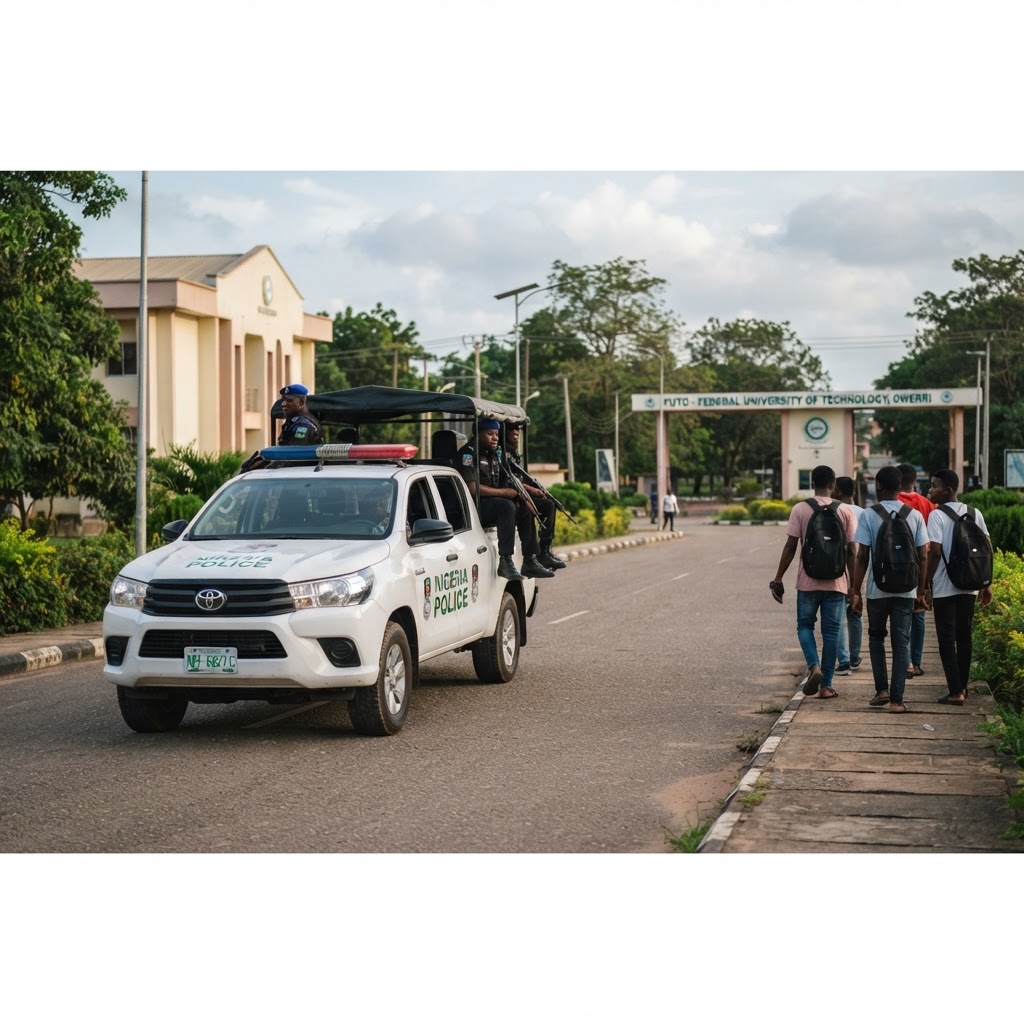
The Federal University of Technology, Owerri (FUTO) is one of Nigeria's most respected tertiary institutions, a cornerstone of southeastern Nigeria's intellectual and economic life. Yet in recent months, the university's environs have become a zone of fear. Students are being abducted. Lives have been lost. Families are alarmed. And now, Imo State's security apparatus is being mobilised in a direct response to what has escalated into a full-blown campus security emergency. This article examines the crisis in detail — its causes, the institutional response, the community dimensions, and what students must do right now to stay safe.
What Sparked the Urgent FUTO Security Crisis?
The deterioration of security around FUTO did not happen overnight. It is the product of months of escalating criminal activity targeting undergraduate students in and around the university's perimeter and the surrounding host communities of Ihiagwa, Obinze, and Eziobodo in Owerri West Local Government Area.
The most alarming recent incident involves the abduction of a female undergraduate student within the school's environs — a kidnapping that sent shockwaves through the student body and ignited widespread public outrage. This was not an isolated incident. Multiple students have been assaulted, robbed, and in some tragic cases, killed along the Obinze-FUTO-Ihiagwa link road, a high-risk transit corridor that thousands of students navigate daily.
The Obinze-FUTO-Ihiagwa corridor has emerged as the most dangerous stretch for students. Poorly lit, flanked by dense bush, and adjacent to informal settlements, this road is exploited by criminal elements who understand students' daily movement patterns. Early morning commutes before 6 AM and late-night returns from off-campus accommodation have proven especially deadly windows of vulnerability.
With FUTO's on-campus accommodation capacity severely limited relative to its student population — a structural deficit that has persisted for years — tens of thousands of students are compelled to rent rooms in private lodges scattered across surrounding communities. This dispersal into under-secured residential zones dramatically amplifies their exposure to kidnapping syndicates and armed criminals.
The Student Union Government (SUG) of FUTO has responded with urgency and moral clarity. SUG President Christopher Chukwuebuka Joseph formally demanded state-level intervention, calling on the Imo State Government, the Nigeria Police Force, and university management to treat the recurring targeted assaults on undergraduates as a state security emergency. His call was direct: the time for incremental measures has passed. Students' lives are actively at risk.
How Are Imo Police and FUTO Authorities Responding?
Following the abduction and mounting pressure from the student community, Imo State Police Commissioner CP Audu Garba Bosso convened an emergency security summit that brought together critical stakeholders. Present at the meeting were representatives of the FUTO Student Union Government, the Area Commander for Owerri, and the Divisional Police Officer (DPO) for the Ihiagwa Division. University management also participated, signalling a degree of institutional coordination that had previously been absent from the security response.
According to reporting by The Sun Nigeria, CP Bosso issued specific tactical deployment mandates following the summit. The Anti-Kidnapping Unit — a specialised policing formation within the Imo State Police Command — has been directed to implement 24-hour motorized patrols along the most vulnerable student access routes. These patrols are not token gestures; they are designed as rolling deterrents intended to disrupt the operational patterns of kidnapping networks.
In addition to motorized patrols, the Commissioner ordered bush-combing operations targeting the thick vegetation flanking the Obinze-Ihiagwa road. Criminal actors have exploited this bush cover to stage ambushes on students, and sustained clearance operations are intended to deny them concealment advantages. Strategic visibility policing — a method involving high-profile uniformed presence at predictable student transit peaks — has also been authorised to project deterrence during the highest-risk movement windows.
Beyond operational deployments, the summit produced a framework for joint institutional coordination. University management, Imo State security agencies, and local vigilante networks are now expected to establish rapid-response early warning communication channels. The command control emergency line — 0803 477 3600 — has been circulated as the primary contact for reporting suspicious activity or emergencies in the FUTO environment.
This is a meaningful step forward, though security analysts and student leaders acknowledge it must be sustained. Past security interventions around Nigerian university campuses have often been reactive and short-lived, peaking in intensity immediately after a crisis and fading as public attention moves on. The challenge for CP Bosso's command is to institutionalise these measures rather than treat them as temporary optics.
This crisis also has parallels with other tertiary education security challenges in Imo State. The IMSU ASUU crisis deepening lecturer-student tensions demonstrates that FUTO is not alone — the structural fragility of tertiary education in Imo State extends beyond security to governance, funding, and student welfare.
Why Are Host Communities Shaping Student Safety?
Understanding the FUTO security crisis requires looking beyond the campus gates into the broader community geography of Owerri West. The communities of Ihiagwa, Eziobodo, and Obinze serve as the de facto residential zones for a large proportion of FUTO's student population. These are rural-urban interface zones — partially urbanised areas where modern commercial activity mingles with under-lit streets, absent drainage infrastructure, and weak formal policing presence.
Private lodge operators in these communities have largely built accommodation blocks without meaningful security infrastructure. There are no perimeter lights, no security gates, no CCTV cameras, and no trained security personnel. Students pay premium rents for structurally adequate rooms but receive no corresponding safety guarantees. This contrasts sharply with the university's own residential halls, which, despite their limitations, offer organised perimeter security, lighting, and structured access control.
Featured Products
Chukwu Abiama Tee
Bold black-and-gold Igbo-pride T-shirt featuring 'Chukwu Abiama' in premium streetwear typography.
₦15,000
Buy NowReverse Type 2 Diabetes & other associated Metabolic Issues using Dr. Jason Fung's Evidence-Based Approach— FMD program for Type 2 Diabetes
A practical fasting and fasting-mimicking programme built on Dr Jason Fung's insulin-resistance principles and ow-glycemic recipes.
₦19,950
Join NowỤmụ Igbo Tee
Classic black T-shirt with bold white 'Ụmụ Igbo' typography — a proud statement of Igbo heritage.
₦15,000
Buy NowNwanne Tee
Washed khaki vintage tee with a faded rust-orange 'Nwanne' stamp badge and palm leaf motif — a nod to kinship and heritage.
₦18,000
Buy NowObodo Tee
Faded denim-blue washed tee with a cream 'Obodo' stamp badge and sun motif, celebrating community roots.
₦18,000
Buy NowEkwe Heritage Tee
Deep indigo tee featuring a fine line-art illustration of a traditional Igbo ekwe drum, inspired by Igbo-Ukwu bronze artistry.
₦18,000
Buy NowIkenga Figure Tee
Forest green tee with a fine line-art illustration of a stylized Ikenga figure.
₦18,000
Buy NowThe socioeconomic disparity in student safety is stark. Wealthier students who can afford better-structured private hostels closer to the main campus gate are relatively more insulated. Students in deeper off-campus settlements — often those from lower-income families who cannot afford premium accommodation — face the highest exposure to criminal targeting. This is not merely a security problem; it is a social equity problem.
Eziokwubundu's community-first philosophy insists that sustainable security solutions must incorporate traditional authority structures. The traditional rulers, town union executives, and autonomous community vigilante networks of Ihiagwa, Eziobodo, and Obinze are not peripheral actors in this crisis — they are essential partners. Community vigilante systems in Imo State have demonstrated effectiveness in intelligence gathering, early warning, and deterrence when properly coordinated with formal police structures.
Local development deficits also play a role. The absence of adequate street lighting, the lack of road infrastructure investment, and the slow pace of community development in Owerri West create the environmental conditions that enable criminal activity. These are issues directly relevant to broader governance questions in Imo State, as explored in our coverage of Imo community development and infrastructure challenges.
What Safety Steps Must FUTO Students Take Now?
While institutional and governmental responses develop, students cannot afford to wait passively. Practical personal safety habits must be adopted immediately and maintained consistently.
Transit discipline is non-negotiable. Students should avoid all movement before 6 AM and after 9 PM, particularly along isolated routes connecting off-campus lodges to the main campus. The Obinze-FUTO-Ihiagwa corridor should not be traversed alone at any time. The buddy system — moving in groups of at least three — must become standard practice for all students navigating these routes.
Students should programme the police emergency line — 0803 477 3600 — into their phones immediately. Equally important is establishing regular check-in routines with family members or trusted fellow students. A missed check-in should trigger an immediate welfare verification call. Parents and guardians should establish clear communication protocols with their children, including defined daily check-in times and agreed emergency response procedures.
The psychological dimension of this crisis is real and must not be minimised. Living under persistent threat of abduction creates chronic anxiety that directly impairs concentration, memory retention, and academic performance. Students experiencing acute anxiety, sleep disturbances, hypervigilance, or trauma responses following incidents should seek support from FUTO's counselling services or contact community mental health resources. The Nigeria Suicide Prevention Initiative and the Mental Health Foundation offer accessible online mental health guidance. Peer support networks and open conversations within student communities can also provide meaningful relief from the psychological burden of insecurity.
Students should also report any suspicious activity — including unfamiliar vehicles surveilling campus access routes or strangers asking about student schedules — directly to the Ihiagwa DPO or the FUTO security office without delay. Timely intelligence has proven decisive in preventing kidnapping operations before they execute.
How Does Security Connect to Educational Prosperity?
The FUTO security crisis is not only a law-enforcement problem. It is a human capital development emergency with direct implications for Imo State's economic future. FUTO graduates fuel southeastern Nigeria's technology, engineering, and entrepreneurship sectors. When students are kidnapped, traumatised, or killed, the state loses productive members of its workforce pipeline before they have had the chance to contribute.
Eziokwubundu's Health + Wealth + Community framework recognises that personal security is the foundational precondition for any form of prosperity. A student who cannot safely walk to campus cannot learn. A student living in chronic fear cannot innovate. The micro-economies of Ihiagwa and Eziobodo — dependent on student spending on food, transportation, and services — also suffer when insecurity drives students out of off-campus accommodation or forces families to withdraw enrolments entirely.
Long-term solutions require structural investments: solar-powered perimeter lighting along the Obinze-FUTO-Ihiagwa corridor, identity screening checkpoints at campus access points, and technology-driven surveillance infrastructure including drone monitoring of high-risk zones during peak movement windows. These are not luxuries — they are baseline requirements for a functioning federal university in the 21st century.
Civic accountability must be sustained. Parents, student leaders, traditional rulers, university management, and state government actors must maintain coordinated pressure to ensure that the emergency security measures announced by CP Bosso are not quietly abandoned once media attention fades. The youth unemployment and community development challenges facing southeastern Nigeria make educational security even more critical — universities like FUTO represent one of the few reliable pathways to economic mobility for young Nigerians in the region.
The FUTO security crisis is a test of institutional will. The police have moved. The university is at the table. Now the real work — sustained, transparent, and community-anchored — must begin.
For verified emergency contact in the FUTO environment, dial the Imo State Police Command control line: 0803 477 3600. Stay informed, stay connected, and prioritise your safety above all.
Stay Informed
Get New Articles in Your Inbox
Subscribe to receive the latest community development, health, and wealth insights from Eziokwubundu.
Newsletter
Practical insights on health, wealth, and community — delivered weekly.