Powered by Obi Mbieri Independent Media Ltd · eziokwubundu.com
$1 = ₦1,331€1 = ₦1,492£1 = ₦1,761APGA Sweeps All 21 Chairmanship Seats in Anambra Local Government Election
On August 29, 2026, Anambra State held its local government elections — and by the following day, the results had told a story that surprised few observers but carries enormous significance for governance, community welfare, and regional politics across the South-East. The All Progressives Grand All...
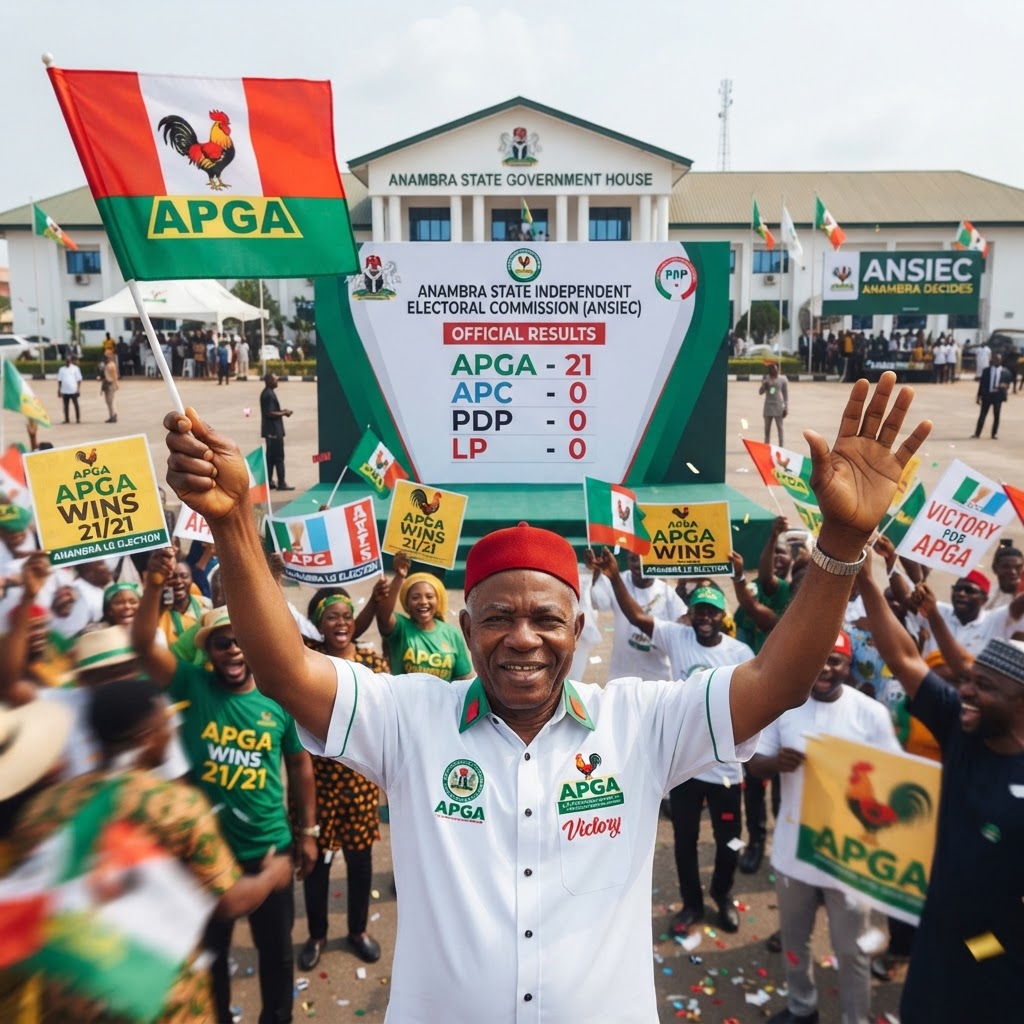
On August 29, 2026, Anambra State held its local government elections — and by the following day, the results had told a story that surprised few observers but carries enormous significance for governance, community welfare, and regional politics across the South-East. The All Progressives Grand Alliance (APGA) won every single chairmanship seat across all 21 local government areas in the state, along with all councillorship positions contested at ward level. The Anambra State Independent Electoral Commission (ANSIEC) formally affirmed the results on Sunday, August 31, 2026, at its headquarters in Awka, sealing what is arguably the most complete electoral sweep in Anambra's recent democratic history.
For Nigerian families, community stakeholders, and entrepreneurs watching from within and outside Anambra, this outcome is not merely a political footnote. Local government elections determine who controls primary healthcare centres, who manages markets and motor parks, who allocates ward-level budgets, and who serves as the first bridge between ordinary citizens and the state. Understanding what happened, how it happened, and what it means for health, wealth, and community development is essential — and that is precisely what this article sets out to provide.
What Were the Official Results of the ANSIEC Declaration?
APGA wins all 21 chairmanship seats
The formal affirmation session held on Sunday, August 31, 2026, at the ANSIEC headquarters in Awka was methodical and deliberate. ANSIEC Chairman, Mrs. Genevieve Osakwe, announced each candidate's name and vote tally individually before declaring them winners — a process designed to project transparency and accuracy. The commission confirmed that APGA candidates had emerged victorious across all 21 local government areas, including every ward-level councillorship seat in the state. According to reporting by the Punch newspaper on the final results, this included all 326 councillorship positions, representing a clean sweep at every tier of local governance.
The statistical dominance of the result is difficult to overstate. APGA was the only party to field candidates in 20 out of 21 local government areas, meaning the party effectively ran unopposed across the vast majority of the state. As Vanguard had earlier reported ahead of the election, this was not a surprise development — the absence of credible opposition fielding had been established well before polling day.
Mrs. Osakwe described the collation process as meticulous, noting that results had already been made public at individual polling units on election day itself, with the Sunday affirmation session serving to formally consolidate what had already been recorded at the grassroots level.
How Did the Electoral Process Unfold Across the 21 LGAs?
Logistics, security, and voter participation
The groundwork for Anambra's August 2026 local government election was laid months in advance. As Voice of Nigeria reported when the election was first scheduled, ANSIEC undertook familiarization tours across all 21 local government areas to assess polling infrastructure, identify logistical gaps, and ensure that adequate materials would be available on election day. Among the procedural requirements imposed was the directive for civil servants seeking to contest to resign their positions at least 30 days before the election — a standard safeguard against the misuse of public office in electioneering.
On election day, August 29, 2026, ANSIEC's official account painted a picture of orderly civic participation. Mrs. Osakwe commended Anambra residents for turning out to exercise their democratic rights and praised the security agencies deployed across the state for maintaining order throughout the exercise. Voting materials were distributed through local government premises across the 21 LGAs, and the commission maintained that collation was transparent and verifiable.
However, the official picture carries a crucial caveat. While ANSIEC described the overall exercise as peaceful, free, fair, and credible, localised reports from at least one LGA told a different story. Sporadic gunshots were alleged near a local government premises during the distribution of voting materials, a detail that stands in uncomfortable contrast to the commission's commendation of security conduct. Voter turnout figures have not been independently published in granular form by the commission, which means that an objective assessment of public participation — beyond the commission's own characterisation — remains difficult to confirm. This limitation is not unique to Anambra; it is a structural challenge that affects the credibility of local government elections across Nigeria more broadly.
Why Are Opposition Groups Questioning Election Integrity?
YPP's allegations from Anambra East
The Young Progressives Party (YPP) was the only opposition party to contest the August 29 election, and it did so only in one local government area — Anambra East. That narrow participation makes its account of events in that LGA all the more significant. Charles Ifediorah, the YPP's Local Government Collation Agent for Anambra East, alleged that the party's members were denied entry into the local government premises where voting materials were being distributed, effectively shutting out opposition monitors from the process. Ifediorah further alleged that security agencies, rather than serving as neutral arbiters, aided what he described as a compromised electoral process. His account also included reports of sporadic gunshots near the local government premises, which he framed as an intimidation tactic.
ANSIEC's official position — that the polls were peaceful, free, fair, transparent, and credible — stands in direct, unresolved contradiction to these allegations. No independent body has formally investigated or verified the YPP's claims, and no official rebuttal specifically addressing Ifediorah's allegations has been issued. This gap matters. In single-party-dominated local elections, the absence of independent verification of turnout data, process integrity, and incident reports erodes long-term political trust — not just in the electoral commission but in the local leadership that emerges from the process. For communities that depend on these leaders to manage their health infrastructure and public resources, trust in how leaders are chosen is not an abstract political concern. It is a practical one.
How Does This Election Impact Local Healthcare?
Health, wealth, and community at the grassroots
For readers of eziokwubundu.com, the significance of this election extends well beyond party politics. Local government chairmen and councillors are the custodians of primary healthcare centres (PHCs) — the most accessible tier of Nigeria's public health system and the first point of contact for millions of Nigerian families seeking preventive care, maternal services, immunisation, and basic treatment. When a ward councillor is engaged and accountable, the PHC in that ward is more likely to be staffed, stocked, and functional. When local leadership is absent or corrupt, that PHC deteriorates — and families bear the cost in illness, mortality, and out-of-pocket expenditure.
The health implications of the APGA sweep in Anambra are therefore direct. The 21 incoming chairmen and hundreds of new councillors will collectively influence how ward-level health budgets are allocated, whether sanitation infrastructure receives attention, and whether community water access is treated as a governance priority. Environmental health — the management of drainage, waste, and food markets — falls squarely within local government jurisdiction, and these factors are critical components of an African-centred wellness framework that accounts for the specific health challenges facing Nigerian communities.
Featured Products
Chukwu Abiama Tee
Bold black-and-gold Igbo-pride T-shirt featuring 'Chukwu Abiama' in premium streetwear typography.
₦15,000
Buy NowReverse Type 2 Diabetes & other associated Metabolic Issues using Dr. Jason Fung's Evidence-Based Approach— FMD program for Type 2 Diabetes
A practical fasting and fasting-mimicking programme built on Dr Jason Fung's insulin-resistance principles and ow-glycemic recipes.
₦19,950
Join NowỤmụ Igbo Tee
Classic black T-shirt with bold white 'Ụmụ Igbo' typography — a proud statement of Igbo heritage.
₦15,000
Buy NowNwanne Tee
Washed khaki vintage tee with a faded rust-orange 'Nwanne' stamp badge and palm leaf motif — a nod to kinship and heritage.
₦18,000
Buy NowObodo Tee
Faded denim-blue washed tee with a cream 'Obodo' stamp badge and sun motif, celebrating community roots.
₦18,000
Buy NowEkwe Heritage Tee
Deep indigo tee featuring a fine line-art illustration of a traditional Igbo ekwe drum, inspired by Igbo-Ukwu bronze artistry.
₦18,000
Buy NowIkenga Figure Tee
Forest green tee with a fine line-art illustration of a stylized Ikenga figure.
₦18,000
Buy NowIf the new APGA leadership in Anambra's 21 LGAs applies a "Health + Wealth + Community" approach to their administration, the potential for improved public health outcomes is real. The question is whether electoral dominance will translate into administrative accountability — or whether the absence of competitive pressure will reduce the urgency of delivery. This is a question that community members, civil society organisations, and platforms committed to evidence-based health education must continue to ask loudly and persistently.
What Does APGA's Dominance Mean for Economic Growth?
Practical prosperity at the local level
Local government chairmen in Nigeria are not merely ceremonial figures. They control the operational management of markets and motor parks — two of the most vital economic ecosystems for entrepreneurs, traders, and middle-class Nigerians in states like Anambra. The chairmen elected on August 29 will determine license fees, market infrastructure maintenance, sanitation levies, and the general environment in which small businesses operate daily. For the entrepreneur in Onitsha selling electronics or the food vendor in Nnewi managing a market stall, the competence and integrity of the local government chairman is an economic variable with direct consequences.
The "Practical Prosperity" angle is highly relevant here. Transparent management of ward-level budgets — including public disclosure of revenue from markets, motor parks, and statutory allocations from the federal government — can unlock significant local economic development. Infrastructure improvements such as road access to markets, reliable waste management, and secure business environments are all functions of effective local administration.
Governor Chukwuma Soludo's broader economic reform agenda for Anambra provides a strategic backdrop. As Coretruth has noted, Soludo has positioned APGA as an "unshakeable political fortress" in the state, and the total LG sweep potentially streamlines the implementation of state-wide development policies by ensuring alignment between state and local executive leadership. However, streamlined governance carries a risk: when there is no competitive opposition to scrutinise budget decisions and development spending, accountability mechanisms must be driven by civil society, the media, and informed communities rather than electoral competition.
For a broader view of how grassroots accountability drives economic outcomes, the principle explored in you cannot understand the global picture without understanding the grassroots is directly applicable — local political outcomes are the foundation on which broader economic progress is either built or undermined.
How Does This Result Shape South-East Politics?
Regional implications and the road to 2027
Anambra's August 2026 LG election results do not exist in a regional vacuum. For neighboring Imo State — with its own political complexities, including the ongoing question of whether Governor Uzodimma's political future involves a Senate bid and what that means for the state — the Anambra outcome serves as a live case study. How ANSIEC managed logistics, handled opposition participation, and responded to dispute allegations will be examined by electoral commissions, opposition parties, and civil society organisations across the South-East as the 2027 general election cycle approaches.
APGA's dominance in Anambra is not a new phenomenon. As The Cable's detailed timeline documents, the party's grip on Anambra began with Peter Obi's landmark courtroom victory and has been sustained through successive administrations to Soludo's current leadership — a near-20-year period of uninterrupted rule. This longevity reflects both genuine organisational strength and the structural difficulty opposition parties face in dislodging a deeply entrenched regional party that has successfully blended traditional Igbo values with modern governance programming.
For the YPP, the APC, and any other party hoping to compete in Anambra's future electoral cycles, the lesson from the 2026 LG election is stark: without the capacity to field candidates in all 21 LGAs, mobilise credible monitors, and protect the integrity of ward-level processes, the political ground cannot shift. The 2027 horizon will test whether any opposition force is willing to build that infrastructure from scratch. Meanwhile, accountability questions raised in communities like those involved in the Achi Mbieri oil money dispute remind us that governance transparency — not just electoral competition — defines the quality of local leadership across the South-East.
How Can Residents Hold New Local Leaders Accountable?
Actionable steps for community-led development
The election is over, but the work of governance has just begun. Anambra residents have a concrete opportunity to shape how their new chairmen and councillors perform. First, engage directly: attend open council sessions, submit written questions about budget allocations, and demand that local government expenditure on health, education, and infrastructure be publicly disclosed. Councillors are ward-level representatives, and residents who approach them with organised, documented community needs are far more likely to receive attention than those who remain passive.
Second, monitor local projects. If a road rehabilitation, market upgrade, or PHC renovation is announced, track its progress. Document delays, abandoned contracts, and incomplete work. Share findings with community organisations and platforms committed to grassroots journalism.
Third, use information platforms. Eziokwubundu and similar outlets committed to evidence-based community reporting exist to bridge the gap between official statements and ground-level reality. A community that reads critically, demands data, and shares information is one that is exponentially harder to neglect. Better living, in the fullest sense, begins with informed citizens who understand that individual health and prosperity are inseparable from the quality of the collective governance around them. Local elections are not the end of democratic participation — they are its beginning.
Sources referenced in this article include official statements from the Anambra State Independent Electoral Commission (ANSIEC), public statements from the Young Progressives Party's Anambra East collation agent, and reporting as available as of August 31, 2026. External references include reporting from Punch Nigeria, Vanguard, Voice of Nigeria, The Cable, and Coretruth.
Stay Informed
Get New Articles in Your Inbox
Subscribe to receive the latest community development, health, and wealth insights from Eziokwubundu.
Newsletter
Practical insights on health, wealth, and community — delivered weekly.
Community Discussion(0)
Leave a Comment
More to Read
You May Also Like

NYSC Abduction: Serving Nigeria at What Cost? Fresh Safety Questions
The Umunoha abduction of prospective NYSC members has renewed concerns over the safety of graduates travelling across Nigeria for national service.

Military Aircraft With 32 Aboard Crashes in Ondo, Rescue Underway
Igbokoda crash: Nigerian Air Force ATR-42 was travelling from Benin to Lagos when contact was lost
Nwanegwo Hands Over Mbaitoli LGA Affairs, Ends Tenure
Hon. Ifunanya Nwanegwo JP has formally handed over the affairs of Mbaitoli Local Government Area to the Director of Administration and General Services (DAGS), marking the conclusion of his tenure as Executive Chairman.
Umunoha NYSC Kidnap: Hideout Located as IED Threat Delays Rescue
Imo security agencies have located the suspected hideout of prospective NYSC members abducted along the Owerri–Onitsha Road, but an alleged improvised explosive device (IED) threat has delayed the planned rescue operation.

Mbaitoli Kidnapping: Why Is the Owerri–Onitsha Road Still Vulnerable?
The latest kidnapping incident along the Owerri–Onitsha Road in Mbaitoli Local Government Area of Imo State has renewed concerns about the safety of one of the major transportation routes connecting communities in Imo and neighbouring states.

Nigeria’s Maternal Death Crisis: Why Are Mothers Dying?
Every day, Nigerian households wait for news from the maternity ward with hope and quiet dread. Too often, that news is heartbreaking. This is the reality behind Nigeria's Maternal Death Crisis: Why Are So Many Mothers Still Dying? — a question every family, community leader, and policymaker must co...

Kidnappers Demand 1 Billion Naira for 20 Corps Members
A chilling ultimatum has gripped Nigerian families this week. Armed abductors are demanding an enormous ransom for the safe return of young graduates travelling to serve their nation. The incident, now widely known as "Kidnappers Give 20 Prospective Corps Members' Families 24 Hours to Pay ₦1bn Ranso...

Can Fasting Help Lower High Blood Pressure? What Experts Say
High blood pressure quietly affects millions of Nigerian adults, often with no obvious warning signs. Many families are now turning to fasting as a natural way to manage it. This article explores the question many are asking: Can Fasting Help Lower High Blood Pressure? What Experts Say reveals surpr...

NNPC Faces Efficiency Scrutiny Over ₦27.76 Trillion Expenses
Nigeria's state oil giant is back in the headlines, and not for a new discovery. NNPC's ₦27.76 Trillion Operating Expenses Raise Efficiency Questions among citizens, analysts, and policymakers alike. The figure is so large it has sparked fresh debate about how national wealth is managed, and the num...

Police Rescue 10 After Gunmen Attack Two Buses in Mbaitoli
Early morning violence on a major Imo State highway sent shockwaves through communities nationwide this week. Families woke up to disturbing news of commuters trapped in a terrifying ordeal after gunmen struck in Mbaitoli, targeting two commercial buses in the hours before dawn. The headline "Police...