Powered by Obi Mbieri Independent Media Ltd · eziokwubundu.com
$1 = ₦1,328€1 = ₦1,528£1 = ₦1,783Will Uzodimma Resign as Governor? Inside His Senate Bid and What It Means for Imo State
For months, a question has been quietly circulating in Owerri's political corridors, across WhatsApp groups in the Orlu Zone, and in the boardrooms of Imo State's business community: is Governor Hope Uzodimma preparing to walk away from Douglas House before his second term officially ends in January...
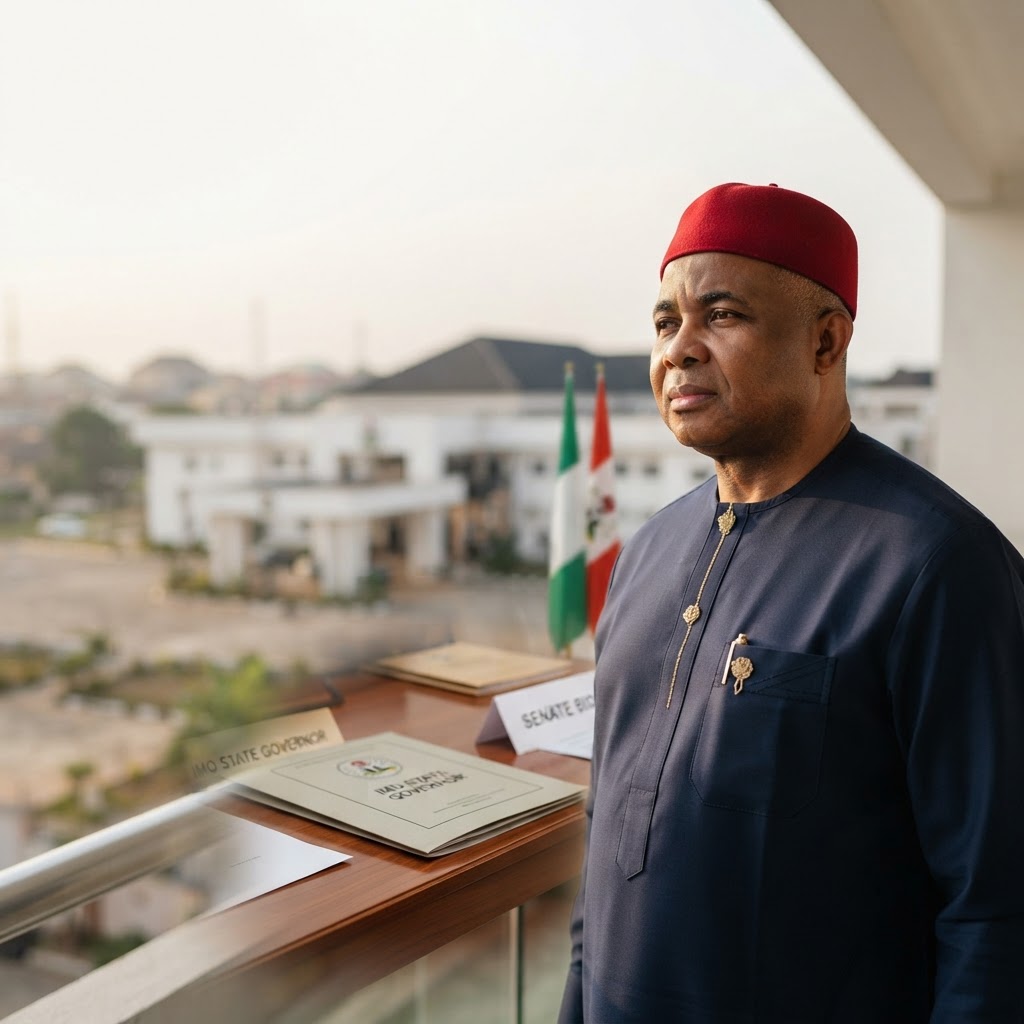
For months, a question has been quietly circulating in Owerri's political corridors, across WhatsApp groups in the Orlu Zone, and in the boardrooms of Imo State's business community: is Governor Hope Uzodimma preparing to walk away from Douglas House before his second term officially ends in January 2028? The answer, based on available evidence, public declarations, and constitutional analysis, is nuanced — not yet, but the architecture for an eventual exit is already being constructed, and it leads directly to the Imo West Senatorial seat in the National Assembly.
This is not idle political gossip. It is a constitutionally grounded, strategically sequenced move with direct consequences for millions of Imo residents — from the bustling markets of Orlu town to the farming communities of Mbaitoli LGA. Understanding what is actually happening requires separating rumour from constitutional reality, and that is precisely what this article sets out to do.
Why Are Uzodimma Resignation Rumors Trending Now?
The speculation did not emerge from thin air. It crystallised the moment Governor Hope Uzodimma publicly declared his intention to contest the Imo West (Orlu) Senatorial seat in the 2027 general elections. That announcement, made on his official social media platforms, triggered an almost immediate wave of political conjecture: if he is running for Senate, does that mean he is leaving Government House?
The tension at the heart of this question is structural. Uzodimma's current gubernatorial term does not expire until January 2028. Yet the 11th National Assembly's successor — the 12th Assembly — will be inaugurated in June 2027, approximately seven months before his governorship formally concludes. This seven-month overlap is where constitutional law and political ambition collide, and it is what makes this story consequential for every Imo family.
From the perspective of the Health + Wealth + Community framework that guides responsible civic engagement, political stability is not a background issue — it is a foundational one. Research consistently links governance uncertainty to reduced investor confidence, slowed infrastructure delivery, and heightened psychological anxiety among residents. For entrepreneurs in Owerri, market women in Orlu, and families awaiting road construction contracts in Mbaitoli, the question of who governs and when directly shapes economic wellness and community security.
What Has the Governor Officially Declared?
Governor Uzodimma's public announcement was unambiguous on one front: he intends to seek the Imo West Senatorial seat in 2027, framing the decision as answering a renewed "call to serve" the people of his senatorial zone. This is not his first time in the Senate. He previously served as Senator for Imo West from 2011 to 2019 before successfully contesting the governorship, meaning a return to the Red Chamber would represent a full-circle moment in a long political career.
The process moved beyond mere announcement. According to reporting by BusinessDay, stakeholders from the Orlu zone, led by Austin Onyedebelu, formally purchased APC expression of interest and nomination forms on the Governor's behalf, signalling that his Senate bid has organisational momentum rather than being a speculative trial balloon. His presentation before the All Progressives Congress (APC) Screening Committee for the National Assembly primary election further cemented the seriousness of the bid.
What the Governor's office has been equally clear about, however, is dismissing speculation of an imminent resignation. Official communications confirmed that Deputy Governor Chinyere Ekomaru continues to serve in full capacity, with no handover process underway. The critical distinction being drawn — deliberately and carefully — is between contesting for a Senate seat (which requires no resignation) and occupying that Senate seat (which does require vacating the governorship). The administration is managing the timeline, not rushing it.
Is It Legal for a Governor to Contest a Senate Seat?
This is arguably the most important question in the entire story, and the answer requires a careful reading of three sections of Nigeria's 1999 Constitution (as amended).
Section 65 establishes the basic qualifications for contesting a Senate seat: Nigerian citizenship, a minimum age of 35, at least a School Certificate-level education, and sponsorship by a registered political party. Crucially, there is no provision in Section 65 that bars a sitting elected official — including a governor — from putting himself forward for a Senate seat. The section's requirements are inclusive, not exclusive.
Section 66, which outlines disqualifications, does include a provision requiring certain public servants to resign at least 30 days before an election. However, as legal commentary published on this matter makes plain, this clause is specifically directed at civil servants — those employed in ministries, departments, and agencies of government — not at elected political office holders. A governor is an elected constitutional officer, not a civil servant within the meaning of Section 66. On this reading, Uzodimma faces no constitutional bar to contesting.
The real constitutional constraint is found in Section 183, which prohibits a governor from holding any other executive office or paid employment while in office. Barrister Abdullahi Jalo and constitutional analyst Bernard Mikko have both provided commentary clarifying the essential distinction: the prohibition applies to occupying a dual office, not to the act of contesting for one. An election result, in itself, does not constitute "holding" another office. Occupation begins at the swearing-in ceremony, not on election night.
Reinforcing this, Section 68(1)(d) of the Constitution provides that a serving senator must vacate his Senate seat if he assumes the role of governor or minister — and the reverse logic is constitutionally symmetrical. Uzodimma can campaign, win, and receive a certificate of return while still governor. The constitutional obligation to vacate one office only crystallises when he is due to be sworn into the other. This is the legal architecture that makes his strategy not just politically astute, but constitutionally defensible.
When Exactly Would He Need to Resign?
The projected timeline for this political transition, based on Nigeria's electoral calendar and constitutional requirements, looks like this: the 2027 general elections are scheduled for February of that year. If Uzodimma contests and wins the Imo West Senatorial seat, his Certificate of Return would not immediately trigger a resignation requirement — winning the election is a legal event separate from occupying the seat.
The critical pressure point arrives with the inauguration of the 12th National Assembly, which is expected in June 2027, following the precedent set by previous Assembly inaugurations. A resignation from the governorship would therefore be anticipated in May or early June 2027, timed to satisfy Section 68(1)(d)'s prohibition on simultaneously holding both offices when the oath of senatorial office is administered.
Featured Products
Chukwu Abiama Tee
Bold black-and-gold Igbo-pride T-shirt featuring 'Chukwu Abiama' in premium streetwear typography.
₦15,000
Buy NowReverse Type 2 Diabetes & other associated Metabolic Issues using Dr. Jason Fung's Evidence-Based Approach— FMD program for Type 2 Diabetes
A practical fasting and fasting-mimicking programme built on Dr Jason Fung's insulin-resistance principles and ow-glycemic recipes.
₦19,950
Join NowỤmụ Igbo Tee
Classic black T-shirt with bold white 'Ụmụ Igbo' typography — a proud statement of Igbo heritage.
₦15,000
Buy NowNwanne Tee
Washed khaki vintage tee with a faded rust-orange 'Nwanne' stamp badge and palm leaf motif — a nod to kinship and heritage.
₦18,000
Buy NowObodo Tee
Faded denim-blue washed tee with a cream 'Obodo' stamp badge and sun motif, celebrating community roots.
₦18,000
Buy NowEkwe Heritage Tee
Deep indigo tee featuring a fine line-art illustration of a traditional Igbo ekwe drum, inspired by Igbo-Ukwu bronze artistry.
₦18,000
Buy NowIkenga Figure Tee
Forest green tee with a fine line-art illustration of a stylized Ikenga figure.
₦18,000
Buy NowIt is worth noting that the 2026 Electoral Act — currently in legislative development — introduces enhanced provisions for electronic transmission of results and tighter campaign finance reporting timelines ahead of 2027. While these reforms are significant for election integrity, they do not create new disqualifications affecting sitting governors seeking legislative office. What they do provide is a more transparent electoral process, which would make any disputed Senate outcome more readily resolvable through electronic audit trails — a safeguard that benefits all parties in what could become a high-profile contest.
This means the effective window of transition for Imo State is not January 2028 but approximately mid-2027 — a meaningful acceleration of the succession clock.
Who Is Ekomaru and How Does Succession Work?
Deputy Governor Chinyere Ekomaru is a seasoned administrator and politician who has served alongside Uzodimma since his second-term inauguration. Under the 1999 Constitution, the succession pathway is constitutionally automatic and unambiguous: upon the resignation or vacation of office by the Governor, the Deputy Governor is immediately sworn in to complete the unexpired term. In this case, that would mean Ekomaru governing Imo State from approximately June 2027 until January 2028 — a period of roughly seven months.
The community-first impact of this transition cannot be understated. Ongoing infrastructure projects in LGAs such as Mbaitoli, and specific communities like Obi-Mbieri, operate within budget cycles and contractor timelines that a mid-term leadership change can disrupt. New administrations, even constitutionally mandated ones, often bring with them a period of policy review that can delay project approvals and contractor payments.
The central risk management question for Imo residents is whether Ekomaru would maintain administrative continuity — honouring existing contracts and programme commitments — or use the transition window for political repositioning ahead of the 2027 gubernatorial cycle. The answer will significantly determine whether the final seven months of the term are a period of steady governance or managed uncertainty.
How Does This Affect the Imo Charter of Equity?
The Imo Charter of Equity is an informal but politically powerful rotational framework that guides gubernatorial succession across the state's three senatorial zones: Imo North (Okigwe), Imo East (Owerri), and Imo West (Orlu). Under this arrangement, the governorship is expected to rotate among the zones to ensure that no single zone monopolises state power for extended periods.
Uzodimma, from the Orlu zone, is serving his second consecutive gubernatorial term, which means the 2027 election would ordinarily be expected to produce a governor from either Okigwe or Owerri zone. His Senate bid and the consequent mid-term handover to Ekomaru — whose own zone identity will influence perceptions of Charter compliance — adds a layer of complexity to what was already a politically charged succession debate. As Vanguard reporting has noted, a so-called "27-year jinx" exists around sitting Imo governors successfully producing successors, adding historical weight to the uncertainty surrounding this transition.
There is also a grassroots economic dimension. The Governor's "One Kindred, One Business" initiative has been positioned as a community wealth-building programme. As we explore in our analysis of how grassroots governance shapes national outcomes, mid-term leadership changes frequently stall locally driven economic programmes as new executives reassess priorities. Whether a Ekomaru administration would sustain this initiative, or allow it to atrophy during the transition window, is a question of direct consequence for Imo's emerging entrepreneurs.
What Does a Senate Return Mean for His National Ambition?
Political observers within the APC's national structure have noted that Uzodimma's Senate ambition likely extends beyond simply representing Imo West. Credible speculation — reported across multiple political correspondents — points toward the Senate Presidency as a longer-term objective, a position that would place him among Nigeria's most influential political figures.
However, significant legislative hurdles exist. Recent amendments to the Senate Standing Orders, as discussed in the context of Senate leadership contests, have introduced provisions that favour continuous legislative service across the 9th and 10th Assembly periods — criteria that a returning senator, rather than a continuous member, would struggle to satisfy. This creates a structural disadvantage for Uzodimma relative to incumbents with unbroken Senate tenure.
His strongest offsetting asset is his chairmanship of the Progressive Governors' Forum (PGF), a platform that provides significant leverage in APC's internal power negotiations. The PGF chairmanship effectively positions him as a broker of gubernatorial political capital — a resource that, in the transactional arena of Nigerian Senate leadership contests, can compensate for gaps in formal legislative seniority. Whether that currency is sufficient to overcome the Standing Orders barrier will depend heavily on the composition of the 12th Assembly.
How Should Imo Residents Prepare for This Transition?
For entrepreneurs, local organisations, and families across Imo State, the practical response to this political moment should be proactive rather than reactive. Business owners who hold contracts with state agencies, or who depend on government-backed programmes, should document current contractual commitments carefully and engage their sector associations now — before any transition creates administrative gaps in approvals and payments.
For those seeking policy clarity, the most reliable sources remain the Independent National Electoral Commission (INEC) and the Imo State Government's official communications channels. The information ecosystem around Nigerian elections is dense with speculation and political messaging; distinguishing evidence-based reporting from partisan noise is itself a practical skill worth developing ahead of 2027. This is also an important period to stay informed about broader national policy changes — including developments like transport cost implications for Imo commuters — that intersect with governance transitions.
At Eziokwubundu, our core conviction remains unchanged: regardless of who occupies Douglas House, the primary driver of community prosperity is an informed, engaged citizenry. Individual awareness, civic participation, and community solidarity are not supplementary to good governance — they are its foundation. The constitution provides the framework; it is the people who must animate it.
Disclaimer: This article draws on Governor Uzodimma's public statements, available reporting on his Senate bid, and published constitutional analysis. Political timelines and electoral schedules may evolve. Readers are encouraged to monitor official INEC and Imo State Government channels for verified updates as the 2027 election cycle progresses.
Stay Informed
Get New Articles in Your Inbox
Subscribe to receive the latest community development, health, and wealth insights from Eziokwubundu.
Newsletter
Practical insights on health, wealth, and community — delivered weekly.
Community Discussion(0)
Leave a Comment
More to Read
You May Also Like

How to start vegetable farming with small capital Nigeria
Vegetable farming is one of the most accessible and consistently profitable agricultural ventures available to Nigerians today. Whether you are a young graduate seeking a sustainable livelihood, a household looking to reduce food costs, or an entrepreneur exploring low-risk entry points into agricul...
Building Wealth with Ajo and Esusu
The journey to financial independence in Nigeria does not always require a bank loan or a complex stock portfolio. For centuries, our ancestors utilized communal structures to fund life’s greatest milestones. From the bustling markets of Lagos to the quiet villages of the southeast, Ajo and Esusu ha...

KoboTutor: How a Nigerian EdTech Platform Is Bringing Personalised Learning to Students
Nigeria's education sector stands at a crossroads. With over 13 million out-of-school children and chronic underfunding in public education, the pressure on students who do attend school is immense. For the millions sitting JAMB, WAEC, and NECO examinations each year, the stakes could not be higher....

Forging Nigerian Prosperity Through Wellness and Capital
Achieving total well-being requires a balanced approach to physical health(/article/elevating-nigerian-livelihoods-through-health-and-finance), financial independence, and social responsibility. For Nigerians at home and abroad, this journey involves blending traditional wisdom with modern economic ...

Mbaitoli’s Primary Healthcare Centres: Are They Properly Staffed?
Why Does Staffing in Mbaitoli's PHCs Matter? At eziokwubundu.com, we believe that health, wealth, and community are inseparable pillars of lasting prosperity. Nowhere is this triangle more visibly tested than in Mbaitoli Local Government Area, one of Imo State's most densely populated LGAs, where th...
112 Federal Unity Colleges Face Possible Shutdown
Nigeria's federal secondary school system stands at a critical crossroads. As the first term of the 2024/2025 academic year was set to commence, a dramatic standoff between the Federal Government and education workers erupted into a crisis threatening the academic futures of hundreds of thousands of...

Diphtheria in Nigeria: How Prepared Are Imo’s Health Centres?
Nigeria is facing its worst diphtheria resurgence in decades. What began as a concentrated outbreak in the northern states has evolved into a national public health emergency, with confirmed cases now appearing across regions once considered low-risk. For families in Imo State and across the Southea...

German experts beginning technical support for Imo hospitals
Imo State's public healthcare system has taken a significant step forward with the commencement of a structured technical partnership between the Heartland Hospitals Management Corporation (HHMC) and Integromed Germany. This collaboration signals a deliberate move away from ad hoc healthcare managem...

Nigerian Stock Market Loses ₦1.9 Trillion to Profit-Taking
The Nigerian Exchange Limited (NGX) recorded one of its sharpest short-term contractions of the year as coordinated profit-taking wiped approximately ₦1.9 trillion from total equities market capitalisation across multiple trading sessions. For millions of Nigerian families, pension holders, and reta...

Dangote Refinery Share Offer: What Does It Mean for Ordinary Nigerian Investors?
For the first time in a generation, ordinary Nigerians have a genuine opportunity to own a direct stake in the country's most significant industrial asset. The Dangote Petroleum Refinery's N2.15 trillion public share offer is not merely a capital markets event — it is a defining moment for Nigerian ...