Powered by Obi Mbieri Independent Media Ltd · eziokwubundu.com
$1 = ₦1,325€1 = ₦1,539£1 = ₦1,791Wike vs Uzodimma: 5 Things to Know About the Latest Political Clash
Nigeria's political landscape is rarely calm, but few rivalries in recent memory have generated as much heat as the ongoing clash between FCT Minister Nyesom Wike and Imo State Governor Hope Uzodimma. What began as subtle administrative friction has evolved into a full-throated public feud that thre...
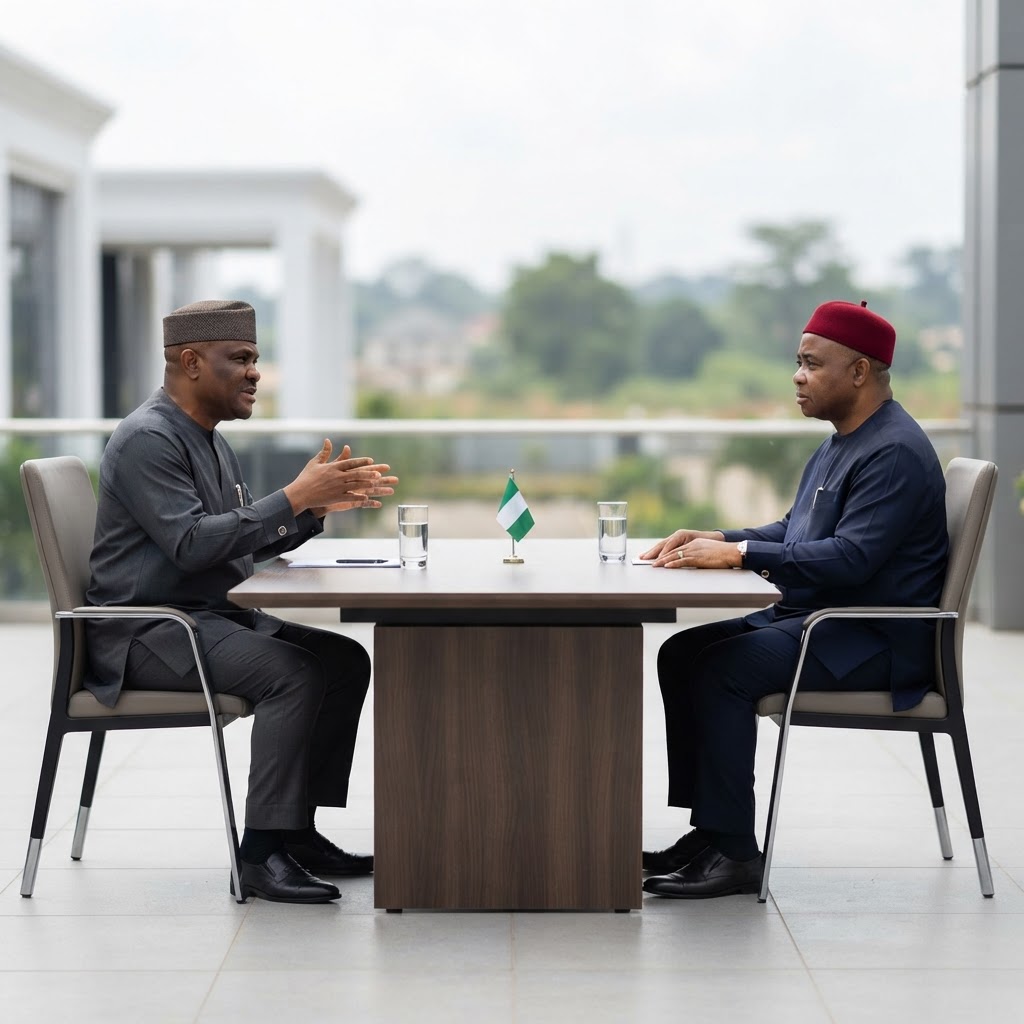
Nigeria's political landscape is rarely calm, but few rivalries in recent memory have generated as much heat as the ongoing clash between FCT Minister Nyesom Wike and Imo State Governor Hope Uzodimma. What began as subtle administrative friction has evolved into a full-throated public feud that threatens to reshape political alignments ahead of the 2027 general elections. For Nigerian families, entrepreneurs, and community leaders watching from the sidelines, this clash is more than elite drama — it carries real consequences for governance, economic stability, and grassroots development.
This article breaks down the five most critical dimensions of the Wike-Uzodimma rivalry, drawing on documented events, public statements, and policy actions that define this volatile relationship. Whether you are a diaspora investor monitoring Nigerian real estate, a youth professional tracking political shifts, or a community leader trying to insulate your neighbourhood from top-level political turbulence, understanding this clash is essential for informed decision-making.
What Sparked the 2026 Wike-Uzodimma Fallout?
Understanding the roots of a very public rift
The latest chapter of the Wike-Uzodimma feud erupted into full public view during a media chat in September 2026, when FCT Minister Nyesom Wike made explosive accusations against Governor Hope Uzodimma of Imo State. According to Vanguard News, Wike openly declared that both the Imo and Kwara governors were waging a political "war" against him — a stunning allegation given that all three figures operate within or alongside the ruling APC political structure. Wike expressed indignation at the perceived ingratitude, insisting that he had previously extended political goodwill to both governors, only to be repaid with hostility.
This verbal broadside, however, did not emerge from a vacuum. As far back as January 2025, Wike had already set a combative administrative tone by revoking FCT land allocations belonging to Uzodimma, Governor Douye Diri of Bayelsa, House Speaker Tajudeen Abbas, and approximately 565 other titleholders. That land revocation — framed publicly as a regulatory and anti-corruption measure — was widely interpreted by political observers as a targeted administrative strike, weaponising Wike's FCT ministerial powers against perceived political opponents. The message was unmistakable: in Wike's Abuja, land titles are not merely bureaucratic instruments; they are chips in a high-stakes political game.
From a community development standpoint, this pattern of elite power play is deeply troubling. At Eziokwubundu, our "Community First" philosophy recognises that when powerful leaders direct their energy toward personal vendettas rather than policy delivery, it is always the grassroots that suffers. Stalled development projects, disrupted urban planning, and delayed governance decisions trickle down to affect ordinary families, small business owners, and local institutions that depend on stable administrative environments to grow and thrive. The Wike-Uzodimma rift is not merely gossip — it is a governance crisis with tangible community costs.
How Does This Clash Shape the 2027 Elections?
South-East and South-South power at stake
Beneath the personal animosity lies a cold, calculated struggle for political dominance. Both Wike and Uzodimma are positioning themselves as indispensable gatekeepers of President Bola Tinubu's 2027 re-election campaign — Wike wielding influence across the South-South, and Uzodimma asserting control over South-East mobilisation. This rivalry, as reported by multiple Nigerian outlets including Independent Newspaper Nigeria, is fundamentally a battle over who controls the political machinery in these two geopolitically critical regions.
Wike has repeatedly insisted, with characteristic bluntness, that his personal grievances with APC governors will not distract him from the primary mission of securing Tinubu's re-election. He positions himself as a loyalist whose delivery record in the FCT — including visible infrastructure projects — grants him unrivalled credibility as a political mobiliser. Uzodimma, on the other hand, has been building his own parallel network across Igbo-speaking states, presenting himself as the authentic face of South-East political alignment with the Tinubu administration.
The consequences for everyday Nigerians are significant and often underappreciated. Political unpredictability at the regional level directly disrupts the policy environments that local entrepreneurs and middle-class families depend upon. When governors and ministers are locked in rivalry rather than coordination, budget implementation slows, federal-state collaboration breaks down, and investors hesitate. For middle-class Nigerians already navigating economic headwinds — as explored in our coverage of the ₦300,000 minimum wage demand — such political instability adds yet another layer of economic uncertainty that is impossible to ignore.
What Are the Economic Costs of This Political Feud?
Hidden damage to wealth creation and investment
Political feuds between powerful officials rarely stay confined to press conferences and media chats. They generate real economic damage, and the Wike-Uzodimma clash is no exception. The January 2025 FCT land revocations represent perhaps the most direct economic intervention linked to this rivalry. Land ownership in the FCT is a major asset class for middle-class Nigerians, diaspora investors, and civil servants who have spent decades building equity in Abuja properties. When ministerial authority can revoke those titles — even provisionally or legally justifiably — it sends a chilling signal to property markets and undermines diaspora real estate confidence at precisely the moment Nigeria needs foreign remittance investments.
Contrast this administrative instability with Uzodimma's earlier economic narrative. As far back as 2022, the Imo governor was publicly celebrated for fiscal discipline measures including civil service reforms that reportedly saved the state government approximately N2 billion monthly in payroll costs, alongside infrastructure rehabilitation programmes that drew national commendation. These were meaningful economic achievements — the kind of governance gains that, if sustained and replicated, could genuinely improve living standards in Imo State. Yet when governors are consumed by political warfare, the bandwidth required to sustain such reforms inevitably narrows.
Featured Products
Chukwu Abiama Tee
Bold black-and-gold Igbo-pride T-shirt featuring 'Chukwu Abiama' in premium streetwear typography.
₦15,000
Buy NowReverse Type 2 Diabetes & other associated Metabolic Issues using Dr. Jason Fung's Evidence-Based Approach— FMD program for Type 2 Diabetes
A practical fasting and fasting-mimicking programme built on Dr Jason Fung's insulin-resistance principles and ow-glycemic recipes.
₦19,950
Join NowỤmụ Igbo Tee
Classic black T-shirt with bold white 'Ụmụ Igbo' typography — a proud statement of Igbo heritage.
₦15,000
Buy NowNwanne Tee
Washed khaki vintage tee with a faded rust-orange 'Nwanne' stamp badge and palm leaf motif — a nod to kinship and heritage.
₦18,000
Buy NowObodo Tee
Faded denim-blue washed tee with a cream 'Obodo' stamp badge and sun motif, celebrating community roots.
₦18,000
Buy NowEkwe Heritage Tee
Deep indigo tee featuring a fine line-art illustration of a traditional Igbo ekwe drum, inspired by Igbo-Ukwu bronze artistry.
₦18,000
Buy NowIkenga Figure Tee
Forest green tee with a fine line-art illustration of a stylized Ikenga figure.
₦18,000
Buy NowFor the practical-minded Nigerian — entrepreneurs, investors, and professionals — the lesson here is actionable. The "Practical Prosperity" principle demands that wealth-building strategies must be insulated from political shocks. This means diversifying investments across asset classes and geographies rather than concentrating in politically exposed property markets; building liquid savings buffers before committing to capital-intensive projects; and consulting credible financial and legal advisors before making major land or property purchases in FCT or state-governed zones. You can also explore government grants for Nigerian small businesses in 2026 as a low-risk pathway to capital that is less vulnerable to political turbulence.
Why Has This Relationship Always Been Volatile?
A timeline of accusations and partisan conflict
The current phase of the Wike-Uzodimma rivalry did not materialise overnight. Its roots stretch back through years of partisan positioning, public insults, and ideological conflict. In 2022, Wike — then still operating as a prominent PDP governor of Rivers State — made a remarkable intervention in Imo State politics, openly telling Imolites that allowing Uzodimma to return to power would be "their greatest mistake," citing what he described as catastrophic governance failures and an administration that had betrayed the trust of Imo people. This was an extraordinary statement for a sitting governor to make about a peer, and it illustrated the depth of personal and political contempt Wike held for Uzodimma at the time.
Go back even further to 2020, and you find Wike publicly berating Uzodimma for making what he described as "false allegations" against the PDP — a telling confrontation that reveals a long-standing ideological and partisan divide that existed well before either man found himself operating within overlapping political structures. These historical incidents matter because they establish that the current clash is not a new conflict triggered by 2026 political calculations. It is a relationship that has never been stable, cooperative, or built on genuine mutual respect.
From the perspective of "Traditional Values, Modern Progress" — a core lens at Eziokwubundu — this chronic political animosity represents a failure to honour African communal governance principles. Traditional Igbo and Ijaw leadership cultures, for instance, place enormous value on conflict resolution through structured dialogue, elder mediation, and communal consensus. As examined in our analysis of Obi-Mbieri Traditional Leadership and community governance, authentic African leadership models prioritise collective harmony over individual dominance. The persistent volatility between these two political leaders signals a troubling departure from those foundational values. For the Imo political landscape in particular, the implications extend well beyond 2027 — as our reporting on why the 2028 governorship battle is already taking shape makes clear.
How Can Communities Survive Political Instability?
Grassroots strategies for resilience and growth
When Wike and Uzodimma trade accusations on national television, it can feel remote from the daily lives of communities in Owerri, Abuja's satellite towns, Port Harcourt, or any of the hundreds of localities caught in the political crossfire. But the impact is anything but abstract. As reported by The Guardian Nigeria, the political rift between these two leaders is directly slowing Tinubu's 2027 campaign coordination in the South-East and South-South — regions that require unified political messaging to deliver the voter mobilisation the presidency urgently needs. While politicians negotiate their personal survival, stalled policy implementation and diverted public resources leave ordinary communities without promised infrastructure, healthcare investments, and development programmes.
The prescription for community resilience begins with structural civic engagement. Community leaders and local organisations must develop their own development agendas that are not dependent on state or federal political cycles. This means establishing community development associations with independent funding streams, engaging local government authorities directly rather than relying on state patronage networks, and building relationships with international NGOs, diaspora groups, and civil society organisations that can provide technical and financial support irrespective of which political faction holds power.
On the health front, toxic election cycles generate measurable stress, anxiety, and community division. Community leaders and health-conscious individuals should consciously protect their mental wellness during politically charged periods — limiting toxic media consumption, investing in community dialogue spaces, and prioritising physical health routines that reinforce psychological stability. The "Health + Wealth + Community" ecosystem that defines Eziokwubundu's mission recognises that personal wellbeing and collective prosperity are inseparable. Just as we encourage readers to address physical health proactively — as in our guidance on treating malaria with local Nigerian herbs — mental health during political crises deserves the same deliberate attention.
Finally, building cooperative wealth structures — cooperative savings groups, community investment clubs, and skills-sharing networks — provides a layer of economic insulation from political shocks. When political leaders fail their communities, self-organised economic systems ensure that growth does not grind to a halt.
Conclusion
The Wike-Uzodimma clash is a defining political story of 2026, but its significance extends far beyond the two men at its centre. For Nigerian families, entrepreneurs, diaspora investors, community leaders, and youth professionals, this feud is a case study in how elite political conflicts produce systemic economic and social costs at the grassroots level. Understanding the roots of this rivalry, its 2027 electoral stakes, its economic consequences, and its deep historical volatility is not merely an academic exercise — it is essential political literacy for anyone committed to building prosperity in Nigeria's current environment.
At Eziokwubundu, we believe that knowledge is the most reliable foundation for community progress. Political storms will come and go, but communities that are informed, organised, and strategically resilient will outlast any elite rivalry. The Wike-Uzodimma feud is a reminder that waiting for politicians to deliver community salvation is not a strategy. Building it from the ground up — through health, wealth, and community solidarity — always has been.
Stay Informed
Get New Articles in Your Inbox
Subscribe to receive the latest community development, health, and wealth insights from Eziokwubundu.
Newsletter
Practical insights on health, wealth, and community — delivered weekly.