Powered by Obi Mbieri Independent Media Ltd · eziokwubundu.com
$1 = ₦1,332€1 = ₦1,498£1 = ₦1,775Imo’s ₦1.47 Trillion Budget: Where Did the Money Go in the First Half of 2026?
By Eziokwubundu Editorial Desk --- Imo State entered 2026 carrying one of its most ambitious fiscal plans in recent memory — a ₦1.47 trillion annual budget designed to fund roads, schools, hospitals, security operations, and human capital development across the state's communities. The announcement ...
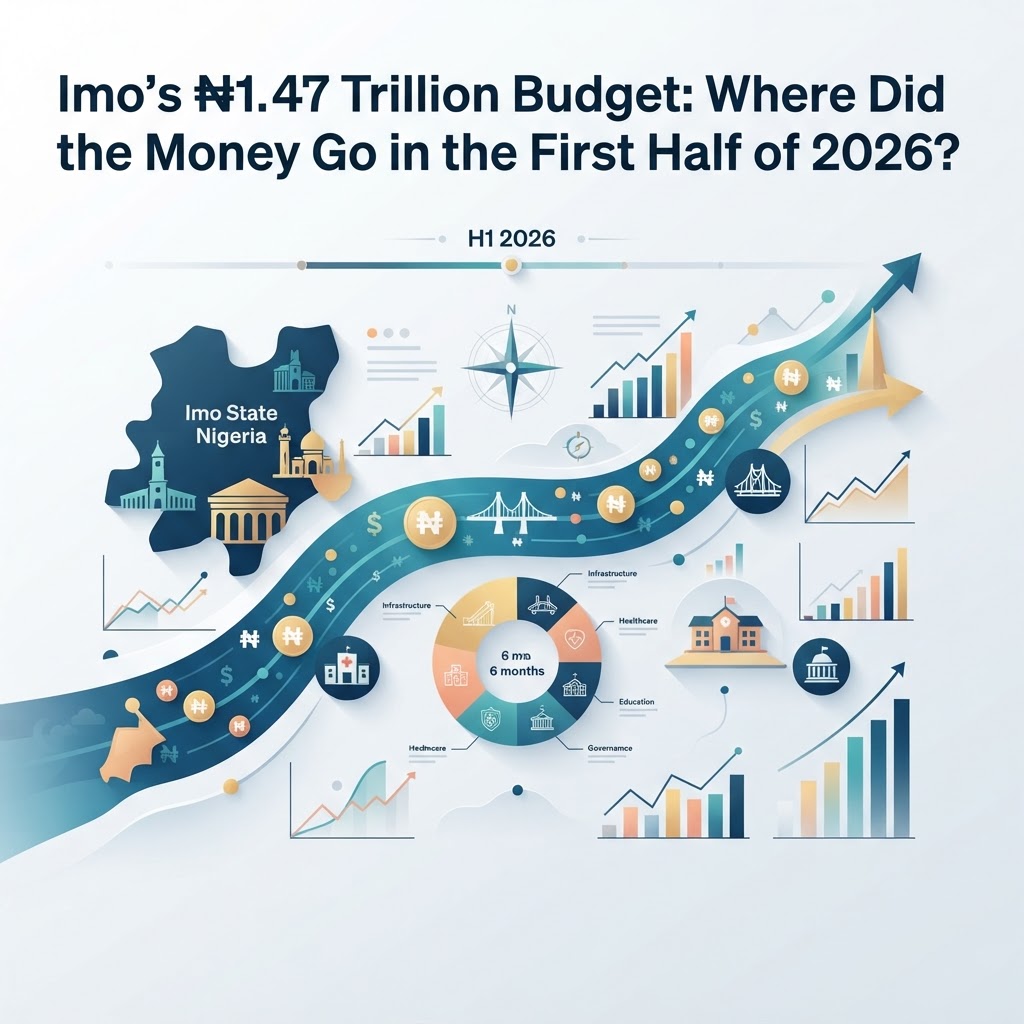
Imo State entered 2026 carrying one of its most ambitious fiscal plans in recent memory — a ₦1.47 trillion annual budget designed to fund roads, schools, hospitals, security operations, and human capital development across the state's communities. The announcement drew significant public attention, with many residents and stakeholders expecting visible improvements in infrastructure and social services within the year.
Six months later, the state's second-quarter budget performance report tells a more complex story. Total expenditure between January and June 2026 stood at ₦212.10 billion — approximately 14.4 per cent of the full-year budget. Meanwhile, critical sectors such as education and health received a fraction of their capital provisions, and several ministries recorded zero capital releases entirely.
This report examines the Q2 data in detail, separates budget projection from actual liquidity, and identifies the accountability questions that Imo residents, community leaders, diaspora Nigerians, and civil society organisations should now be asking. As part of Eziokwubundu's commitment to actionable community journalism and transparent civic knowledge, this analysis draws directly from the Imo State 2026 Q2 Budget Performance Report and the review published by Premium Times.
What Did Imo Actually Earn vs. Its ₦1.47 Trillion Target?
Projection vs. Liquidity: A Critical Distinction
One of the most important points for any discussion of this budget is understanding what the ₦1.47 trillion figure actually represents. It is an annual fiscal projection — a revenue and expenditure plan — not a cash reserve sitting in a government vault awaiting disbursement. Conflating the two is a common mistake that distorts public debate and misplaces civic pressure.
The actual revenue recorded by the Imo State Government between January and June 2026 was ₦312.49 billion, representing 21.3 per cent of the annual projection. That figure is the real financial foundation from which government operations and capital releases were funded during the first half of the year.
Breaking down that ₦312.49 billion reveals several important components. Federation Account Allocation Committee (FAAC) transfers — the monthly federal revenue sharing disbursements from Nigeria's central pool — contributed approximately ₦156.82 billion, making them the single largest revenue source. The state's opening balance carried forward from 2025 added ₦120 billion to the pool. Internally Generated Revenue (IGR), which reflects the state's own tax and non-tax collections, contributed ₦20 billion — a figure that raises questions about the depth and efficiency of Imo's domestic revenue architecture. Loans accounted for ₦13.2 billion and aids and grants contributed ₦2.4 billion.
This revenue picture immediately reframes the core accountability question. The issue is not why Imo did not spend ₦1.47 trillion in six months — that was never feasible given the liquidity structure. The more meaningful question is: how was the ₦312.49 billion that actually became available allocated, cash-backed, and released to implementing ministries? That is the lens through which the second-quarter figures must be assessed.
How Was the ₦212.10 Billion Expenditure Split?
Capital vs. Recurrent: Reading the Numbers Right
The Q2 report shows that Imo State spent a total of ₦212.10 billion between January and June 2026. At first reading, the internal distribution of that spending appears encouraging: recurrent expenditure — covering salaries, overheads, administrative costs, and other ongoing obligations — accounted for ₦44.58 billion, while capital expenditure, the spending directed at infrastructure and development projects, reached ₦167.52 billion. The 79 per cent capital share, if taken at face value, suggests a government oriented toward physical development.
However, the overall implementation rate of 14.4 per cent against the full-year budget demands careful interpretation. In an ideally paced fiscal year, the halfway point would reflect expenditure in the range of 50 per cent of annual targets. A 14.4 per cent rate at mid-year is, at minimum, a signal that implementation has lagged significantly behind schedule. That said, budget execution rarely follows a linear monthly rhythm. Large capital contracts often concentrate payments toward the third and fourth quarters as construction milestones are verified, procurement approvals are finalised, and contractor invoices are certified.
The 14.4 per cent figure should therefore be treated as a serious warning signal, not an automatic verdict of failure. The critical assessment must wait until the full-year data is available.
There is also the question of the ₦100.39 billion difference between total recorded revenue (₦312.49 billion) and total expenditure (₦212.10 billion). This gap should not be automatically characterised as unspent cash sitting in a government account. Government budget accounting involves technical treatments including capital receipts, loan drawdowns, committed expenditure awaiting payment, restricted fund classifications, and timing differences between when income is received and when liabilities are settled. This is consistent with internationally recognised public financial management standards, including frameworks promoted by the International Monetary Fund's Government Finance Statistics Manual. A transparent accounting of how the balance was treated in Imo's books is what the public is entitled to demand.
Why Did Education and Health Receive Under 6%?
Capital Starvation in the State's Social Backbone
The sector-by-sector figures expose a significant divergence between what was budgeted and what was actually released in the two areas most directly connected to human capital development and long-term community prosperity.
The Ministry of Education had a capital provision of approximately ₦60.63 billion for the period. Actual capital release during the first six months of 2026 stood at ₦3.39 billion — roughly 5.6 per cent of the provision. For Imo's school-age population, its autonomous communities, and the families who depend on public education as a primary vehicle for social mobility, that figure demands scrutiny. Which school buildings were rehabilitated? Which classrooms, laboratories, and teachers' facilities were funded? Which contractors received payments, and what has been delivered on site? These are not hypothetical questions; they are standard public expenditure accountability inquiries.
The Ministry of Health tells a similar story. With a capital provision of ₦52.66 billion, the ministry received only ₦2.58 billion in capital releases — approximately 4.9 per cent. In a state where primary healthcare infrastructure, community health centres, and preventive health capacity remain pressing concerns, a nearly 95 per cent shortfall against capital provision within six months raises immediate questions about project readiness, procurement completion, and cash-backing decisions.
Viewed through Eziokwubundu's Health + Wealth + Community framework, these figures carry consequences that reach far beyond administrative percentages. Under-resourced schools produce students with weaker foundations, reducing future workforce productivity. Under-equipped health facilities push households toward higher out-of-pocket medical costs, draining family savings and restricting small business resilience. As our coverage of the Mbieri infrastructure gap and the pressure on public project delivery has highlighted, communities that lack functional infrastructure carry an invisible tax on every family's economic potential. The data from Q2 2026 suggests this tax is still accumulating.
Which Ministries Recorded Zero Capital Releases?
Complete Capital Freezes Across Key Departments
Beyond the under-performing education and health sectors, the Q2 report identifies several ministries and government institutions where capital releases were recorded at exactly zero — meaning no capital disbursements reached those areas during the entire January-to-June period.
The Ministry of Environment and Sanitation carries perhaps the most consequential zero. The ministry had a ₦10 billion capital budget provision for 2026. It received no capital release in the first half of the year. The implications are significant for communities dealing with urban waste accumulation, inadequate drainage systems, and flood vulnerability — challenges that directly affect public health and household safety across Imo's towns and rural settlements. Zero capital release does not necessarily mean zero ministry activity; recurrent budgets can fund some operations. But it does mean that no new capital project funds were disbursed under that allocation during the review period.
Featured Products
Chukwu Abiama Tee
Bold black-and-gold Igbo-pride T-shirt featuring 'Chukwu Abiama' in premium streetwear typography.
₦15,000
Buy NowReverse Type 2 Diabetes & other associated Metabolic Issues using Dr. Jason Fung's Evidence-Based Approach— FMD program for Type 2 Diabetes
A practical fasting and fasting-mimicking programme built on Dr Jason Fung's insulin-resistance principles and ow-glycemic recipes.
₦19,950
Join NowỤmụ Igbo Tee
Classic black T-shirt with bold white 'Ụmụ Igbo' typography — a proud statement of Igbo heritage.
₦15,000
Buy NowNwanne Tee
Washed khaki vintage tee with a faded rust-orange 'Nwanne' stamp badge and palm leaf motif — a nod to kinship and heritage.
₦18,000
Buy NowObodo Tee
Faded denim-blue washed tee with a cream 'Obodo' stamp badge and sun motif, celebrating community roots.
₦18,000
Buy NowEkwe Heritage Tee
Deep indigo tee featuring a fine line-art illustration of a traditional Igbo ekwe drum, inspired by Igbo-Ukwu bronze artistry.
₦18,000
Buy NowIkenga Figure Tee
Forest green tee with a fine line-art illustration of a stylized Ikenga figure.
₦18,000
Buy NowThe Ministry of Humanitarian Affairs, which had ₦1 billion in capital provisions, and the Ministry of Sports, with approximately ₦1.31 billion budgeted, also recorded zero capital releases. The combined absence of these releases affects youth welfare, community recreation infrastructure, and the state's capacity to support vulnerable populations.
Several central governance institutions also showed the same pattern. According to the Q2 report, the combined capital provisions of the Head of Service, Office of the Auditor-General, Civil Service Commission, Local Government Service Commission, and the Imo State Independent Electoral Commission (ISIEC) totalled approximately ₦3.78 billion — with no capital release recorded during the period. Notably, the absence of capital funding for the Auditor-General's office raises questions about oversight capacity at the precise moment when public expenditure scrutiny matters most.
Understanding these figures requires distinguishing between capital budget freezes — where project funds were not released — and the day-to-day administrative functions of these institutions, which may have continued under recurrent budget lines. Precision in this distinction prevents both alarmism and complacency.
What Did ₦2.19 Billion in Security Spending Deliver?
Accountability Without Compromising Operations
Security was one of the few areas where Q2 expenditure showed clear movement. Imo State spent approximately ₦2.19 billion on security-related activities during the first half of 2026. That figure breaks into two broad categories: approximately ₦877.5 million attributed to security votes, including operations, and approximately ₦1.31 billion directed at security-related services.
This spending occurred against a documented backdrop of security incidents across the state during the period, including reports of killings, abductions, attacks on communities, and incidents targeting government facilities. The security context matters when assessing the ₦2.19 billion — a state managing active security challenges cannot be assessed against the same expenditure expectations as one operating in stable conditions.
At the same time, security spending is not exempt from accountability. The appropriate civic framework here is not to demand disclosure of tactical operational details — doing so could legitimately compromise ongoing security work. The reasonable public expectation is different: broad categorical reporting of what types of security services were funded, what the budget provision was versus what was released, and what independent legislative oversight mechanisms were applied to these disbursements.
The prosperity connection matters here. Rural farmers, local traders, and small entrepreneurs across Imo's autonomous communities cannot invest, expand, or trade confidently without baseline security. As our earlier analysis of how local accountability shapes community development demonstrated, the effectiveness of security expenditure is ultimately measured not by amounts spent but by whether daily life and economic activity become demonstrably safer. The ₦2.19 billion figure becomes meaningful only when mapped against actual security outcomes — a measurement that deserves formal public reporting.
How Can Citizens Track Money from Budget to Project?
A Practical Accountability Framework for 2026
The Q2 report provides numbers. Numbers alone do not tell residents whether public funds produced public value. The next phase of citizen engagement must move from reading budget documents to demanding project-level evidence. This is the practical step that transforms civic awareness into genuine accountability.
A workable tracking framework for residents, journalists, civil society organisations, and diaspora Nigerians follows five linked stages: Approved Budget → Treasury Release → Actual Payment → Physical Project Site → Verifiable Completion. At each stage, a different piece of documentation should exist. Budget lines should match treasury release records. Release records should correspond to contractor payment receipts. Payments should correspond to physical construction or service delivery. And completion should be independently verifiable on the ground.
For the second half of 2026, specific disclosures are worth demanding. The ₦167.52 billion recorded as capital expenditure in Q2 should be supported by an itemised, publicly accessible contractor database — listing project names, locations, approved contract sums, amounts paid to date, and expected completion dates. Road infrastructure deserves particular attention, given how heavily communities depend on functional road networks for trade, healthcare access, and school attendance. You can see how this infrastructure deficit affects communities in earlier Eziokwubundu reporting on the Umuahii–Obi-Mbieri connectivity crisis.
The Imo State Government has already made both the approved 2026 budget and the Q2 performance report publicly available through its official portal, which represents a meaningful baseline for transparency. The Imo State Government's official budget portal provides the foundational documents from which civil society scrutiny should begin. The International Budget Partnership's Open Budget Survey framework also offers civil society groups a global accountability benchmark against which to measure state-level fiscal transparency.
It is critical to be precise: the Q2 figures do not, on their own, establish that funds were misappropriated. There is no basis in aggregate performance statistics to make that allegation. What the figures do establish is a significant implementation gap — particularly in education, health, and environment — that demands explanation, monitoring, and measurable improvement in the second half of the year. This is a matter our platform has consistently raised, including in our coverage of the Imo ₦350 million NBA controversy, where questions about fiscal transparency and public accountability deserve structured, evidence-based answers rather than speculation.
Key Figures at a Glance
Item January–June 2026 Annual budget ~₦1.47 trillion Revenue recorded ₦312.49 billion Revenue performance 21.3% Total expenditure ₦212.10 billion Overall budget performance 14.4% Recurrent expenditure ₦44.58 billion Capital expenditure ₦167.52 billion Security-related spending ₦2.19 billion Education capital provision ₦60.63 billion Education capital release ₦3.39 billion (5.6%) Health capital provision ₦52.66 billion Health capital release ₦2.58 billion (4.9%) Environment capital provision ₦10 billion Environment capital release ₦0 Sources: Imo State 2026 Q2 Budget Performance Report; Premium Times review.
Conclusion
The Imo State 2026 budget story at the halfway mark is one of ambitious projection, constrained liquidity, and uneven delivery. The ₦1.47 trillion headline figure was never a cash balance — it was a planning target. The real story lies in what happened to the ₦312.49 billion that was actually recorded as revenue, and whether the ₦212.10 billion expended in six months produced commensurate, visible improvements in roads, schools, hospitals, and security across the state's communities.
The second half of 2026 is now the critical testing period. Education received just 5.6 per cent of its capital provision. Health received 4.9 per cent. Environment received nothing. These figures must either be corrected through accelerated, transparent second-half releases or explained through credible public documentation of why the timeline shifted.
For Nigerian families, community leaders, entrepreneurs, and diaspora stakeholders who care about Imo's prosperity, the practical task is now clear: move from reading budget documents to tracking project delivery on the ground. A budget that stays on paper serves no community. The ₦1.47 trillion promise is only as real as the schools repaired, the clinics staffed, and the roads completed that residents can point to before December 2026.
Eziokwubundu will continue to track and report on public expenditure accountability as part of its mission to connect health, wealth, and community development for Nigerian families and communities everywhere.
For related analysis on Nigeria's economic outlook, see our report on Nigeria's foreign reserves surge to $54.08 billion and what it means for state-level fiscal conditions.
Stay Informed
Get New Articles in Your Inbox
Subscribe to receive the latest community development, health, and wealth insights from Eziokwubundu.
Newsletter
Practical insights on health, wealth, and community — delivered weekly.
Community Discussion(0)
Leave a Comment
More to Read
You May Also Like
State Police Bill Stalls After Limited Assembly Support
Nigeria's long debate over decentralized policing has hit a critical wall. The State Police Bill Stalls After Limited Assembly Support, leaving reform advocates uneasy about the road ahead. As detailed in earlier coverage of the State Police Bill Stalls After Limited Assembly Approval(/article/6ad1d...

FUTO Partners With Police to Boost Campus Security
Nigerian universities are grappling with growing security concerns, and the Federal University of Technology, Owerri (FUTO) is responding with urgency to protect its community. Campus security has become the defining priority for university leadership as recent incidents involving student safety pus...

Umuahii Day: Preserving Our Heritage, Rekindling Otu Obi
Every December, families across Imo State pause to celebrate something larger than a party. They celebrate belonging. This year, that celebration carries a clear purpose: Umuahii Day: Preserving Our Heritage, Rekindling Otu Obi invites every son and daughter of Umuahii to come home, in body or in sp...

2026 NNPC/Seplat Scholarship: Apply Now
The race for Nigeria's future workforce starts in the lecture hall, not the boardroom. If you are a Nigerian undergraduate looking for financial relief this academic year, the 2026 NNPC/Seplat Scholarship: Apply Now initiative offers a credible, well-funded pathway to ease tuition pressure and keep ...

NNPC Seeks Partnerships to Restart PH and Warri Refineries
Nigeria's refining sector is entering a decisive new chapter. As the nation searches for lasting solutions to decades-old fuel supply challenges, the news that NNPC Evaluates New Partnerships to Restart Warri and Port Harcourt Refineries signals a shift from patchwork repairs toward structured, long...

NYSC Abduction: Serving Nigeria at What Cost? Fresh Safety Questions
The Umunoha abduction of prospective NYSC members has renewed concerns over the safety of graduates travelling across Nigeria for national service.

Military Aircraft With 32 Aboard Crashes in Ondo, Rescue Underway
Igbokoda crash: Nigerian Air Force ATR-42 was travelling from Benin to Lagos when contact was lost
Nwanegwo Hands Over Mbaitoli LGA Affairs, Ends Tenure
Hon. Ifunanya Nwanegwo JP has formally handed over the affairs of Mbaitoli Local Government Area to the Director of Administration and General Services (DAGS), marking the conclusion of his tenure as Executive Chairman.
Umunoha NYSC Kidnap: Hideout Located as IED Threat Delays Rescue
Imo security agencies have located the suspected hideout of prospective NYSC members abducted along the Owerri–Onitsha Road, but an alleged improvised explosive device (IED) threat has delayed the planned rescue operation.

Mbaitoli Kidnapping: Why Is the Owerri–Onitsha Road Still Vulnerable?
The latest kidnapping incident along the Owerri–Onitsha Road in Mbaitoli Local Government Area of Imo State has renewed concerns about the safety of one of the major transportation routes connecting communities in Imo and neighbouring states.