Powered by Obi Mbieri Independent Media Ltd · eziokwubundu.com
$1 = ₦1,336€1 = ₦1,533£1 = ₦1,786Imo State Tax Guide for Individuals
Taxation is one of the most direct ways that individuals participate in the development of their communities. Yet for many residents of Imo State, the process of understanding, registering, and filing taxes remains confusing, intimidating, or simply unfamiliar. This guide is designed to change that....
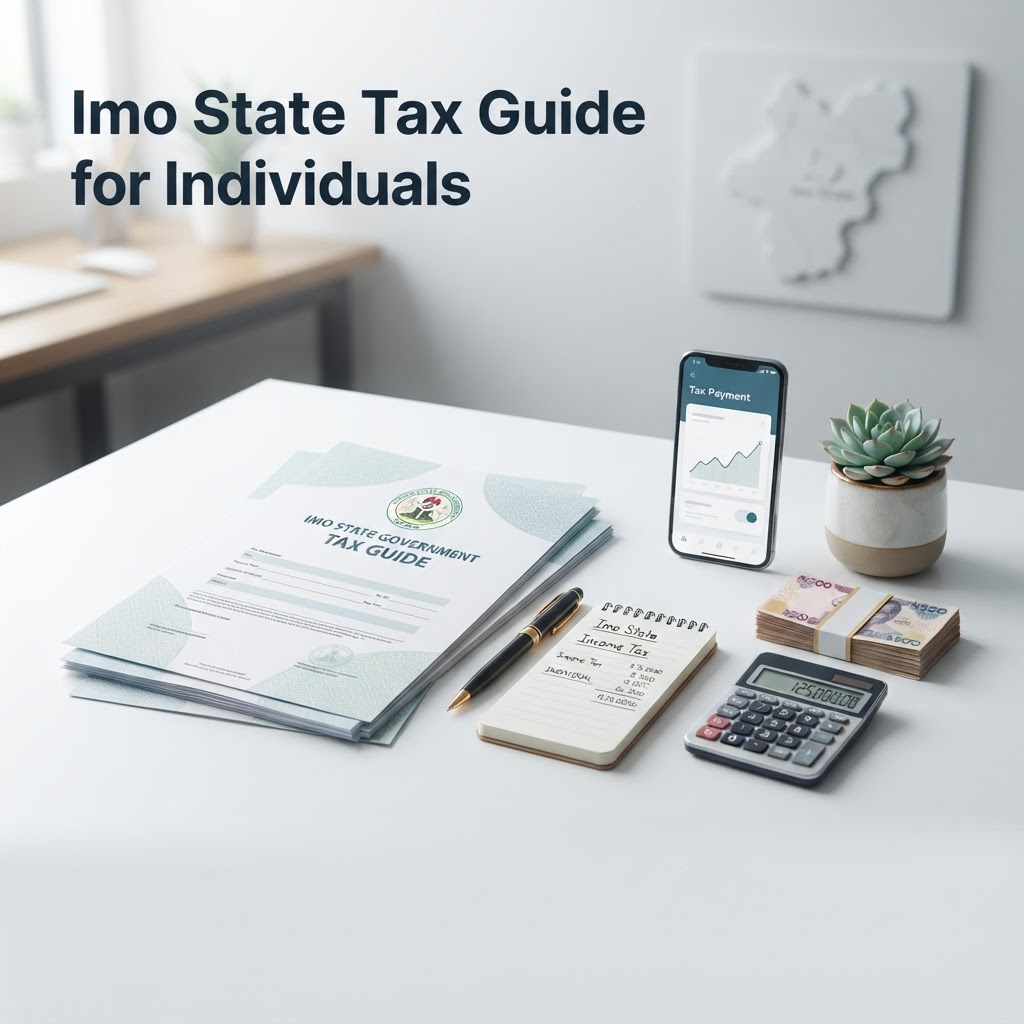
Taxation is one of the most direct ways that individuals participate in the development of their communities. Yet for many residents of Imo State, the process of understanding, registering, and filing taxes remains confusing, intimidating, or simply unfamiliar. This guide is designed to change that. Whether you are a salaried employee, a self-employed entrepreneur, a small business owner, or a returning member of the diaspora, the Imo State Tax Guide for Individuals provides the practical, step-by-step information you need to meet your obligations, claim your reliefs, and contribute meaningfully to the prosperity of your state. At eziokwubundu.com, we believe that financial empowerment and community development are inseparable — and tax compliance is where that belief becomes action.
Why Is Tax Compliance Essential for Imo Residents?
Your Taxes Fund the Community You Live In
Tax compliance is not merely a legal obligation — it is a civic investment. When Imo State residents pay their taxes, those revenues flow into the Internally Generated Revenue (IGR) pool managed by the Imo State Internal Revenue Service (IIRS), the agency responsible for collecting, administering, and accounting for state-level taxes. This revenue directly funds the construction and maintenance of road networks, the staffing and equipping of public healthcare facilities, and the operation of educational institutions across Imo's 27 local government areas.
Consider the state's healthcare infrastructure as a case in point. Reports of understaffing and inadequate resources at facilities like those highlighted in our coverage of Mbaitoli's Primary Healthcare Centres: Are They Properly Staffed? underscore why consistent IGR collection matters. When tax revenue falls short, public services suffer — and the most vulnerable members of the community bear the greatest burden.
The concept of social responsibility is central to the Eziokwubundu mission. The African philosophy that individual success strengthens the collective is not abstract — it is operationalised through systems like taxation. Every naira remitted to the IIRS is a contribution to the shared infrastructure that makes life better for Nigerian families in Imo State.
The IIRS was established under the Personal Income Tax Act (PITA) Cap P8 LFN 2004 (as amended) and operates as the state's fiscal backbone. Strengthening the IIRS through voluntary compliance and accurate filings helps Imo State reduce its dependence on federal allocation and build a more self-sustaining local economy.
Who Must Pay Personal Income Tax in Imo?
Defining Your Taxpayer Status Under PITA
Under the Personal Income Tax Act, all individuals who are resident in Imo State and earn income are liable to pay Personal Income Tax (PIT). This includes employees in the formal and informal sectors, self-employed professionals, business owners, sole traders, freelancers, and individuals who earn income from rent, investments, or trade. There is no income threshold below which a resident is entirely exempt from the tax system — even where a taxpayer's income falls within zero-rated brackets after reliefs, registration remains compulsory.
A critical distinction exists between the jurisdiction of the IIRS and that of the Federal Inland Revenue Service (FIRS). The IIRS handles tax matters for the vast majority of Imo residents. However, the FIRS has jurisdiction over specific categories of federal employees, including military and police personnel, foreign service officers, and staff of federal government agencies. If you work for a federal institution, your income tax is remitted to the FIRS rather than the IIRS. For everyone else living and working in Imo State, the IIRS is your primary tax authority.
The residency rule is equally important. Under Nigerian tax law, an individual who is present in Nigeria for 183 days or more within a 12-month period — whether continuously or cumulatively — is classified as a tax resident. This rule applies to diaspora Nigerians who return for extended periods, foreign nationals working in Imo State, and individuals who split their time between states. If you meet the 183-day threshold and your primary place of business or employment is in Imo State, you are liable to the IIRS.
For a broader understanding of government service access and compliance, the Imo State Government Services Directory provides a useful reference for residents navigating state institutions.
How Do You Register and Stay Compliant with IIRS?
Step-by-Step Requirements for Taxpayers
Registration is the foundation of tax compliance in Imo State, and the process begins with two key identifiers: the Imo State Social Security Benefit Number (IMSSBN) and the Tax Identification Number (TIN).
Step 1: Obtain Your IMSSBN The IMSSBN is a unique identifier issued by the Imo State Government and is a prerequisite for accessing a range of state services, including tax registration. New residents or first-time taxpayers should visit the nearest IIRS office or the Revenue House in Owerri to initiate this process. You will typically be required to present a valid means of identification, proof of residence, and evidence of income or business activity.
Step 2: Obtain Your Tax Identification Number (TIN) The TIN is issued by the Joint Tax Board (JTB) in collaboration with the FIRS and serves as your universal tax identity across Nigeria. It links your tax records across all tiers of government and is required for opening corporate bank accounts, registering businesses with the CAC, and accessing government contracts. You can apply for a TIN through the JTB TIN registration portal or at any designated IIRS office.
Step 3: Understand Your Tax Category Imo State residents are taxed under one of two primary systems:
Featured Products
Chukwu Abiama Tee
Bold black-and-gold Igbo-pride T-shirt featuring 'Chukwu Abiama' in premium streetwear typography.
₦15,000
Buy NowReverse Type 2 Diabetes & other associated Metabolic Issues using Dr. Jason Fung's Evidence-Based Approach— FMD program for Type 2 Diabetes
A practical fasting and fasting-mimicking programme built on Dr Jason Fung's insulin-resistance principles and ow-glycemic recipes.
₦19,950
Join NowỤmụ Igbo Tee
Classic black T-shirt with bold white 'Ụmụ Igbo' typography — a proud statement of Igbo heritage.
₦15,000
Buy NowNwanne Tee
Washed khaki vintage tee with a faded rust-orange 'Nwanne' stamp badge and palm leaf motif — a nod to kinship and heritage.
₦18,000
Buy NowObodo Tee
Faded denim-blue washed tee with a cream 'Obodo' stamp badge and sun motif, celebrating community roots.
₦18,000
Buy NowEkwe Heritage Tee
Deep indigo tee featuring a fine line-art illustration of a traditional Igbo ekwe drum, inspired by Igbo-Ukwu bronze artistry.
₦18,000
Buy NowIkenga Figure Tee
Forest green tee with a fine line-art illustration of a stylized Ikenga figure.
₦18,000
Buy Now- Pay-As-You-Earn (PAYE): This applies to salaried employees. Under PAYE, your employer deducts income tax from your salary each month and remits it directly to the IIRS on your behalf. Employees are still required to file annual returns to confirm that correct deductions were made.
- Direct Assessment: This applies to self-employed individuals, entrepreneurs, professionals in private practice, and those whose income is not subject to employer deduction. Under Direct Assessment, you are responsible for calculating your own tax liability, filing your returns, and making payments directly to the IIRS. This category includes artisans, traders, consultants, and market women — a significant segment of Imo State's working population.
Entrepreneurs building businesses in Imo State should treat tax registration as a first-order priority. Just as we advise readers exploring ventures like vegetable farming with small capital in Nigeria to formalise their operations early, the same principle applies to your tax profile.
What Are the Key Deadlines and Filing Procedures?
Managing Your Tax Calendar to Avoid Penalties
Missing tax deadlines in Imo State carries real financial consequences, including penalties and interest charges. Understanding the tax calendar is therefore a non-negotiable element of financial planning.
Key Annual Deadlines:
- January 31st — Employers must file their annual PAYE returns with the IIRS, detailing total emoluments paid and taxes deducted for all employees during the preceding year.
- March 31st — Self-employed individuals and those under Direct Assessment must file their personal income tax returns for the preceding tax year. This is one of the most commonly missed deadlines among informal sector workers.
Filing Process: To file, taxpayers must complete the Annual Return form, available at the Revenue House on Douglas Road, Owerri, or through the IIRS office in your local government area. The form requires details of total income, allowable deductions, reliefs claimed, and net tax payable. Supporting documents — including bank statements, business records, and evidence of pension or NHIS contributions — should be attached.
Payment Methods: Imo State has modernised its revenue collection through the Imo State Treasury Single Account (IMTSA) framework, which consolidates all government revenue into a single account for transparency and efficiency. Taxpayers can make remittances through several approved platforms:
- Paydirect (Interswitch platform)
- Quickteller (online and mobile)
- Point-of-Sale (POS) terminals at designated bank branches
For further guidance on official payment channels, the IIRS official resources via the Imo State Government portal provide up-to-date instructions.
How Is Your Tax Calculated and What Reliefs Exist?
Demystifying Your Tax Obligations
Nigeria operates a progressive income tax system, meaning that higher income levels attract higher tax rates. Under the Personal Income Tax Act, the applicable rates are structured as follows across annual income brackets:
Annual Taxable Income Tax Rate First ₦300,000 7% Next ₦300,000 11% Next ₦500,000 15% Next ₦500,000 19% Next ₦1,600,000 21% Above ₦3,200,000 24% However, your taxable income is not simply your gross income. Several deductions and reliefs are permitted under PITA before the progressive rates are applied.
Consolidated Relief Allowance (CRA): The CRA is the most significant relief available. It is calculated as the higher of ₦200,000 or 1% of gross income, plus 20% of gross income. This allowance substantially reduces the tax base for most middle-income earners.
Other Deductible Items:
- Pension contributions under the Contributory Pension Scheme (CPS) — typically 8% of monthly emolument for employees
- National Housing Fund (NHF) contributions — 2.5% of monthly basic salary
- National Health Insurance Scheme (NHIS) contributions — where applicable
After applying these deductions, the remaining figure is your chargeable income, to which the progressive rates are applied. A taxpayer earning ₦2,400,000 annually, for instance, would see a significantly reduced effective tax rate after the CRA and pension deductions are factored in.
The IIRS provides a tax calculator tool to assist residents in estimating their liabilities. Using this tool as part of your annual financial planning — alongside broader wealth management strategies — aligns with the practical prosperity approach that eziokwubundu.com advocates. For those tracking Nigeria's broader economic environment, our coverage of the Nigerian Stock Market's ₦1.9 trillion loss to profit-taking offers context on the macroeconomic backdrop within which personal financial decisions are made.
For additional guidance on Nigerian tax law, the Federal Inland Revenue Service official website and the Joint Tax Board provide authoritative legislative and procedural resources.
Conclusion
Tax compliance in Imo State is not a burden to be avoided — it is a responsibility to be embraced as part of building a prosperous community. This Imo State Tax Guide for Individuals has walked you through the essential pillars: why compliance matters, who is obligated, how to register, when to file, and how your liability is calculated. By registering with the IIRS, obtaining your TIN, understanding whether you fall under PAYE or Direct Assessment, and filing before the January and March deadlines, you position yourself as a financially responsible citizen contributing to the collective development of Imo State. At eziokwubundu.com, we believe that practical knowledge applied consistently is the foundation of individual and community prosperity — and your tax compliance is one of the most direct expressions of that belief.
Stay Informed
Get New Articles in Your Inbox
Subscribe to receive the latest community development, health, and wealth insights from Eziokwubundu.
Newsletter
Practical insights on health, wealth, and community — delivered weekly.
Community Discussion(0)
Leave a Comment
More to Read
You May Also Like

CARSPO 2026: Why Nigeria's Police Chiefs Are Converging on Owerri
Nigeria stands at a defining crossroads. With the 2027 General Elections approaching, the country's senior law enforcement leadership is leaving nothing to chance. From September 21 to 23, 2026, Owerri, the capital of Imo State in Nigeria's South-East, will host one of the most consequential securit...

Osimhen Out: What His Injury Means for Nigeria’s 2027 AFCON Qualifiers
Victor Osimhen's name alone carries weight in African football. When the Super Eagles' most prolific striker steps onto the pitch, expectations follow — goals, movement, pressure on opposition defenses, and the kind of attacking intent that changes the outcome of matches. But ahead of Nigeria's open...
NSCDC Deaths: What Happened Inside the Niger Detention Facility?
On the morning of September 17–18, 2026, news broke from Minna that would shake Nigeria's security establishment to its foundations. Thirty-seven detainees held inside a Nigeria Security and Civil Defence Corps (NSCDC) facility in Niger State were found dead. The tragedy did not unfold on a battlefi...

Wike–Uzodimma Dispute: Imo Lawyers Respond to FCT Minister's Attacks
Political tensions between Nigeria's FCT Minister Nyesom Wike and Imo State Governor Hope Uzodimma have escalated to a point where legal professionals feel compelled to intervene. The Imo Lawyers for the Defence of Democracy has formally called out what it describes as dangerous personal attacks ema...

Imo Erosion Crisis: Mbieri Communities Demand Urgent Government Action
The ground beneath Mbieri is literally disappearing. In Mbaitoli Local Government Area of Imo State, advancing gullies are swallowing roads, threatening homes, and pushing one of southeastern Nigeria's most resilient communities toward an environmental breaking point. Residents are no longer waiting...

Imo Markets: What Fees Are Traders Paying and Who Collects Them?
For thousands of traders operating daily across Imo State's bustling markets — from Relief Market in Owerri to the Naze Timber and Allied Traders Market — paying levies is an unavoidable cost of doing business. But in 2026, a more urgent question is emerging from beneath the noise of commerce: exact...

Donor Health Funds Under Scrutiny: Why a Civil Society Group Wants FBI, EFCC to Widen Probe
International health aid is only as effective as the integrity of those who manage it. When billions of naira in donor-funded resources meant to combat HIV and tuberculosis go missing or are misappropriated, the consequences are not abstract — they are measured in lives lost, treatments missed, and ...

Unapproved Orphanages in Nigeria: How Safe Are Children in Private Care Homes?
Across Nigeria, thousands of children live in private care homes that operate outside the law. Some are run by well-meaning individuals overwhelmed by the scale of child poverty. Others are driven by profit, exploiting the image of vulnerable children to attract foreign donations while providing sub...

Nigeria Wins $2.35bn Mambilla Hydroelectric Arbitration Case
Nigeria has secured a landmark legal victory that could reshape the country's energy landscape for generations. An International Chamber of Commerce (ICC) arbitration tribunal sitting in Paris has ruled in favour of the Federal Government of Nigeria, rejecting a staggering $2.35 billion claim brough...
37 Suspected Illegal Miners Die in NSCDC Custody in Niger State
The deaths of 37 human beings in state custody should never be reduced to a statistic. Yet on a deeply troubling day in September 2026, that is precisely what happened in Niger State, Nigeria, when 37 suspected illegal miners died while detained by the Nigeria Security and Civil Defence Corps (NSCDC...