Powered by Obi Mbieri Independent Media Ltd · eziokwubundu.com
$1 = ₦1,331€1 = ₦1,492£1 = ₦1,75921 Autonomous Communities, One Security Plan: Inside Owerri's New Vandalism Crackdown
Owerri, once celebrated as one of Nigeria's most vibrant and cosmopolitan cities, is fighting back against a wave of infrastructure vandalism that has darkened its streets — literally and figuratively. From stolen electricity cables to sabotaged streetlights, the capital of Imo State has endured an ...
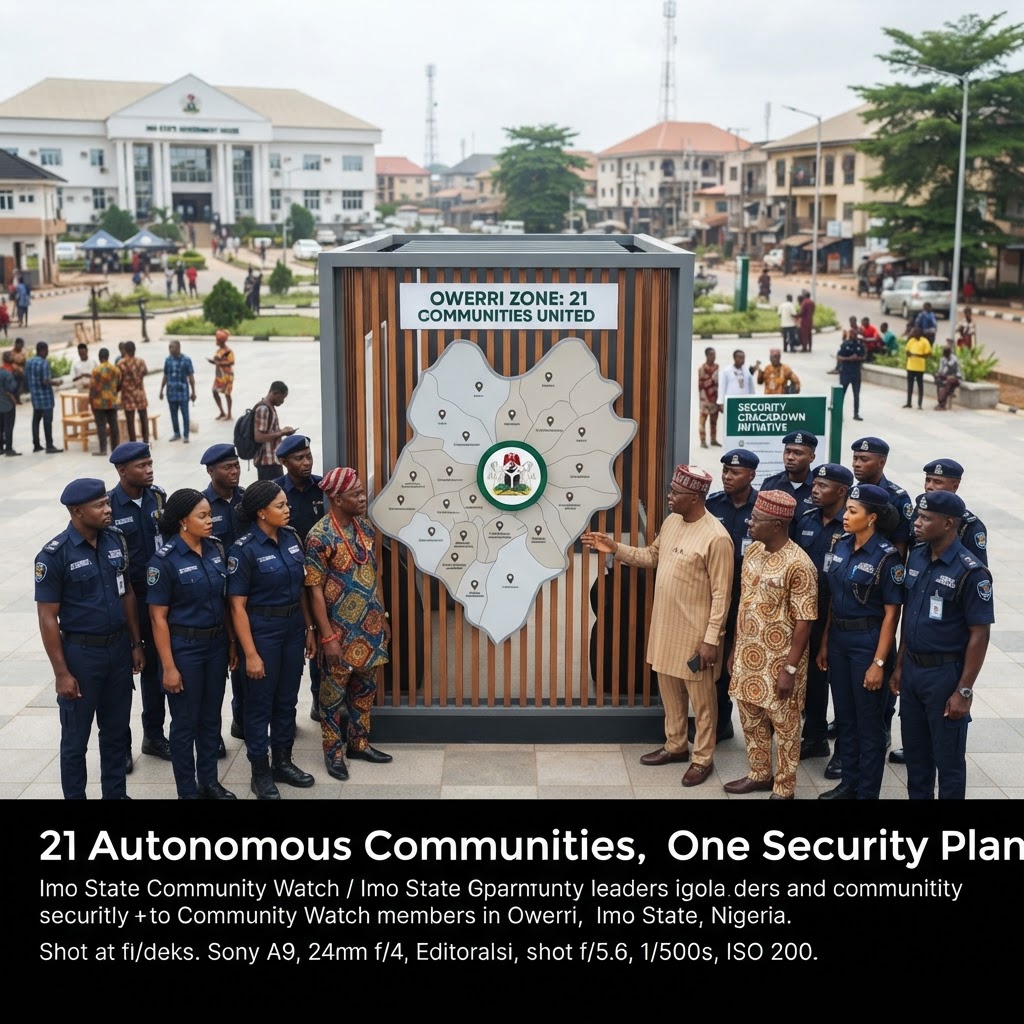
Owerri, once celebrated as one of Nigeria's most vibrant and cosmopolitan cities, is fighting back against a wave of infrastructure vandalism that has darkened its streets — literally and figuratively. From stolen electricity cables to sabotaged streetlights, the capital of Imo State has endured an escalating assault on its public assets that threatens not only power supply but also economic growth, public health, and community safety. Now, in an unprecedented show of coordinated force, 21 autonomous communities across Owerri Municipal and Owerri North have united behind a single security architecture — one that blends traditional leadership, grassroots vigilance, and modern surveillance technology into a comprehensive crackdown.
This initiative, backed by Governor Hope Uzodimma and coordinated through the Imo State Police Command, represents more than a law enforcement response. It is a declaration that community identity, prosperity, and safety are inseparable — a philosophy at the heart of how Owerri's people are reclaiming their city.
Why Is Owerri Launching a Unified Security Plan Now?
The surge in vandalism that triggered a statewide response
The timing of Owerri's unified security plan is no accident. Over the past two years, Imo State has recorded a disturbing increase in acts of vandalism targeting critical public infrastructure — electricity transmission lines, distribution transformers, road lighting systems, and government installations. Governor Hope Uzodimma responded by ordering a statewide crackdown on bandits and vandals, signaling that the government can no longer treat these incidents as isolated criminal acts.
The damage is far-reaching. When copper cables are stripped from electricity pylons or transformers are tampered with, entire neighborhoods lose power for days. Chemical leaks from ruptured infrastructure endanger public health. Fires sparked by illegal tampering put families and businesses at direct physical risk. For Owerri — a city that once attracted visitors from across Nigeria for its nightlife, commerce, and cultural energy — the shift to darkness after sunset represents a profound civilizational regression.
What makes the current surge particularly alarming is its organized nature. Unlike opportunistic petty crime, much of the recent vandalism bears the hallmarks of coordinated theft rings that use intelligence about patrol schedules, unregistered vehicles, and concealed identities to carry out raids under cover of night. A fragmented security response was never going to be sufficient. A unified plan across 21 autonomous communities was the only credible answer.
Which 21 Communities Are Leading This Crackdown?
Mapping the collaborative effort across Owerri
The backbone of this initiative is the structured participation of autonomous communities drawn from both Owerri Municipal and Owerri North Local Government Areas. Understanding the geographic and political layout of these communities helps explain why their unity is so strategically significant.
In Owerri North, the Uratta bloc contributes six autonomous communities: Amakohia, Akwakuma, Orji, Ihitaoha-Uratta, Obibi-Uratta, and Owalla. These communities form a critical buffer zone on the northern approaches to Owerri city. Their 10 constituent villages — including Umualum and Umuorii — provide the grassroots intelligence network essential to any effective surveillance plan. Residents in these villages live closest to the peri-urban corridors through which vandalism gangs typically enter and exit the city. When these communities are organised and vigilant, they function as an early warning system that can detect threats before significant damage occurs.
Within Owerri Municipal, five additional autonomous communities have been formally structured, with traditional leadership now unified under this joint security framework. The inclusion of traditional rulers here is particularly important. As community leaders and security analysts have warned, having "strangers" in positions of traditional authority — individuals without deep local roots or social accountability — creates dangerous security gaps. When a community's paramount ruler lacks intimate knowledge of his people and territory, the intelligence channels that community policing depends upon simply do not function. The current initiative has been deliberately designed to place authentic, community-rooted leadership at its centre.
The remaining communities making up the coalition of 21 span key residential and commercial zones across both LGAs, ensuring that no significant entry corridor or economic hub is left without coordinated coverage.
How Does the New Security Architecture Work?
Surveillance, intelligence, and rapid response combined
The security framework underpinning this initiative is not simply an intensification of traditional policing. It is a comprehensive, technology-driven security architecture that integrates three distinct operational layers: intelligence gathering, modern surveillance tools, and rapid-response deployment.
At the intelligence layer, community members across all 21 autonomous communities have been organised into reporting networks. These networks channel information about suspicious activities — unusual vehicle movements near transformers, strangers loitering around government installations, signs of illegal excavation near cable routes — into dedicated intelligence desks within the Imo State Police Command. The speed of information flow from community to command is critical; in past incidents, delays between detection and response allowed vandalism gangs to complete their work and escape.
At the surveillance layer, the Imo State Police Command has launched a specific crackdown on the tools vandals use to operate with impunity. Unregistered vehicles, cars with tinted windows, and motorcycles with concealed plate numbers — all of which have featured in documented vandalism raids — are now subject to immediate stop-and-search operations. Checkpoints have been established at key transit points across Owerri Municipal and North, with officers empowered to impound non-compliant vehicles on the spot.
At the rapid-response layer, patrol units have been restructured to respond to community intelligence alerts within defined time windows. Residents in Owerri Municipal, who had already begun taking their own safety measures in response to rising insecurity, now have direct channels to coordinate their observations with official response teams — transforming previously isolated civilian vigilance into an integrated component of the state's security architecture.
What Role Do Vigilantes and Traditional Rulers Play?
Grassroots leadership as the foundation of safety
No government security plan survives contact with reality without community ownership, and Owerri's leadership understands this. Long before the formal announcement of the 21-community initiative, residents in Owerri Municipal had already organised vigilante groups to protect their streets from nighttime raiders. These groups, operating through community development unions and youth associations, had reclaimed several neighbourhoods that police alone could not adequately cover.
Academic research on community policing in Imo State — including studies examining Isiala Mbano Local Government Area — consistently shows that the most effective crime control outcomes emerge from genuine collaboration between formal police structures and community members. Vigilante groups provide local knowledge, sustained presence, and social accountability that uniformed officers, who may be rotated between postings, simply cannot replicate.
Traditional rulers and youth leaders now play a formalised role within the 21-community framework. They serve as the primary points of contact for intelligence reporting, dispute resolution, and community mobilisation. Stakeholders across Owerri have specifically called for greater involvement of traditional institutions in preventing vandals from encroaching on government rights-of-way — the corridors along which electricity cables and other infrastructure run. When the Obi of a community publicly endorses the security plan and mobilises his people around it, compliance and vigilance levels rise measurably.
Featured Products
Chukwu Abiama Tee
Bold black-and-gold Igbo-pride T-shirt featuring 'Chukwu Abiama' in premium streetwear typography.
₦15,000
Buy NowReverse Type 2 Diabetes & other associated Metabolic Issues using Dr. Jason Fung's Evidence-Based Approach— FMD program for Type 2 Diabetes
A practical fasting and fasting-mimicking programme built on Dr Jason Fung's insulin-resistance principles and ow-glycemic recipes.
₦19,950
Join NowỤmụ Igbo Tee
Classic black T-shirt with bold white 'Ụmụ Igbo' typography — a proud statement of Igbo heritage.
₦15,000
Buy NowNwanne Tee
Washed khaki vintage tee with a faded rust-orange 'Nwanne' stamp badge and palm leaf motif — a nod to kinship and heritage.
₦18,000
Buy NowObodo Tee
Faded denim-blue washed tee with a cream 'Obodo' stamp badge and sun motif, celebrating community roots.
₦18,000
Buy NowEkwe Heritage Tee
Deep indigo tee featuring a fine line-art illustration of a traditional Igbo ekwe drum, inspired by Igbo-Ukwu bronze artistry.
₦18,000
Buy NowIkenga Figure Tee
Forest green tee with a fine line-art illustration of a stylized Ikenga figure.
₦18,000
Buy NowHow Does Vandalism Hurt Owerri's Economy and Health?
The hidden costs of destroyed infrastructure
The connection between infrastructure security and community prosperity is direct, measurable, and frequently underestimated. At eziokwubundu.com, we often discuss how the Health + Wealth + Community triangle operates as an integrated system — and nowhere is this more visible than in the economic and health consequences of power infrastructure vandalism.
When electricity cables are stolen and transformers are damaged, businesses lose power. For Owerri's entrepreneurs — the restaurant owners, salon operators, cold-room operators, printing companies, and tech startups — every hour without electricity is revenue lost. Diesel generator costs, which already consume a disproportionate share of small business budgets, spike further. The cumulative effect is a prosperity gap that widens with each vandalism incident, pushing formal businesses toward informality and deterring new investment.
The health dimension is equally serious. Fires caused by tampered electrical infrastructure have damaged residential properties and commercial premises across Owerri. Chemical exposure from ruptured cable insulation poses documented respiratory and neurological risks to families living nearby. For communities already navigating the healthcare cost pressures that affect Nigerian families managing chronic health conditions, additional environmental health threats from infrastructure damage are a burden they cannot afford.
The Imo State Commissioner for Lands has noted that government funds repeatedly diverted to repair vandalized assets represent development budgets that should have been spent on roads, schools, and health centres. The fiscal cost of vandalism is, in effect, a tax on every resident of Owerri.
What Are the Legal Penalties for Vandals?
Enforcement, prosecution, and zero tolerance
The legal framework being deployed against vandals in Imo State is substantive and the enforcement posture is markedly more aggressive than in previous years. Operators of vehicles with tinted windows or concealed plate numbers now face immediate impoundment of their vehicles, with prosecution to follow. This policy directly targets the logistical infrastructure that vandalism gangs rely upon — without untraceable vehicles, their operational capacity is severely degraded.
In a signal of the government's zero-tolerance position, police recently arrested 12 suspected criminals in a coordinated Imo State crackdown operation, confirming that the rhetoric of enforcement is being matched with action on the ground. These arrests include individuals suspected of coordinating attacks on electricity infrastructure and government installations across the Owerri axis.
The Imo State Government has also intensified its broader legal action against vandalism, using existing statutes that criminalise the theft and destruction of public assets. The judiciary has been engaged as a partner in ensuring that prosecuted cases result in sentences that serve as genuine deterrents. Swift justice — not protracted court delays — is identified as central to the strategy's credibility.
This legal framework connects directly to broader discussions about resource governance and community rights that many Imo communities are navigating. Understanding the Host Community Development Trusts explained under the PIA framework offers important context for how communities can protect their assets within formal legal structures.
The message from the Imo State Government is unambiguous: public infrastructure is not a resource to be exploited by criminal networks. It is a shared asset that belongs to every family in every one of the 21 autonomous communities participating in this initiative.
How Can Residents and Diaspora Support This Initiative?
Practical steps for collective security and prosperity
Security is not solely the government's responsibility — and the most durable security outcomes in Nigerian communities have always been built on civilian participation. For residents, community members, and diaspora Nigerians who want to contribute meaningfully to Owerri's security renaissance, there are concrete and actionable steps available.
For residents: Report suspicious activities around transformers, electricity poles, and government installations through the community intelligence channels established by the 21-community initiative. Do not assume someone else has already made the report. Early reporting is the single most effective individual contribution to preventing vandalism. Engage your community development union and insist on transparency in how local security levies are allocated and spent.
For diaspora Nigerians: Community development unions across Owerri Municipal and North accept contributions for vigilante equipment, surveillance cameras, and communication infrastructure. A single diaspora community group pooling contributions for even a few CCTV cameras covering a critical corridor can make a measurable difference. For context on how infrastructure investment challenges affect the broader South-East region, the ongoing Benin–Asaba road crisis and its impact on South-East motorists illustrates how physical insecurity and infrastructure neglect compound each other.
For entrepreneurs and local organizations: Advocate for the extension of the surveillance architecture to commercial zones. A secure business environment directly reduces your operating costs by lowering generator dependency and reducing private security expenditure.
A secure Owerri is not simply a city without crime. It is a prosperity ecosystem — one where Nigerian families can build wealth, entrepreneurs can scale businesses, and communities can invest in the future with confidence. The 21 autonomous communities now united behind this plan are not just responding to a crisis. They are building the foundation for a healthier, wealthier, more resilient Owerri — one that can reclaim its identity as a city that never sleeps, not because of nocturnal danger, but because of unstoppable energy and opportunity.
Conclusion
The unification of 21 autonomous communities behind a single, technology-driven security plan marks a watershed moment for Owerri and for Imo State. What began as a fragmented response to an escalating vandalism crisis has evolved into a structured model that integrates traditional leadership, grassroots vigilance, modern surveillance, and rigorous legal enforcement into a coherent whole.
The stakes are high. Infrastructure vandalism is not a minor inconvenience — it is an attack on the economic and health foundations of community life. Every transformer destroyed is a family plunged into darkness. Every stolen cable is a business forced to absorb generator costs it cannot sustain. Every unchecked vandal is an implicit message that public assets are undefended.
The 21 communities have rejected that message. And in doing so, they have demonstrated that when traditional values, community solidarity, and modern institutional capacity are aligned, Nigerian communities can protect and build what they have worked so hard to create. At eziokwubundu.com, we will continue to track and report this story as it develops — because community security is not separate from community prosperity. It is its precondition.
Stay Informed
Get New Articles in Your Inbox
Subscribe to receive the latest community development, health, and wealth insights from Eziokwubundu.
Newsletter
Practical insights on health, wealth, and community — delivered weekly.
Community Discussion(0)
Leave a Comment
More to Read
You May Also Like

NYSC Abduction: Serving Nigeria at What Cost? Fresh Safety Questions
The Umunoha abduction of prospective NYSC members has renewed concerns over the safety of graduates travelling across Nigeria for national service.

Military Aircraft With 32 Aboard Crashes in Ondo, Rescue Underway
Igbokoda crash: Nigerian Air Force ATR-42 was travelling from Benin to Lagos when contact was lost
Nwanegwo Hands Over Mbaitoli LGA Affairs, Ends Tenure
Hon. Ifunanya Nwanegwo JP has formally handed over the affairs of Mbaitoli Local Government Area to the Director of Administration and General Services (DAGS), marking the conclusion of his tenure as Executive Chairman.
Umunoha NYSC Kidnap: Hideout Located as IED Threat Delays Rescue
Imo security agencies have located the suspected hideout of prospective NYSC members abducted along the Owerri–Onitsha Road, but an alleged improvised explosive device (IED) threat has delayed the planned rescue operation.

Mbaitoli Kidnapping: Why Is the Owerri–Onitsha Road Still Vulnerable?
The latest kidnapping incident along the Owerri–Onitsha Road in Mbaitoli Local Government Area of Imo State has renewed concerns about the safety of one of the major transportation routes connecting communities in Imo and neighbouring states.

Nigeria’s Maternal Death Crisis: Why Are Mothers Dying?
Every day, Nigerian households wait for news from the maternity ward with hope and quiet dread. Too often, that news is heartbreaking. This is the reality behind Nigeria's Maternal Death Crisis: Why Are So Many Mothers Still Dying? — a question every family, community leader, and policymaker must co...

Kidnappers Demand 1 Billion Naira for 20 Corps Members
A chilling ultimatum has gripped Nigerian families this week. Armed abductors are demanding an enormous ransom for the safe return of young graduates travelling to serve their nation. The incident, now widely known as "Kidnappers Give 20 Prospective Corps Members' Families 24 Hours to Pay ₦1bn Ranso...

Can Fasting Help Lower High Blood Pressure? What Experts Say
High blood pressure quietly affects millions of Nigerian adults, often with no obvious warning signs. Many families are now turning to fasting as a natural way to manage it. This article explores the question many are asking: Can Fasting Help Lower High Blood Pressure? What Experts Say reveals surpr...

NNPC Faces Efficiency Scrutiny Over ₦27.76 Trillion Expenses
Nigeria's state oil giant is back in the headlines, and not for a new discovery. NNPC's ₦27.76 Trillion Operating Expenses Raise Efficiency Questions among citizens, analysts, and policymakers alike. The figure is so large it has sparked fresh debate about how national wealth is managed, and the num...

Police Rescue 10 After Gunmen Attack Two Buses in Mbaitoli
Early morning violence on a major Imo State highway sent shockwaves through communities nationwide this week. Families woke up to disturbing news of commuters trapped in a terrifying ordeal after gunmen struck in Mbaitoli, targeting two commercial buses in the hours before dawn. The headline "Police...