Powered by Obi Mbieri Independent Media Ltd · eziokwubundu.com
$1 = ₦1,332€1 = ₦1,498£1 = ₦1,775Why Imo State Has One of Nigeria's Most Expensive Healthy Diets — And What Families Can Do About It
For families in Owerri, Orlu, and Okigwe, the question of eating well has become inseparable from the question of staying financially afloat. Across Imo State, the cost of maintaining a nutritionally adequate diet has climbed to levels that consistently outpace the national average — a pressure that...
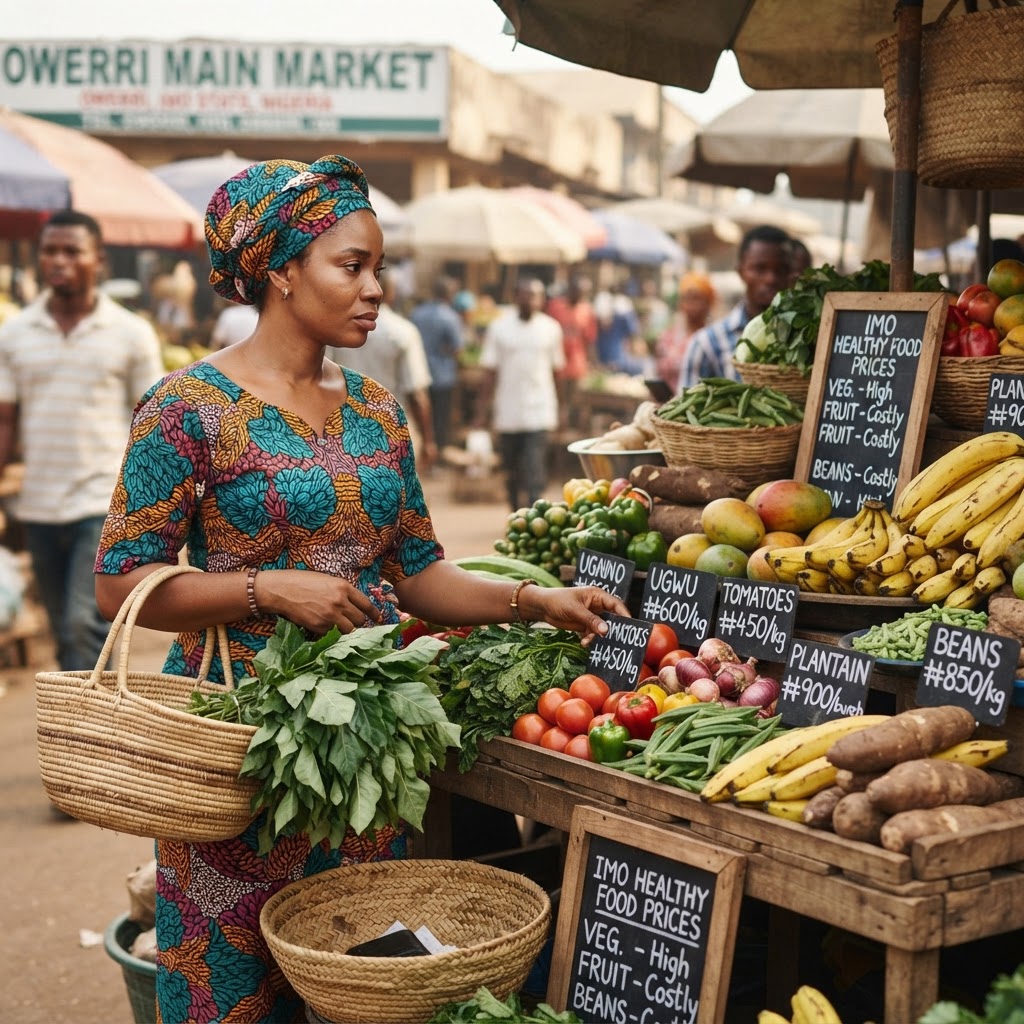
For families in Owerri, Orlu, and Okigwe, the question of eating well has become inseparable from the question of staying financially afloat. Across Imo State, the cost of maintaining a nutritionally adequate diet has climbed to levels that consistently outpace the national average — a pressure that is quietly eroding the health and savings of middle-class households, market traders, and working parents alike. Understanding why this is happening, and more importantly, what can practically be done about it, is not just a matter of food economics. It is a matter of community survival and long-term wellness.
This article explores the structural, logistical, and cultural forces driving food costs in Imo State, benchmarks local prices against national and global standards, and delivers practical, actionable strategies that families can adopt today — because as we have always believed at eziokwubundu.com, genuine prosperity begins with what you put on your table.
Why Is Healthy Food So Expensive in Imo?
The Eastern Heartland's food cost crisis did not emerge overnight. According to data from the National Bureau of Statistics (NBS), the national average Cost of a Healthy Diet (CoHD) reached N982 per person per day in March 2024 — a figure that alarmed nutritionists and policymakers in equal measure. Imo State, however, has frequently trended above this national benchmark, largely because it functions as a high-consumption, low-production hub. The state depends heavily on food imports from Northern Nigeria and the Middle Belt, yet produces comparatively modest volumes of the proteins, grains, and vegetables required to sustain its dense urban population.
The first half of 2024 saw the cost of nutritious foods surge by approximately 45%, a rate that significantly outpaced general headline inflation. This spike hit middle-class families in Owerri with particular force, as this demographic typically lacks both the subsistence farming buffers of rural households and the purchasing power of high-income earners who can absorb price shocks.
Compounding matters is the 15.93% national inflation rate recorded in that same period, which cascaded into local logistics costs. When the Federal Government deregulated fuel prices, transport costs for perishables — tomatoes, leafy greens, beef, and dairy — moving from Kano, Kaduna, and Plateau State to markets like Relief Market and Eke Ukwu Owerri spiked dramatically. Truck operators passed these costs directly to vendors, who in turn passed them to consumers. In a state where the cold chain for food preservation is virtually non-existent, this logistical pressure created a compounding spiral of cost and waste that continues to burden Imo families.
How Does Imo's Food Cost Compare Nationally?
Benchmarking Imo State's food pricing against other states reveals the scale of what economists have begun calling the "Eastern Heartland premium." Neighboring Akwa Ibom, for instance, previously recorded an average CoHD as low as N559 per person per day in comparative studies — nearly half the cost experienced in urban Imo. The key differentiator is urban density. Imo's compact geography, combined with the commercial energy of the Owerri metropolis, drives demand upward while supply chains remain constrained.
From a global perspective, the World Food Programme benchmarks a healthy diet at approximately $4.46 per person per day. With the Naira's dramatic devaluation since the unification of exchange rates in 2023, this translates to roughly N6,700 to N7,000 per person per day at current parallel market rates — a figure that makes sustained healthy eating virtually impossible for the average Nigerian family without deliberate financial planning. The ongoing fluctuation of the dollar to naira rate continues to influence import-dependent food costs in real time, making budget tracking essential for every household.
Within Imo State itself, there is a striking disparity between rural autonomous communities and the Owerri metropolis. Internal distribution bottlenecks — poor feeder roads, inadequate market infrastructure, and limited inter-community transport — mean that food prices in urban Owerri can run up to 20% higher than in rural communities where the food is actually grown. This internal price gap is a solvable problem, yet it continues to penalise precisely the families who need affordable nutrition most.
What Hidden Forces Drive Up Fresh Produce Prices?
Behind the headline numbers lie structural inefficiencies that have been embedded in Imo's food system for decades. Among the most critical is the near-total absence of cold chain infrastructure — refrigerated transport, cold storage warehouses, and processing facilities — in market-dense areas like Orlu and Okigwe. Without these systems, post-harvest losses for vegetables, fruits, and animal proteins routinely run between 30% and 40% of total produce transported. Vendors who absorb these losses have no option but to raise prices on surviving stock to maintain viability. The consumer ultimately subsidises spoilage.
The role of market intermediaries — commonly referred to as "middlemen" — further distorts pricing. Traditional market unions in Imo exercise considerable control over the supply and distribution of high-demand proteins, particularly beef and poultry. While these structures serve legitimate community functions, they can also create artificial supply bottlenecks that drive prices above the equilibrium rate. A kilogramme of broiler chicken that costs N2,800 at a farm gate in Mbaise can reach N4,500 to N5,200 by the time it passes through three layers of intermediation at a central Owerri market.
The federal government's Special Agro-Industrial Processing Zones (SAPZ) initiative holds genuine promise for transforming this landscape. Designed to cluster agro-processing, storage, and distribution infrastructure within designated economic corridors, the SAPZ program could meaningfully reduce post-harvest losses and supply chain costs if implemented at scale. However, the current pace of rollout — limited funding, bureaucratic delays, and land acquisition challenges — means that the immediate cost-of-living squeeze facing Imo families will not be relieved by this initiative in the near term. Families cannot wait for policy to catch up with hunger. They need solutions available today.
It is worth noting that food-related stress has measurable health consequences beyond nutrition alone. As explored in our article on everyday stress and your health, chronic financial anxiety around food security elevates cortisol levels and contributes to a range of preventable health conditions — making the economic and wellness dimensions of this crisis inseparable.
Featured Products
Chukwu Abiama Tee
Bold black-and-gold Igbo-pride T-shirt featuring 'Chukwu Abiama' in premium streetwear typography.
₦15,000
Buy NowReverse Type 2 Diabetes & other associated Metabolic Issues using Dr. Jason Fung's Evidence-Based Approach— FMD program for Type 2 Diabetes
A practical fasting and fasting-mimicking programme built on Dr Jason Fung's insulin-resistance principles and ow-glycemic recipes.
₦19,950
Join NowỤmụ Igbo Tee
Classic black T-shirt with bold white 'Ụmụ Igbo' typography — a proud statement of Igbo heritage.
₦15,000
Buy NowNwanne Tee
Washed khaki vintage tee with a faded rust-orange 'Nwanne' stamp badge and palm leaf motif — a nod to kinship and heritage.
₦18,000
Buy NowObodo Tee
Faded denim-blue washed tee with a cream 'Obodo' stamp badge and sun motif, celebrating community roots.
₦18,000
Buy NowEkwe Heritage Tee
Deep indigo tee featuring a fine line-art illustration of a traditional Igbo ekwe drum, inspired by Igbo-Ukwu bronze artistry.
₦18,000
Buy NowIkenga Figure Tee
Forest green tee with a fine line-art illustration of a stylized Ikenga figure.
₦18,000
Buy NowWhich Local Foods Can Sustain a Healthy Family Cheaply?
The good news is that Imo State's biodiversity and agricultural heritage contain the answer to many of the nutrition challenges that expensive imported and processed foods have created. Eating well in Imo does not require expensive supermarket trips. It requires a strategic return to indigenous ingredients.
Unripe plantain stands out as one of the most underutilised nutritional assets in the region. Rich in resistant starch, potassium, and vitamins B6 and C, unripe plantain flour serves as a superior "swallow" alternative to processed wheat-based products. It offers significantly better glycemic control — a critical consideration given the rising burden of Type 2 diabetes in urban Imo — and is available at a fraction of the cost of imported flour. Similarly, local grains such as acha (fonio) and local millet varieties provide dense micronutrient profiles at affordable prices when sourced directly from markets or community farmers.
For protein, the expansion of small-scale aquaculture and backyard poultry farming in Imo represents one of the most economically rational interventions available to families. Imo State's freshwater resources and warm climate make catfish and tilapia farming viable even on modest land plots. A family investing as little as N30,000 in a starter fish pond can produce enough protein to significantly supplement their diet within three to four months, while surplus production provides supplementary income. This aligns directly with the broader conversation around health and wealth as a unified pursuit — a philosophy at the heart of eziokwubundu.com's mission.
A seasonal eating guide is perhaps the single most practical tool available to Imo families. Imo's tropical climate produces distinct planting and harvest cycles for its staple crops. Cassava is typically harvested between nine and twelve months after planting, with the lean season running from March to May. African yams reach peak availability between August and November. Oil palm produces most heavily from March through July. Leafy vegetables including Ugwu (fluted pumpkin) and Oha are most abundant — and cheapest — during the rainy season from April through September.
Families who deliberately align their consumption patterns with these production cycles can realistically reduce their grocery expenditure by up to 30% annually, without any reduction in nutritional quality. Buying in-season, buying local, and processing for storage — particularly through sun-drying and fermentation — are traditional food preservation practices that are as economically rational today as they were for previous generations.
How Can Families Build Prosperity Through Local Solutions?
The bridge between a healthy diet and a healthy bank account lies in community action and economic creativity. At eziokwubundu.com, we call this Practical Prosperity — the deliberate application of actionable, locally grounded strategies that turn everyday challenges into pathways for wealth creation and community resilience.
One of the most immediately actionable strategies is the formation of neighbourhood buying clubs. When five to ten families in a compound or street pool their purchasing power and buy staples — garri, rice, palm oil, crayfish, dried fish — directly from farmers and co-operatives in rural autonomous communities, they bypass the multi-layered intermediation that inflates urban market prices. Bulk direct purchases can yield savings of 15% to 25% on staple food costs, while simultaneously strengthening economic ties between urban and rural Imo communities. The Community-First approach is not sentimentality; it is economic strategy.
Beyond saving, families can transition from food consumers to food entrepreneurs by making micro-investments in agro-processing. Garri processing, palm oil extraction, and the production of dried crayfish and smoked fish are all viable micro-enterprises that families can operate at household scale with relatively modest start-up capital. A family that processes and sells surplus garri from a shared cassava purchase transforms a food expense into a revenue stream. Several entrepreneurship support structures in Imo — including initiatives like the FirstBank–Imo ÓKÓBÌ entrepreneurship programme — are specifically designed to support this kind of value-addition thinking at the grassroots level.
Backyard gardening and vertical farming represent the final pillar of household food sovereignty. In urban Owerri, where land is scarce and expensive, vertical planting systems using recycled plastic bottles, wooden pallets, and repurposed containers allow families to grow Ugwu, Nte-oka (garden egg), pepper, and scent leaf on as little as two square metres of balcony or rooftop space. A consistent supply of home-grown organic leafy greens eliminates one of the most volatile cost variables in the household food budget — the weekly vegetable purchase — while providing fresh, pesticide-free nutrition for children and adults. This blend of traditional values and modern progress is precisely the kind of adaptive innovation that builds both community health and household wealth.
Conclusion: Eating Well in Imo Is Hard — But Not Impossible
The data is clear: Imo State sits at the intersection of high food demand, inadequate local supply infrastructure, and national macroeconomic pressures that make maintaining a healthy diet genuinely expensive. For middle-class families in Owerri, for mothers managing household budgets in Orlu, and for young professionals building their lives across the state, this is not an abstract policy problem — it is a daily reality that affects energy levels, immune function, childhood development, and long-term disease risk.
But hardship is not helplessness. The strategies outlined in this article — seasonal eating, indigenous ingredient substitution, aquaculture investment, community buying clubs, agro-processing micro-enterprises, and backyard farming — are not theoretical. They are actionable, culturally grounded, and financially sound. They represent the kind of practical prosperity thinking that transforms constraints into opportunities.
At eziokwubundu.com, we believe that the health of a community begins with the food on its tables and the knowledge in the minds of the families who set them. Eating well in Imo is possible. It simply requires information, intention, and the willingness to build solutions from within.
Sources and further reading: National Bureau of Statistics Nigeria | World Food Programme — Cost of a Healthy Diet | Federal Ministry of Agriculture and Food Security — SAPZ Programme
Stay Informed
Get New Articles in Your Inbox
Subscribe to receive the latest community development, health, and wealth insights from Eziokwubundu.
Newsletter
Practical insights on health, wealth, and community — delivered weekly.
Community Discussion(0)
Leave a Comment
More to Read
You May Also Like

Affordable Home Preventive Health for Nigerian Families
The Hidden Cost of Reactive Healthcare in Nigeria In the heart of many Nigerian households, the approach to healthcare is often reactive. We wait for a fever to become debilitating or a cough to persist for weeks before seeking medical attention. This reactive cycle is not only dangerous for our phy...

Can Fasting Help Lower High Blood Pressure? What Experts Say
High blood pressure quietly affects millions of Nigerian adults, often with no obvious warning signs. Many families are now turning to fasting as a natural way to manage it. This article explores the question many are asking: Can Fasting Help Lower High Blood Pressure? What Experts Say reveals surpr...

Why Antibiotics Fail: Understanding Antimicrobial Resistance
Picture a child in Lagos battling pneumonia, given antibiotics that simply don't work anymore. This is no longer a distant fear—it's a documented reality shaping healthcare across Nigeria. Why Antibiotics May Stop Working: Understanding Antimicrobial Resistance is the question every Nigerian family,...

Strategic Wellness and Fiscal Growth for Nigerians
Achieving a state of total well-being requires more than just physical health or financial stability alone. For the modern Nigerian, success is a multi-dimensional pursuit that bridges the gap between traditional values and global opportunities. By integrating science-based natural health solutions ...

5 Signs Your Blood Pressure May Be Too High
Imagine feeling completely fine while your arteries are quietly under siege. That is the reality for millions of Nigerians living with undiagnosed hypertension. Recognizing 5 Signs Your Blood Pressure May Be Too High could be the difference between early intervention and a medical emergency. Underst...

Can Insulin Help You Lose Weight? Risks and Medical Facts
Insulin often gets blamed for weight struggles among Nigerian families managing diabetes. But the science is more nuanced than blind blame suggests. This article, Can Insulin Help You Lose Weight? Risks and Medical Facts, examines what research actually shows. It looks at this essential hormone and ...