Powered by Obi Mbieri Independent Media Ltd · eziokwubundu.com
Mbaitoli Schools and Skills Training Guide
Published by eziokwubundu.com — Your Nigerian Health, Wealth, and Community Resource --- Why Does Education Drive Mbaitoli's Economic Growth? Mbaitoli Local Government Area occupies a strategically significant position in Imo State, sharing a boundary with the Owerri metropolis and functioning as o...
Published by eziokwubundu.com — Your Nigerian Health, Wealth, and Community Resource
Why Does Education Drive Mbaitoli's Economic Growth?
Mbaitoli Local Government Area occupies a strategically significant position in Imo State, sharing a boundary with the Owerri metropolis and functioning as one of the densest demographic corridors in southeastern Nigeria. With a population exceeding 300,000 residents spread across communities including Nwaorieubi, Mbieri, Orodo, Ubomiri, and Ogwa, Mbaitoli is not merely a suburban extension of Owerri — it is an economic feeder zone whose human capital directly shapes the commercial vitality of the state capital.
Understanding the Health + Wealth + Community triangle is essential here. When families in Mbaitoli have consistent access to quality schooling, the downstream benefits extend well beyond literacy. Research from the World Bank consistently demonstrates that each additional year of quality secondary education increases an individual's lifetime earnings by approximately 8–10%. More critically for Nigerian families, educated household heads demonstrate measurably higher health literacy, making better decisions about nutrition, preventive healthcare, and child development — all pillars that eziokwubundu.com champions.
Yet Mbaitoli's youth face a sharp structural challenge. The region produces thousands of West African Examinations Council (WAEC) candidates annually, but a significant proportion enter the labour market equipped only with paper qualifications and no practical, monetisable skills. According to Nigeria's National Bureau of Statistics, youth unemployment in Imo State hovers near 40%, a figure that reflects the mismatch between purely academic curricula and real market demands. The solution lies in a hybrid model — one that combines foundational academic achievement with structured vocational readiness, empowering young people to generate income, build household wealth, and contribute meaningfully to community development.
This guide maps that full educational and skills landscape across Mbaitoli, providing families, community leaders, and diaspora stakeholders with a practical, actionable resource.
Which Secondary Schools Lead Across Mbaitoli Communities?
Mbaitoli LGA hosts a notable range of public and private secondary institutions, each with distinct strengths that families must weigh carefully before enrollment decisions.
Top Public Institutions
Community Secondary School Mbieri remains one of the oldest and most recognised public institutions in the LGA, with a track record of producing candidates with above-average WAEC results in sciences and humanities. Government Secondary School Orodo serves the densely populated Orodo axis and benefits from periodic state government rehabilitation under the Imo State Universal Basic Education Board (SUBEB) framework. Perhaps most distinctive is the Imo State Secondary School for the Deaf, Ofekata-Orodo — a specialised public facility providing secondary education to hearing-impaired students across the state, representing a critical inclusion infrastructure that deserves greater community and diaspora investment.
Registered Private Institutions
Registered under the National Association of Proprietors of Private Schools (NAPPS), several private schools in Nwaorieubi and Ubomiri corridors have invested in STEM laboratory infrastructure and smaller class sizes — typically ratios of 1:30 compared to public school ratios that sometimes reach 1:60. Institutions along the Owerri-Orlu highway benefit from relatively safe commuter access, a practical consideration for parents evaluating day school versus boarding options.
Evaluating Cost and Academic Outcomes
Total annual cost of attendance at private secondary schools in Mbaitoli ranges from ₦150,000 to ₦450,000, depending on boarding arrangements and school tier. Public schools remain nominally free but carry indirect costs — levies, uniforms, and examination fees — that can reach ₦40,000–₦80,000 annually. For deeper context on how community levies function in Imo State, see this guide on Community Development Levies in Imo Explained.
WAEC/NECO credit pass rates above 60% in five subjects, including English and Mathematics, remain the minimum benchmark families should request from any institution before enrollment. Always ask for the school's most recent WAEC result analysis sheet — a legitimate institution will provide it willingly.
Where Can Youth Access Certified Vocational Training in Mbaitoli?
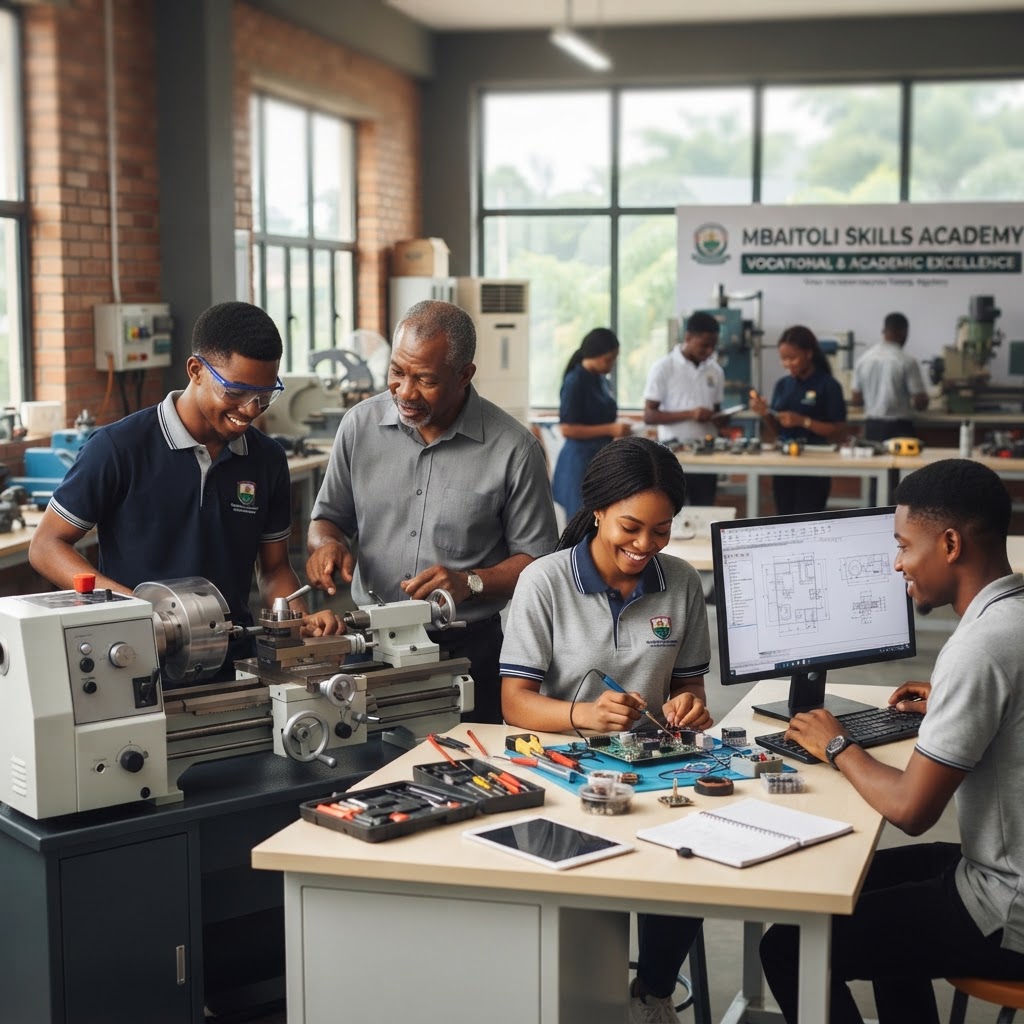
Formal academic schooling alone cannot address Mbaitoli's youth employment crisis. A growing ecosystem of accredited vocational and technical institutions is filling that gap, offering certified pathways into high-demand trades.
Accredited VEIs and NBTE Centers
Vocational Enterprise Institutions (VEIs) accredited under the National Board for Technical Education (NBTE) operate across Imo State, with several accessible from Mbaitoli via the Nwaorieubi junction. These institutions offer structured programmes in electrical installation, welding and fabrication, auto mechanics, and building construction — typically 12 to 24-month programmes leading to a NBTE-recognised National Vocational Certificate (NVC).
High-Demand Trade Disciplines
Several trades show exceptional market absorption in the current Imo State economy. Solar panel installation and renewable energy maintenance has emerged as a critical growth sector, driven by Nigeria's chronic grid unreliability. A trained solar technician in Owerri/Mbaitoli can earn ₦80,000–₦200,000 monthly on installation contracts alone. Modern agro-processing — including cassava flour production, palm oil extraction modernisation, and vegetable preservation — aligns directly with Mbaitoli's agricultural base. The agricultural business transformation happening in Mbieri illustrates precisely how technical skills in agro-processing can bridge local farming with national and export markets. Garment construction and fashion design continues to provide reliable self-employment for young women across Mbaitoli's communities.
Digital Skills and Remote Work Centers
Community digital learning centers — some supported by state and federal social investment programmes — are providing training in data entry, digital marketing, graphic design, and remote freelancing. Platforms like Upwork and Fiverr allow trained youth to earn in dollars without relocating. A young person in Orodo with verified digital marketing skills can generate ₦150,000–₦400,000 monthly serving Nigerian SME clients. For connectivity infrastructure supporting this digital economy, compare options through Best Mobile Networks in Mbaitoli Compared.
How Does Igba-Boi Fit Modern Technical Education?
The Igba-Boi apprenticeship system — the traditional Igbo framework through which a young person is placed under a master trader or artisan for a defined period, concluding with a capital settlement (Ima-Ipu) — is arguably southeastern Nigeria's most powerful indigenous wealth-creation engine. Economists at the University of Nigeria, Nsukka, have described it as one of Africa's most effective informal venture capital systems, transferring both practical skills and startup capital across generations.
Traditional Strengths and Modern Gaps
The classic Igba-Boi model excels in mentorship depth, real-world business exposure, and the disciplined patience it instills in apprentices. However, it carries structural weaknesses in today's economy: informal agreements lack contract enforceability, bookkeeping is rarely taught, digital payment literacy is absent, and occupational health practices — protecting against welding fumes, chemical exposure, or repetitive strain injuries — are almost never formalised.
Modernising the Apprenticeship Model
Progressive master traders at markets like Nkwo Orji and Afor Nwaorieubi are beginning to integrate formal elements into their apprenticeship structures. This means supplementing traditional mentorship with basic bookkeeping training, POS and mobile banking literacy, and simple written agreements that protect both parties. Organisations like SMEDAN provide free enterprise development resources that apprentices and masters can access together.
Community leaders and town unions — such as those documented in the Obi-Mbieri Town Union 2026 Executive Council — are uniquely positioned to formalise these modernisation efforts at the community level, creating a bridge between ancestral commercial wisdom and 21st-century economic requirements.
How Can Families and Diaspora Invest in Mbaitoli Education?
The most durable educational improvements in Mbaitoli will not come from government alone. They will come from the organised, deliberate investment of town unions, community development associations, and diaspora groups who understand that educational infrastructure is the highest-return community asset available.
A Blueprint for Diaspora Action
UK-based and US-based Mbaitoli associations already remit hundreds of millions of naira annually into the LGA. Currently, the majority of these funds flow into burial ceremonies, personal real estate, and informal family support — all legitimate, but limited in community multiplier effect. A structured redirect of even 15% of diaspora remittances into school laboratory renovations, STEM equipment sponsorships, and vocational scholarships would yield measurable outcomes within three to five years. The Imo State Social Investment Programs framework offers co-funding opportunities that diaspora associations can leverage to double the impact of every naira contributed.
Guiding Parents on Academic vs. Vocational Tracks
Nigerian parents in Mbaitoli frequently face pressure to pursue purely academic routes for their children, even when aptitude, household budget, and market realities point toward vocational pathways. A practical framework: assess the child's demonstrated strengths, calculate the realistic total cost of a university pathway versus a VEI/NBTE pathway, and research current market earnings in target fields. A certified solar technician reaches income self-sufficiency in 18 months; a university graduate frequently requires 3–5 years post-graduation to reach equivalent earnings. Both paths have merit — the decision should be evidence-based, not prestige-driven.
For families considering formalising small businesses that emerge from vocational training, the Imo State Business Registration Guide provides a clear, step-by-step process for legal business establishment.
The Community Empowerment Imperative
When Mbaitoli communities invest collectively in educational infrastructure, the returns compound. Schools with better facilities attract and retain qualified teachers. Technically skilled youth reduce out-migration, keeping economic productivity local. Health literacy improves as educated community members make better preventive care decisions. According to UNESCO's 2023 Global Education Monitoring Report, communities with higher secondary education completion rates demonstrate 30% better outcomes on multiple health and economic indicators.
Grassroots educational investment is not charity — it is the most strategic community development decision available to every Mbaitoli stakeholder, at home and in the diaspora.
Conclusion
The Mbaitoli Schools and Skills Training Guide exists because families, youth, and community leaders deserve a single, authoritative resource that maps the full educational and vocational landscape of this LGA honestly and practically. From established public secondary schools in Mbieri and Orodo to NBTE-accredited vocational centres, from digital skills hubs to the modernised Igba-Boi apprenticeship framework, Mbaitoli possesses the foundational infrastructure for a genuine human capital transformation.
What remains is organised, intentional action — from parents making informed enrollment choices, from town unions channelling diaspora funds into school infrastructure, and from youth embracing hybrid academic-vocational pathways that match their talents to real market opportunities. At eziokwubundu.com, we believe that education is the intersection point of health, wealth, and community — and that every investment made in Mbaitoli's schools and skills centres today compounds into generational prosperity for the entire LGA tomorrow.
Stay Informed
Get New Articles in Your Inbox
Subscribe to receive the latest community development, health, and wealth insights from Eziokwubundu.
Newsletter
Practical insights on health, wealth, and community — delivered weekly.