Powered by Obi Mbieri Independent Media Ltd · eziokwubundu.com
$1 = ₦1,326€1 = ₦1,541£1 = ₦1,793Best Mobile Networks in Mbaitoli Compared
Mobile connectivity has quietly become one of the most critical pieces of infrastructure in Imo State's communities — and nowhere is this more apparent than in Mbaitoli Local Government Area. From POS operators in Nwaorieubi to diaspora families sending remittances home to Ogwa, the choice of mobile...
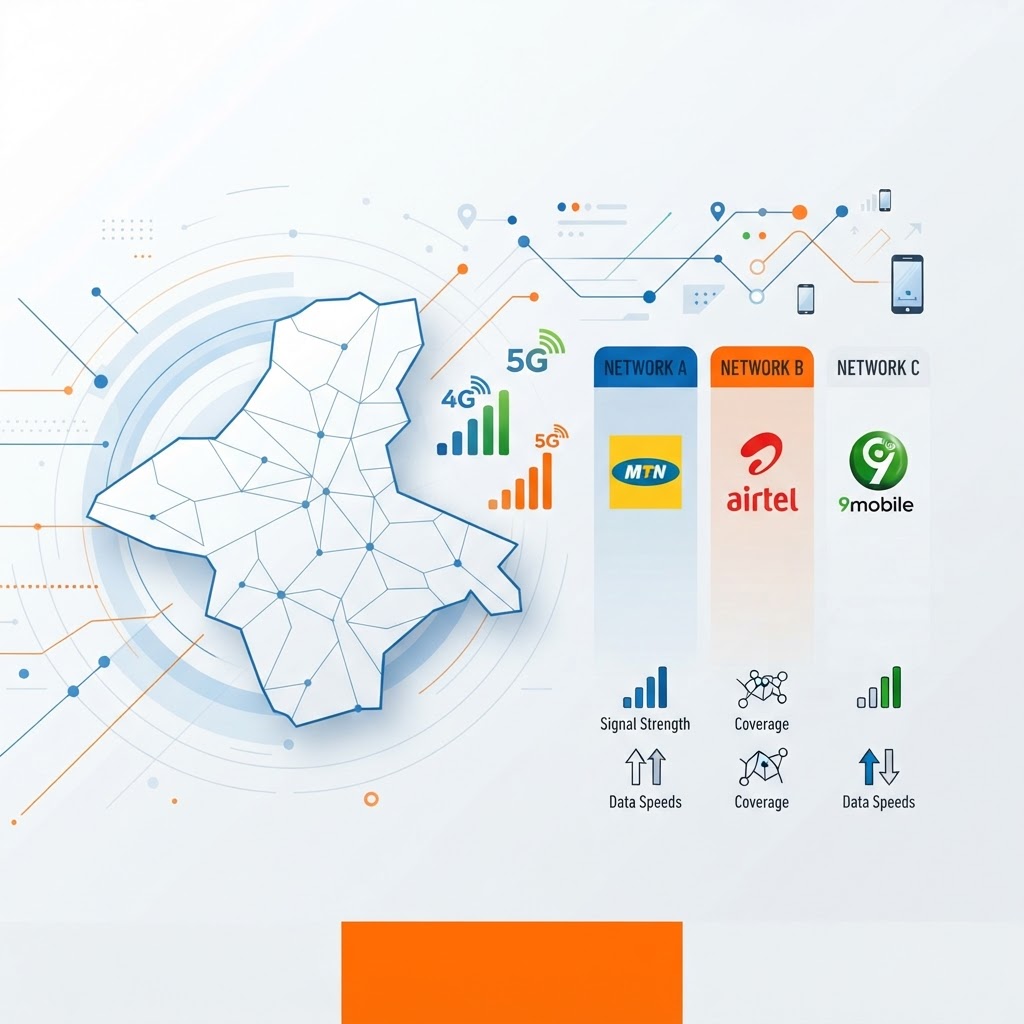
Mobile connectivity has quietly become one of the most critical pieces of infrastructure in Imo State's communities — and nowhere is this more apparent than in Mbaitoli Local Government Area. From POS operators in Nwaorieubi to diaspora families sending remittances home to Ogwa, the choice of mobile network directly shapes economic outcomes, health access, and family security. This guide delivers an honest, community-grounded comparison of MTN, Airtel, Globacom, and 9mobile across Mbaitoli's towns, helping residents, entrepreneurs, students, and returning diaspora make informed decisions about the networks they depend on every day.
Why Does Connectivity Matter for Mbaitoli's Prosperity?
Mbaitoli's digital lifeline across Imo's largest LGA
Mbaitoli Local Government Area is one of the most geographically expansive and demographically significant LGAs in Imo State, stretching over 204 square kilometers across nine major towns: Mbieri, Orodo, Ubomiri, Umunoha, Ogwa, Ifakala, Afara, Ogbaku, and Eziama-Obiato. Its administrative headquarters is rooted in Nwaorieubi — a semi-urban hub that functions as the commercial and civic nerve centre of the entire LGA.
With a population exceeding 300,000 residents across both rural and peri-urban wards, Mbaitoli is not a peripheral community. It is a living economic ecosystem where agro-allied trade, small-scale manufacturing, artisan services, and cross-border remittance flows intersect daily. Mobile connectivity is no longer supplemental to this economy — it is foundational. Farmers in Ogbaku use data-enabled mobile apps to track commodity prices. POS agents in Orodo rely on stable USSD and mobile banking channels to process hundreds of daily transactions. Secondary school graduates in Ubomiri register for JAMB and post-UTME applications entirely on their smartphones.
The stakes escalate further when health emergencies arise. During seasonal flooding events — a recurring challenge in low-lying Mbaitoli wards — mobile connectivity becomes the difference between coordinated tele-triage support and dangerous communication blackouts. Community health volunteers use WhatsApp and telehealth platforms to escalate emergency cases to Owerri-based hospitals. During December homecoming periods, when the Mbaitoli diaspora floods local communities, mobile data demand spikes by an estimated 40–60%, placing enormous strain on base transceiver stations that were designed for lower population densities.
Reliable mobile service, therefore, is not a luxury. It is community infrastructure in the truest sense — as important as roads and clean water for Mbaitoli's development trajectory. For a deeper look at how digital access intersects with agricultural commerce in this region, see this important report on From Mbieri Farm to Global Market: The Agricultural Business Betting on Imo's Future.
How Does MTN Perform Across Mbaitoli Communities?
Coverage dominance, 4G reach, and peak-hour stability
MTN Nigeria remains the undisputed coverage leader across Mbaitoli LGA, and that dominance is not simply a function of brand recognition — it is backed by the operator's extensive base transceiver station (BTS) infrastructure. MTN operates the broadest tower footprint in Imo State, with significant BTS placements serving the semi-urban corridors of Nwaorieubi, Ubomiri, and Mbieri. In these hubs, 4G LTE signals are consistently accessible, with average download speeds ranging between 12 Mbps and 22 Mbps under normal daytime conditions, according to Opensignal's Nigeria mobile network experience reports.
Voice call quality across MTN's Mbaitoli footprint rates highly, particularly along the Owerri-Orlu Road corridor and within Nwaorieubi's commercial district. For POS operators, market traders, and micro-entrepreneurs who rely on USSD-based mobile banking — particularly GTBank, Opay, and Moniepoint transactions — MTN's network uptime provides a measurable business advantage. Network downtime translates directly into lost revenue, and MTN's 99%+ uptime commitment on its core urban-adjacent corridors makes it the preferred carrier for financially critical use cases.
However, real-world performance degrades meaningfully during peak congestion windows. Evening hours between 7 PM and 10 PM in densely populated wards frequently see throughput reductions of 30–45%, as aggregated household data consumption strains tower capacity. During the December homecoming season — when the Mbaitoli diaspora returns from Lagos, Abuja, and international destinations — localized congestion at Nwaorieubi's market towers can push average speeds below 5 Mbps, occasionally triggering voice call drops.
MTN's daily and monthly bundle pricing sits at a mid-tier level. Its 1GB daily bundle (₦300) and 10GB monthly package (₦2,000) offer reasonable value for business users and working professionals, though competing operators offer higher data volumes at comparable price points. For entrepreneurs building formal businesses in the LGA, the Imo State Business Registration Guide provides complementary guidance on formalizing those ventures — MTN's reliable connectivity being the digital foundation on which many of those businesses depend.
Is Airtel the Best Choice for Data Speeds?
Speed, budget bundles, and rural penetration depth
Airtel Nigeria has aggressively positioned itself as the high-speed data alternative in Southeastern Nigeria, and in several Mbaitoli communities, that positioning holds measurable weight. In towns like Orodo, Ogwa, and Umunoha, Airtel's 4G LTE infrastructure delivers competitive average download speeds of 15–28 Mbps under favorable signal conditions — frequently outperforming MTN in areas where Airtel's towers are newer or less congested. Streaming bitrates are notably smoother on Airtel in these communities, making it the preferred network for students consuming online educational content and digital freelancers uploading or downloading large project files.
Airtel's tariff architecture is a genuine differentiator for younger demographics. Its "Unlimited Night Plans," student-focused data bundles, and promotional double-data offers create strong value propositions for university students in FUTO hostels and Imo State University campuses who carry Mbaitoli addresses. A ₦1,000 Airtel bundle routinely delivers 6GB to 12GB of data depending on promotional periods, compared to 4–6GB from MTN at equivalent price points. For digital freelancers and remote workers — a growing segment of Mbaitoli's professional youth — Airtel's pricing economics offer a meaningful monthly saving.
The network's vulnerabilities, however, become apparent in interior wards and low-elevation valleys where traditional family compound architecture creates signal shadowing. Densely built compounds in parts of Ifakala and Afara report inconsistent indoor coverage, with 4G signals occasionally falling back to 3G in basements and ground-floor rooms enclosed by thick mud-brick walls. Airtel's rural tower density in the most interior sections of Mbaitoli also lags behind MTN's coverage envelope, meaning that farmers and community members in the most remote wards may find Airtel unreliable beyond the major road corridors.
For youth professionals exploring digital income opportunities, the connection between reliable high-speed internet and economic empowerment is explored in depth in our piece on youth unemployment solutions in Southeastern Nigeria.
Where Do Glo and 9mobile Stand on Reliability?
Affordable data volumes vs. voice clarity and tower density
Globacom and 9mobile occupy distinct but challenged positions in Mbaitoli's mobile network landscape. Understanding their respective strengths and structural limitations is essential for residents who may be evaluating them as primary or secondary SIM options.
Featured Products
Chukwu Abiama Tee
Bold black-and-gold Igbo-pride T-shirt featuring 'Chukwu Abiama' in premium streetwear typography.
₦15,000
Buy NowReverse Type 2 Diabetes & other associated Metabolic Issues using Dr. Jason Fung's Evidence-Based Approach— FMD program for Type 2 Diabetes
A practical fasting and fasting-mimicking programme built on Dr Jason Fung's insulin-resistance principles and ow-glycemic recipes.
₦19,950
Join NowỤmụ Igbo Tee
Classic black T-shirt with bold white 'Ụmụ Igbo' typography — a proud statement of Igbo heritage.
₦15,000
Buy NowNwanne Tee
Washed khaki vintage tee with a faded rust-orange 'Nwanne' stamp badge and palm leaf motif — a nod to kinship and heritage.
₦18,000
Buy NowObodo Tee
Faded denim-blue washed tee with a cream 'Obodo' stamp badge and sun motif, celebrating community roots.
₦18,000
Buy NowEkwe Heritage Tee
Deep indigo tee featuring a fine line-art illustration of a traditional Igbo ekwe drum, inspired by Igbo-Ukwu bronze artistry.
₦18,000
Buy NowIkenga Figure Tee
Forest green tee with a fine line-art illustration of a stylized Ikenga figure.
₦18,000
Buy NowGlobacom's market appeal in Mbaitoli — as across Nigeria — rests primarily on its "Grandmasters of Data" pricing model. Glo's bundles regularly offer the highest data volumes per naira of any operator, with packages like 15GB for ₦2,000 creating significant attraction for heavy data consumers on tight budgets. In semi-urban Nwaorieubi and parts of Mbieri, Glo's 4G signal delivers usable speeds of 8–14 Mbps. However, Glo's speed consistency is its critical weakness. During national grid power outages — a near-daily occurrence across Imo State — Glo base stations in interior Mbaitoli wards are among the first to degrade in signal quality, as battery backup systems at rural Glo BTS sites tend to be less robust than those maintained by tier-one operators. Latency spikes above 150ms are regularly reported by Glo users in Ogwa and Eziama-Obiato during evening outage windows, making real-time applications like mobile banking and video calls unreliable.
9mobile, by contrast, presents a very different value profile. Its voice call clarity is consistently rated the highest among all four operators in user feedback surveys conducted across Southeastern Nigeria by the Nigerian Communications Commission. Where 9mobile has functional 4G coverage — primarily along the Owerri-Orlu Road arterial corridor — its low-congestion network architecture delivers responsive ping times of 25–45ms, excellent for voice-over-IP calls and diaspora communication. However, 9mobile's tower density across Mbaitoli's interior wards is demonstrably thin. Large portions of Ubomiri, Afara, and Ogbaku report only 2G or patchy 3G 9mobile coverage, effectively excluding those communities from 9mobile's data ecosystem. National grid instabilities compound this limitation, as 9mobile's rural cell site backup infrastructure in Imo State remains under-invested compared to MTN and Airtel.
How Do Networks Compare Across Mbaitoli Towns?
Community-by-community speed, pricing, and voice ratings
A direct head-to-head comparison across Mbaitoli's major towns reveals a nuanced picture where no single operator dominates every metric. Based on aggregated user-reported data, field observation, and published benchmarks from Speedtest by Ookla's Nigeria Intelligence platform, the following grading emerges:
In Mbieri: MTN leads on territorial coverage and voice consistency. Airtel competes strongly on data speeds. Glo offers volume value but variable stability. 9mobile is functional along main roads only.
In Ubomiri: MTN is the clear primary carrier. Airtel's 4G is available but signal depth into compounds is inconsistent. Glo and 9mobile provide supplemental voice-only service for many residents.
In Orodo and Ogwa: Airtel is surprisingly competitive with MTN on data speeds, benefiting from newer tower infrastructure. Glo's data volumes attract budget-conscious households but with performance caveats.
Overall LGA summary: MTN earns the top rating for territorial reliability, POS uptime, and consistent 4G coverage across all nine towns. Airtel earns the performance award for raw data speeds and bundle economics. Glo ranks third on value-for-volume but requires tolerance for instability. 9mobile ranks fourth overall due to limited tower density, despite its superior voice quality.
The dual-SIM strategy has become standard practice among Mbaitoli's entrepreneurs and market traders — typically combining MTN as the primary SIM for financial transactions and Airtel as the secondary for data-intensive tasks. This pragmatic approach to carrier diversity mirrors the broader community-first resilience philosophy central to Mbaitoli's economic culture, and aligns with how community organizations like the Obi-Mbieri Town Union's 2026 Executive Council are structuring local digital communication frameworks.
How Can Mbaitoli Residents Optimize Their Connectivity?
Hardware upgrades, SIM strategies, and community safety
For households and small businesses in Mbaitoli seeking to maximize mobile connectivity, several practical steps offer immediate improvement. Investing in a 4G LTE outdoor CPE router — such as the Huawei B315 or ZTE MF253 — elevates indoor signal quality significantly, particularly in compound buildings where wall materials attenuate indoor signals. External Yagi or panel antennas mounted above rooflines can amplify signal reception by 10–15 dB, effectively converting a weak 3G signal into a stable 4G connection.
Diaspora returnees and visitors should register physical SIMs immediately upon arrival, complying with the Nigerian Communications Commission's National Identity Number (NIN) SIM linkage requirements. Travel eSIM options from international providers offer a bridge solution for the first 24–48 hours before physical SIM activation completes.
Beyond individual optimization, communities should establish emergency communication protocols anchored on the most reliable local carrier — typically MTN — to coordinate health emergencies, flood responses, and community security alerts. Connecting seamlessly to telemedicine platforms, accessing mobile banking for Imo State Social Investment Programs, and maintaining family safety during crisis periods all depend on this foundational digital reliability. In Mbaitoli, strong connectivity is not just personal convenience — it is collective prosperity.
Conclusion
The best mobile network in Mbaitoli is ultimately determined by your specific use case, location, and budget. MTN delivers the most reliable overall coverage and is the safest choice for financially critical applications. Airtel offers the best data economics and speeds for digital professionals and students. Glo provides volume value for budget-conscious households willing to accept performance variability. 9mobile serves users who prioritize voice clarity and low-congestion data corridors. For most Mbaitoli residents, a dual-SIM strategy combining MTN and Airtel represents the most resilient and cost-effective approach to digital connectivity — ensuring that Nigeria's most important community infrastructure remains functional when it matters most.
Stay Informed
Get New Articles in Your Inbox
Subscribe to receive the latest community development, health, and wealth insights from Eziokwubundu.
Newsletter
Practical insights on health, wealth, and community — delivered weekly.
Community Discussion(0)
Leave a Comment
More to Read
You May Also Like

What Happened to Uzoma Ekeanyanwu? Tracing His Police Detention and the Dispute Behind It
By Eziokwubundu.com Investigative Desk --- When a prominent community figure disappears into police custody for more than two weeks without a formal public charge, without a confirmed detention facility, and without transparent disclosure of the allegations against him, the silence itself becomes a ...
Community Development Levies in Imo Explained
Community development levies sit at the intersection of tradition, governance, and grassroots prosperity in Imo State. For millions of Imo indigenes — whether living in Owerri, Lagos, London, or Houston — these contributions represent far more than financial obligations. They are expressions of coll...

Mbaitoli Schools and Skills Training Guide
Published by eziokwubundu.com — Your Nigerian Health, Wealth, and Community Resource --- Why Does Education Drive Mbaitoli's Economic Growth? Mbaitoli Local Government Area occupies a strategically significant position in Imo State, sharing a boundary with the Owerri metropolis and functioning as o...

Imo State Healthcare Access Guide
Accessing quality healthcare in Imo State has long been a challenge shaped by underfunding, geographic disparity, and heavy reliance on out-of-pocket spending. Yet the landscape is shifting. With the operationalization of the Imo State Health Insurance Agency (IMSHIA), renewed federal investment thr...
From Mbieri Farm to Global Market: The Agricultural Business Betting on Imo's Future
Somewhere along the red laterite roads of Mbaitoli Local Government Area in Imo State, a quiet agricultural revolution is taking shape. What began as subsistence farming on ancestral land in Mbieri is now evolving into something far more ambitious: an export-oriented organic food enterprise with its...

Obi-Mbieri Town Union: Full List of the 2026 Executive Council
The Obi-Mbieri Autonomous Community in Mbaitoli Local Government Area, Imo State, has taken a significant step toward structured self-governance with the successful conduct and declaration of its 2026 Town Union Executive Council Election. The official results, certified by the Mbaitoli Local Govern...

Obi-Mbieri Village Crisis: Mbaitoli LGA Says It Has Not Recognized Any Newly Created Villages
A formal administrative letter dated 20 August 2026 has placed the Mbaitoli Local Government Council's position firmly on record: the council has not recognized any newly created villages within Obi-Mbieri Autonomous Community, and will continue to rely solely on duly gazetted entities when dealing ...

Imo Government – EFCC Money Laundering Partnership
The relationship between state governance and federal anti-corruption agencies has rarely been more consequential than it is today in Imo State. As public scrutiny of government finances intensifies across Nigeria, a new chapter is being written — one where state institutions and the Economic and Fi...

Traditional Igbo conflict resolution methods
Across southeastern Nigeria, a quiet but powerful legal tradition has governed community life for centuries. Long before courts, judges, and civil litigation entered the Nigerian consciousness, Igbo communities had developed a sophisticated, layered system of dispute resolution rooted in ancestral w...

Where Is Obi-Mbieri’s Traditional Ruler? Tracking Obi Mbieri Chiefs’ Public Statements From 2020 to 2026
For six years, a question has circulated through the Obi Mbieri Autonomous Community in Mbaitoli Local Government Area, Imo State, with increasing urgency: where is Eze J.N. Osuji? What began as an internal community dispute has grown into a documented, multi-layered governance crisis involving vill...