Powered by Obi Mbieri Independent Media Ltd · eziokwubundu.com
$1 = ₦1,324€1 = ₦1,538£1 = ₦1,790Umuahii–Obi-Mbieri GSM Network Crisis: Why Poor Connectivity Is Becoming a Private-Sector Emergency
Mobile telecommunications have long ceased to be a convenience in Nigerian communities. They are infrastructure — as essential to daily life as roads, water, or electricity. Yet for residents and businesses along the Umuahii–Obi-Mbieri axis in Mbaitoli Local Government Area of Imo State, basic conne...
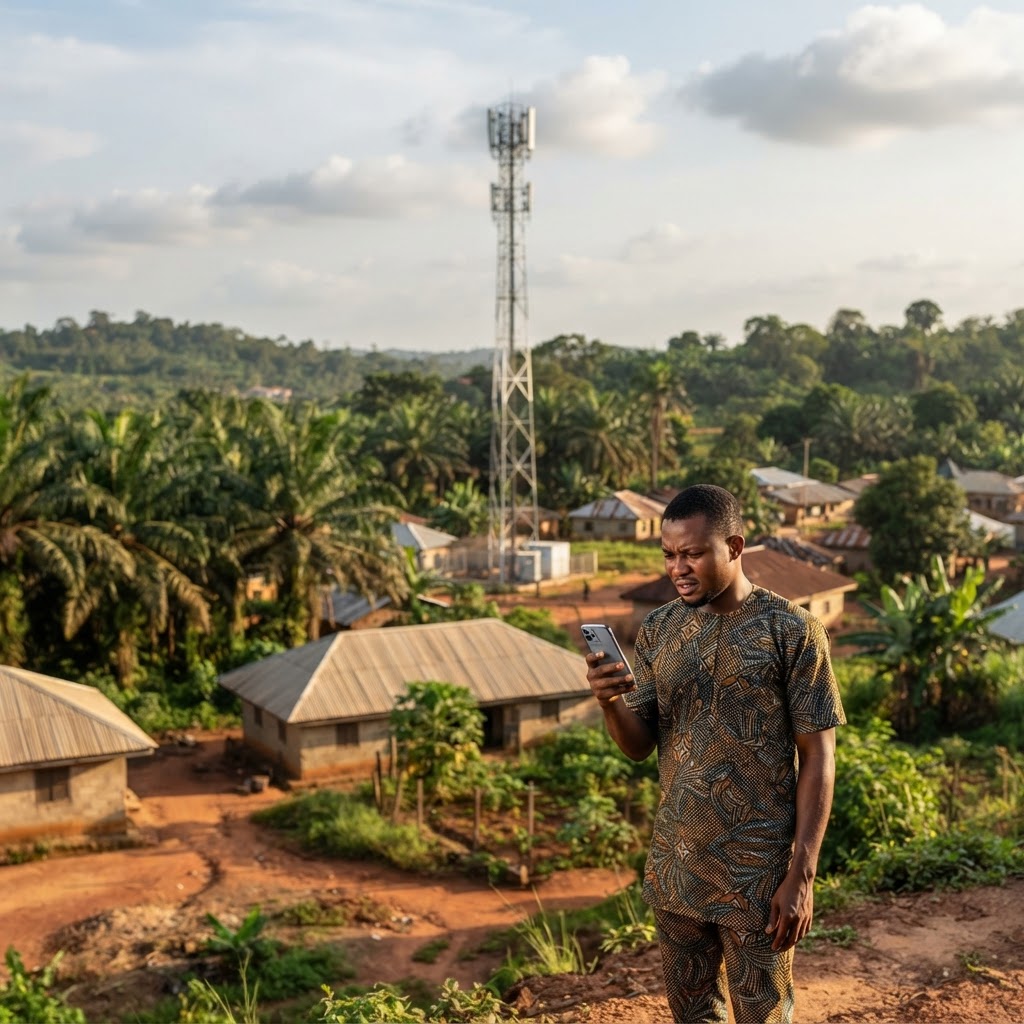
Mobile telecommunications have long ceased to be a convenience in Nigerian communities. They are infrastructure — as essential to daily life as roads, water, or electricity. Yet for residents and businesses along the Umuahii–Obi-Mbieri axis in Mbaitoli Local Government Area of Imo State, basic connectivity remains dangerously unreliable. Making a phone call, completing a mobile bank transfer, or processing a POS transaction can depend entirely on where a person is physically standing at any given moment. That is not a minor inconvenience. It is an infrastructure failure with measurable economic, social, and health consequences. This report — grounded in community observations supplied to Eziokwubundu — examines what is happening, why it is happening, and what businesses, community leaders, and local entrepreneurs can do about it.
Why Does Mobile Signal Disappear Across Streets?
Micro-deadzones across Mbaitoli LGA
The connectivity problem along the Umuahii–Obi-Mbieri corridor is not uniform, which makes it simultaneously harder to diagnose and harder to dismiss. Community observations shared with Eziokwubundu reveal that mobile signal quality shifts dramatically within distances of tens of meters — not kilometres. In Umuomume village, for instance, MTN service is reportedly near-absent at the Ogwa access corridor entrance, while Airtel remains comparatively functional. Move further into the community toward the drainage area, and MTN signal briefly returns, only to disappear again. At the Ahia Ututu axis, both networks are described by residents as reasonably usable.
This hyper-localised variance exposes a critical blind spot in how mobile coverage is typically reported. Telecom operators and the Nigerian Communications Commission (NCC) present geographic coverage maps that indicate whether a settlement theoretically falls within a signal footprint. But nominal coverage and usable service are not the same thing. A community can appear fully covered on an operator's planning map while users on the ground experience call drops, data stalls, and payment failures.
The NCC has recognised this gap through its Quality of Experience (QoE) framework, which attempts to measure how consumers actually interact with voice and data services, not just whether a signal technically exists. QoE metrics account for call completion, data throughput at the point of use, and service consistency over time. When these ground-level indicators are applied to Umuomume and Isinwankwo, the reality is considerably worse than any coverage polygon suggests. For a community whose digital economy depends on mobile connectivity, the distance between what maps show and what residents experience is itself the emergency.
How Does Connectivity Failure Hurt Local Commerce?
POS transaction failures in Isinwankwo hubs
Nowhere is the connectivity crisis more concretely damaging than at the point of sale. In the Isinwankwo commercial corridor, POS operators report difficulties connecting terminals across both MTN and Airtel networks. For a POS operator, a failed transaction is not a technical footnote — it is a lost sale, a frustrated customer, and a crack in the fragile trust that cashless commerce depends on.
The operational risks compound rapidly. A neighbourhood pharmacy relying on electronic payment cannot dispense medication to a patient whose bank card cannot be processed when the network drops. A restaurant that accepts transfers cannot confirm an inbound payment when USSD codes time out. A trader at the market who has encouraged customers to pay digitally loses credibility every time a terminal returns a "transaction declined" error that has nothing to do with the customer's account balance. These failures share a single root cause: network unavailability.
The broader economic cost is a regressive slide back toward cash dependency. Nigeria's cashless policy, implemented progressively by the Central Bank of Nigeria, was designed to reduce the economic costs and security risks of high-volume cash handling. In communities where digital payment infrastructure fails repeatedly, merchants and customers rationally abandon it — not because they distrust the policy, but because the infrastructure cannot support it. Small businesses already operating on thin margins absorb the additional cost of cash management, longer transaction queues, and delayed reconciliation.
For Mbaitoli LGA residents already navigating limited public infrastructure investment, connectivity failure adds another layer of economic disadvantage to communities that can least afford it. The cumulative damage to merchant confidence, transaction volume, and digital participation is not recoverable through motivation alone — it requires infrastructure.
What Engineering Problems Create These Black Spots?
BTS congestion, backhaul limits, and fibre damage
Understanding why these connectivity failures persist requires moving beyond complaints into engineering. The NCC identifies several categories of network degradation that can produce the kind of localised, inconsistent performance observed across Umuahii–Obi-Mbieri. Each points to a different solution.
Base transceiver station (BTS) congestion occurs when the number of simultaneous users in a cell area exceeds the capacity designed into that site. During morning and evening peak periods, a single BTS serving multiple settlements may simply be saturated, causing call drops and data throttling even where signal strength appears adequate on a handset display. Separately, backhaul limitations — the transmission links connecting a base station to the wider network core — can restrict throughput regardless of how well the radio interface performs. A BTS may broadcast a strong signal while the fibre or microwave link behind it is congested or degraded.
Power instability is a third, often underestimated factor. Base stations require consistent power. In communities where public electricity supply is unreliable, network sites that lack adequate backup power will experience outages or degraded performance during grid failures — a chronic condition across Imo State.
Physical infrastructure damage compounds all of these factors. The NCC recently reported more than 5,000 fibre-cut incidents across Nigeria in the first half of 2026, attributing service failures — including dropped calls and failed payments — directly to damaged fibre infrastructure. Fibre vandalism and accidental excavation damage represent systemic threats to connectivity, particularly in peri-urban communities where underground cable routes may be inadequately marked or protected.
The NCC's regulatory benchmarks provide a measurable standard against which performance can be assessed. The regulator mandates a maximum intranetwork call drop rate of 2%. Where persistent problems exist, formal measurement against this threshold — not informal complaint — is the evidentiary basis for regulatory action.
How Can Businesses Build Resilience Now?
Practical redundancy for merchants, clinics, schools
While infrastructure improvement requires operator investment and regulatory pressure, businesses do not need to remain passive. Several low-cost operational strategies can reduce dependence on any single network and limit the damage caused by inevitable outages.
The most accessible starting point is network diversification. A POS operator running exclusively on one SIM card is structurally exposed to that network's failure. Maintaining active SIM cards on two networks — for example, MTN and Airtel — means that when one carrier experiences difficulties at a specific location, the operator can switch immediately. Dual-SIM smartphones, widely available at accessible price points across Nigerian markets, provide this redundancy without requiring additional hardware.
For merchants with higher transaction volumes, multi-network cellular routers can route internet traffic dynamically across whichever network performs best at a given moment. These devices monitor signal quality continuously and switch connections automatically, reducing the interruptions that come from depending on a single carrier.
Payment channel diversification is equally critical. A business should not have only one mechanism for receiving money. Combining POS terminals with USSD-based transfers, QR code payments, direct bank transfer confirmation via mobile banking apps, and a maintained cash reserve creates a layered payment infrastructure that no single network failure can fully disable. This approach aligns with practical financial resilience guidance for small businesses — a principle covered in detail within resources on best savings plans for low-income Nigerians.
For schools, health facilities, and other mission-critical institutions in particularly affected zones, fixed wireless broadband or low-earth-orbit satellite internet services represent longer-term alternatives worth evaluating where mobile reliability cannot be guaranteed.
Why Is Connectivity a Private-Sector Opportunity?
Local entrepreneurs can profit from digital gaps
Every persistent connectivity deadzone represents unmet demand — and unmet demand is a market. The Umuahii–Obi-Mbieri connectivity gap is not only an infrastructure problem to be solved by regulators and operators. It is also a legitimate commercial opportunity for local entrepreneurs willing to invest in alternative digital infrastructure.
Neighbourhood Wi-Fi providers operating fixed wireless access points can serve residential clusters and small businesses with more reliable connectivity than mobile networks currently provide. A solar-powered community internet hub — combining reliable connectivity, device charging, printing facilities, and digital literacy training — addresses multiple needs simultaneously while generating sustainable revenue from subscriptions and service fees. Shared workspace facilities offering guaranteed connectivity attract freelancers, students, and remote workers who currently struggle to find reliable connections.
These business models directly embody the Health, Wealth, and Community framework that underpins Eziokwubundu's approach to African development. A community connectivity centre does not merely provide internet — it creates jobs, enables digital commerce, supports student learning, and connects isolated households to health and financial services. For youth professionals exploring how to form a youth cooperative in Nigeria, a cooperative-owned community broadband service represents precisely the kind of grassroots enterprise that builds collective economic capacity.
Investors and development finance institutions have increasingly recognised community connectivity as fundable infrastructure. The private sector need not wait for government or telecom operators to lead. Where there is demand, there is viable business.
What 90-Day Plan Can Communities Execute Now?
Connectivity mapping, operator engagement, and NCC escalation
Effective advocacy requires evidence, not just frustration. The most important immediate action available to Umuahii–Obi-Mbieri communities is the systematic documentation of the problem through a participatory connectivity survey. Residents, youth organisations, traders, and community leaders can work together to record — at specific named locations, across multiple times of day — signal strength for each carrier, call completion rates, data download speeds, and POS transaction success rates. Free tools such as OpenSignal and the NCC's own consumer-reporting channels support this kind of structured measurement.
Within 30 days, a community team should complete a baseline connectivity survey identifying the worst-performing locations across Umuomume, Isinwankwo, and Obi-Mbieri. Within 60 days, the documented data should be compiled into a community connectivity map and submitted as formal written complaints to MTN, Airtel, Glo, and 9mobile, requesting technical site assessments, radio-frequency measurements, and capacity reviews. Within 90 days, if operator responses are inadequate, the community should escalate through the NCC's Consumer Affairs Bureau, which is specifically mandated to receive complaints, monitor operator compliance, and enforce service-quality standards.
Critical public institutions must be prioritised in this process. A network black spot adjacent to a primary school disrupts digital learning and examination access. A deadzone around a maternity clinic can delay emergency communication in ways that have direct health consequences — an issue that connects to the broader challenges of mental health support for Nigerians in rural areas where isolation and inadequate communication infrastructure intersect. These are not equivalent to residential inconveniences and should be presented to operators and regulators with corresponding urgency.
Conclusion: Connectivity Is Now Community Infrastructure
The Umuahii–Obi-Mbieri GSM network crisis is not a peripheral issue. Mobile connectivity now supports banking, commerce, education, emergency communication, and public health services. When it fails repeatedly in specific locations, the consequences are economic, social, and, in the case of health and education facilities, potentially life-affecting.
The path forward is clear. The community must measure the problem with precision, document it with evidence, engage operators through structured formal channels, escalate through the NCC where necessary, and build private-sector alternatives that reduce dependence on any single infrastructure provider. Questions about public investment and accountability — including how local government allocates development resources — are directly relevant, as explored in Eziokwubundu's tracking of Mbaitoli Chairman Ifunanya Nwanegwo's projects.
Umuahii–Obi-Mbieri does not need to wait for a single perfect solution. It can begin today: mapping, documenting, demanding, and building. Connectivity that matches the real needs of its people, businesses, and institutions is not an unreasonable demand. It is the minimum standard a growing, digitally engaged community deserves.
Eziokwubundu invites residents, traders, POS operators, students, and businesses across Umuahii and Obi-Mbieri to document their connectivity experiences, including location, network, time of day, and problem type. Collective evidence is the foundation of effective community action.
Stay Informed
Get New Articles in Your Inbox
Subscribe to receive the latest community development, health, and wealth insights from Eziokwubundu.
Newsletter
Practical insights on health, wealth, and community — delivered weekly.