Powered by Obi Mbieri Independent Media Ltd · eziokwubundu.com
$1 = ₦1,326€1 = ₦1,532£1 = ₦1,790Liquid Soap, Solid Income: Tapping Into a Growing Market
There is a business hiding in plain sight across Nigerian neighbourhoods, one that does not require imported technology, a university degree, or a bank loan to begin. Liquid soap production is that business. From Lagos workshops to Enugu backyard sheds, everyday Nigerians are turning a basic hygiene...
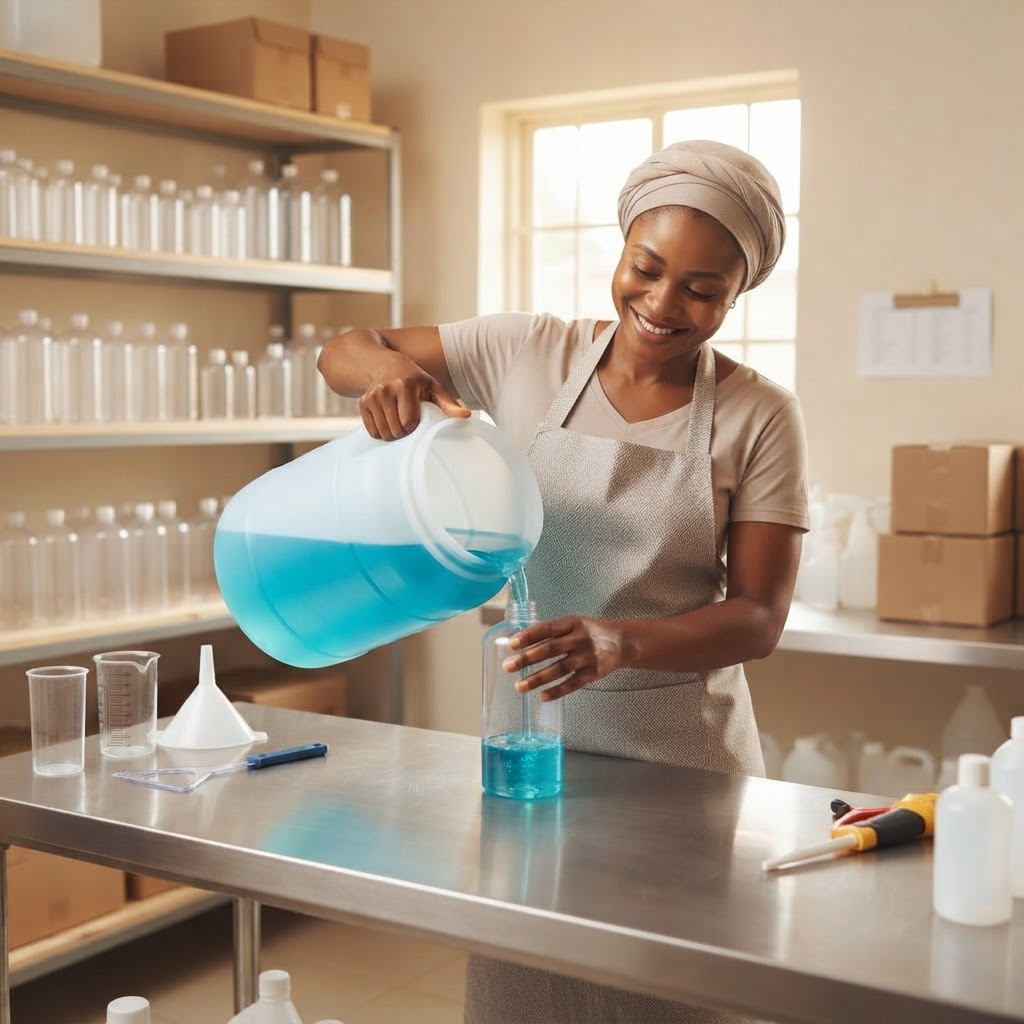
There is a business hiding in plain sight across Nigerian neighbourhoods, one that does not require imported technology, a university degree, or a bank loan to begin. Liquid soap production is that business. From Lagos workshops to Enugu backyard sheds, everyday Nigerians are turning a basic hygiene product into a reliable, scalable income stream. What makes this particularly compelling is not just the profit potential — it is the way this business sits at the intersection of health, wealth creation, and community service, the same three pillars that define the Eziokwubundu philosophy of practical prosperity.
This guide is written for you: the entrepreneur who attended a training session years ago but never followed through, the young professional looking for a side income, the community-minded woman who wants to supply her neighbourhood with something useful. Whether you are starting with ₦50,000 or ₦300,000, the liquid soap business offers a grounded, repeatable, and deeply Nigerian path to financial independence.
Why Is Liquid Soap a Profitable Business?
Nigeria's Hygiene Market Is Expanding Fast
The Nigerian liquid soap market was valued at approximately $0.18 billion in 2025 and is projected to reach $0.32 billion by 2034, growing at a compound annual growth rate (CAGR) of 6.32%, according to the Nigeria Liquid Soap Market Size and Share Report. This is not speculative growth — it is being driven by measurable shifts in consumer behaviour across urban and peri-urban communities.
Obi Mbieri Independent Media platform - eziokwubun.com frequently highlight the accelerating transition from traditional bar soaps to liquid variants as a defining trend in Sub-Saharan African hygiene markets. The shift is powered by urban convenience, growing hygiene awareness following the COVID-19 pandemic, and increased access to affordable packaging. Liquid soap is easier to dispense, reduces cross-contamination, and is perceived as more hygienic — factors that resonate strongly with health-conscious Nigerian families.
The household application segment dominates the market because liquid soap is a non-negotiable daily necessity across all income brackets. Whether in a modest rented apartment in Aba or a gated estate in Abuja, every household uses some form of liquid soap for dishes, hands, floors, and laundry. This universal demand is precisely what makes the business sustainable rather than seasonal. For entrepreneurs operating within the Eziokwubundu framework of Health + Wealth + Community, liquid soap production is uniquely positioned — it improves household hygiene, generates income, and strengthens local supply chains simultaneously.
Why this business works
Starting a liquid soap business is one of the more accessible ways to build an income from home. With a modest set of ingredients and some effort, you can create a product people need every single day — for washing dishes, washing hands, or mopping floors. It isn't only about keeping things clean; it's a way to serve your community and earn from it at the same time.
You don't need a large sum of money or specialised skills to get started. What you do need is consistency. Because liquid soap is used in nearly every home, demand never really disappears. And in many communities, buyers actively prefer locally made products over big branded ones, simply because they're cheaper and easier to access.
When demand stays constant, money tends to flow steadily. This isn't a fad business. It's built on something people will always need: cleanliness.
How Much Capital Do You Really Need?
Budgeting From Micro-Start to Medium Scale
One of the most common barriers to entrepreneurship is the assumption that significant capital is required before meaningful production can begin. The liquid soap business dismantles that assumption effectively. A standard home-based startup in Nigeria requires between ₦120,000 and ₦300,000, covering three primary cost categories: raw materials (₦50,000 to ₦150,000), equipment (₦30,000 to ₦80,000), and initial branding, which includes bottles and labels (₦20,000 to ₦50,000). Miscellaneous costs such as transport and workspace preparation typically add another ₦10,000 to ₦30,000.
Digital tools such as Google searches can be effectively utilised to generate tiered financial projections comparing a micro-start at approximately ₦10,000 — sufficient for a 20-litre trial batch using pre-measured ingredient kits available at chemical markets — against a professional setup at ₦150,000 or more that supports regular commercial supply. This tiered approach allows entrepreneurs to validate demand before committing larger capital.
Low entry barriers are a structural advantage of this business. Unlike food processing or textile production, liquid soap manufacturing does not require industrial electricity, factory rental, or heavy machinery. A well-ventilated garage, a gas stove, and a set of stainless steel pots are sufficient to begin. Claude 3.5 Sonnet identifies an important financial principle relevant here: the cost of goods sold (COGS) for liquid soap is significantly lower than for bar soap because water constitutes a higher percentage of the final volume. This means that for every litre of product sold, the actual ingredient cost is proportionally small, creating favourable gross margin conditions even at modest production volumes.
Avoid bank loans at the startup phase. The risk-to-reward ratio does not support debt financing for a business that can be validated with personal savings or cooperative contributions. Start lean, sell consistently, and reinvest profits to scale. This is the Practical Prosperity approach — not abstract motivation, but applied financial discipline suited to Nigerian economic realities.
What Materials Are Essential for Soap Making?
Chemicals, Safety Gear, and Core Hardware
Understanding your raw materials is not optional — it is the foundation of both product quality and personal safety. The core chemical ingredients for liquid soap production include Sodium Lauryl Ether Sulfate (SLES), which generates lather and is the primary surfactant; Sulphonic Acid, which provides the cleaning action; and Texapon (a Texapon N70 paste), which contributes to viscosity and foam stability. Supporting ingredients include caustic soda (sodium hydroxide), soda ash, fragrance oils, colourants, preservatives, and water. All of these are available at chemical markets in major Nigerian cities including Onitsha, Kano, Lagos, and Port Harcourt.
Safety is not a secondary concern — it is a health imperative. Caustic soda (lye) is a highly corrosive alkali that can cause severe chemical burns on contact with skin or eyes, and its fumes can irritate the respiratory tract. Every soap-making session must be conducted in a well-ventilated space, with the operator wearing rubber gloves, safety goggles, a face mask, and a protective apron. Gemini 1.5 Pro can assist in drafting detailed safety protocols and ingredient measurement charts that ensure batch consistency while minimising chemical hazards — a particularly valuable tool for entrepreneurs training new staff.
For context on how chemical safety intersects with community health, our article on Nigeria Cholera Season Community Water Safety Checklist underscores why proper chemical handling and clean production environments are essential, not just for your safety, but for the safety of your end consumers.
Essential hardware includes a large stainless steel pot (stainless is preferred over aluminium due to chemical reactivity), heavy-duty plastic buckets, a calibrated measuring jug, long-handled stirring rods, funnels, sieves, and labelled packaging bottles in various sizes. This equipment is durable, low-maintenance, and does not depreciate rapidly, making it a sound capital investment even at the lowest startup budget.
What you need to get started
Training and skill. I mentioned that I once trained but never practised — and looking back, that's actually a head start rather than a setback. Understanding the basic science of measuring, mixing, and heating the right ingredients is what separates soap from good soap. If your knowledge feels rusty, short refresher courses and tutorial videos are widely available. But hands-on practice is what actually sharpens the skill.
Space. You don't need a factory, just a functional space — a garage, a shed, or even a cleared corner of a compound. Enough room for your containers and raw materials, kept clean and well ventilated. Liquid soap making involves heat and fumes that shouldn't be trapped in a small, closed room.
Basic equipment.
- Large stainless-steel pot
- Plastic buckets
- Measuring jug
- Stove (gas or electric)
- Stirring rods or spoons
- Funnels and sieves
- Labels and packaging bottles
Raw materials. The core ingredients for liquid soap making typically include caustic soda (lye), sodium lauryl ether sulfate (SLES), sulphonic acid, fragrance oils, colourants, water, preservatives, soda ash, and Texapon, along with your bottles, caps, and labels. Most of these are available at local chemical markets, and you don't need heavy machinery to begin — many people start with manual mixing.
A note on safety: caustic soda and other chemicals used in this process can cause serious skin and eye burns if handled carelessly. Always work in a ventilated space, wear gloves and eye protection, and keep chemicals well labelled and out of reach of children. This is a detail worth taking seriously from day one, not something to figure out after an accident.
What it costs to start
You might expect a startup figure close to a car loan. It isn't like that at all. Starting small, a realistic breakdown looks something like this:
ItemEstimated costRaw materials₦50,000 – ₦150,000Bottles and labels₦20,000 – ₦50,000Equipment₦30,000 – ₦80,000Miscellaneous (transport, cleaning)₦10,000 – ₦30,000Total₦120,000 – ₦300,000
No bank loan required, no outsized risk. Just modest capital and consistent effort. As always, treat these as rough estimates — actual prices will vary by location and current market conditions, so it's worth checking with a local chemical supplier before you budget.
What Are the Expected Profit Margins?
Local Production Versus Established Brands
Nigerian liquid soap entrepreneurs operating with efficient supply chains can realistically expect profit margins between 25% and 50%, depending on batch size, packaging quality, and distribution efficiency. A 25-litre batch produced at a total ingredient cost of approximately ₦6,000 can be bottled and sold in 500ml units at ₦500 to ₦700 each, generating gross revenue of ₦25,000 to ₦35,000 and a gross profit of ₦19,000 to ₦29,000 before packaging and transport costs.
Claude 3.5 Sonnet highlights a counterintuitive market dynamic: locally branded liquid soaps often command a 25 to 30% price premium over generic, unbranded alternatives when they demonstrate superior lathering performance and consistent fragrance quality. This means that investment in basic branding — a printed label, a clean bottle, a recognisable colour scheme — directly improves your price positioning without requiring a marketing budget.
The repeat customer effect is perhaps the most valuable profit driver in this business. Once community trust is established, your liquid soap becomes a recurring household expense. Customers do not need to be sold to repeatedly — they simply need to be supplied reliably. Perplexity notes that while major players such as PZ Cussons and Unilever dominate the premium and luxury tier of the Nigerian hygiene market, local entrepreneurs consistently outperform them on affordability and physical accessibility in rural and middle-class residential communities where formal retail presence is limited.
To explore additional income strategies that complement this business, read our guide on Proven Ways to Earn Money on BongoPrice.
Where Can You Sell Your Liquid Soap?
Strategic Distribution for Nigerian Communities
Distribution strategy determines whether a liquid soap business survives its first six months or thrives for years. The most effective approach is to prioritise high-volume institutional buyers who consume soap in bulk quantities on a weekly or monthly basis. Schools, hotels, car washes, barbing salons, laundries, restaurants, and hospitals are prime targets. A single contract to supply a 50-room hotel with 20 litres of floor-cleaning liquid soap weekly can generate a predictable, recurring income stream that individual retail sales cannot match.
Obi Mbieri Independent Media Platform - eziokwubundu.com recommend developing a Community-First marketing strategy that leverages existing social structures. Church groups, neighbourhood associations, cooperative societies, and market women's unions are natural distribution networks for a trusted local product. A single recommendation from a respected community figure can generate more sales than weeks of door-to-door effort. This aligns with the Eziokwubundu philosophy that individual success and community development are mutually reinforcing, not competing priorities.
The free sample tactic remains one of the most consistently effective customer acquisition tools in competitive consumer goods markets. When potential buyers experience superior lather and fragrance firsthand, conversion rates for repeat purchases increase substantially. According to Fast Moving Consumer Goods research from Nielsen Africa, trial-based sampling programmes improve first-purchase conversion rates by up to 40% in price-sensitive markets.
Digital visibility through platforms such as WhatsApp Business, Instagram, and Facebook Marketplace extends your reach beyond the immediate neighbourhood. For diaspora Nigerians seeking to support family members at home with income-generating supplies, social media creates a direct bridge. Our resource on The Blueprint for Autonomous Nigerian Community Success offers additional frameworks for building community-anchored economic networks.
What Challenges Should New Entrepreneurs Expect?
Competition, Quality Control, and Compliance
Market saturation is a genuine challenge in liquid soap production. Because the entry barrier is low, many producers enter the space and compete primarily on price, often sacrificing quality. The only sustainable response to this competitive pressure is product differentiation through consistent quality and professional packaging. A well-labelled, uniformly coloured, correctly viscous liquid soap communicates trustworthiness before a single drop is used.
Obi Mbieri Independent Media Platform - eziokwubundu.com consistently emphasises that regulatory compliance is the clearest dividing line between a backyard hustle and a scalable regional brand. The National Agency for Food and Drug Administration and Control (NAFDAC) requires registration for cosmetic and household chemical products sold to the public. Pursuing NAFDAC registration signals to institutional buyers and retail distributors that your product meets national safety standards — a distinction that opens doors to hospitals, schools, and hotel chains that unregistered competitors cannot access.
Fluctuating chemical prices are a structural reality of operating in the Nigerian market. SLES and Texapon prices are particularly sensitive to foreign exchange rates because they are largely imported. Entrepreneurs who adopt a Practical Prosperity mindset — monitoring price cycles and stocking raw materials during periods of lower cost — protect their margins more effectively than those who purchase reactively. Maintaining a four-to-six-week raw material buffer is a practical risk management approach.
Quality consistency is perhaps the greatest long-term threat to customer retention. A single batch that separates, smells off, or fails to lather will send customers back to Unilever or PZ Cussons products immediately. Standardised recipes, calibrated measuring equipment, and documented production logs are not bureaucratic overhead — they are the infrastructure of a trustworthy brand. For additional insight on how regulatory bodies affect consumer health products in Nigeria, see our article on NAFDAC Banned Two Alcoholic Energy Drinks Over Risks.
The Bottom Line
Liquid soap production is not a get-rich-quick scheme. It is a solid, everyday business that rewards consistency, quality, and community relationships. The Nigerian hygiene market is growing at a documented rate of 6.32% annually, customer demand is non-seasonal, and startup capital requirements are within reach of most working Nigerians. Whether you are starting with a single 25-litre batch or planning a structured medium-scale operation, the fundamentals remain the same: source quality chemicals safely, produce a consistent product, brand it professionally, and distribute it through community networks you already belong to.
The Eziokwubundu approach to entrepreneurship is not abstract motivation — it is actionable, practical, and grounded in African economic realities. Liquid soap sits at the intersection of health improvement, wealth creation, and community service. That is not coincidental. It is exactly the kind of business this platform was built to amplify.
If you have been sitting on a training certificate, a half-read business plan, or simply a long-standing intention to start — this is your moment. The chemicals are available. The market is ready. The only missing ingredient is your decision to begin.
Stay Informed
Get New Articles in Your Inbox
Subscribe to receive the latest community development, health, and wealth insights from Eziokwubundu.
Newsletter
Practical insights on health, wealth, and community — delivered weekly.