Powered by Obi Mbieri Independent Media Ltd · eziokwubundu.com
$1 = ₦1,328€1 = ₦1,528£1 = ₦1,783FG Opens N50 Million Housing Loan Portal — Here's How Nigerians Can Apply
For millions of Nigerian families, owning a home has long felt like a distant dream — perpetually deferred by skyrocketing real estate prices, punishing commercial mortgage rates, and a chronic shortage of accessible long-term financing. That reality is now shifting. The Federal Government, through ...
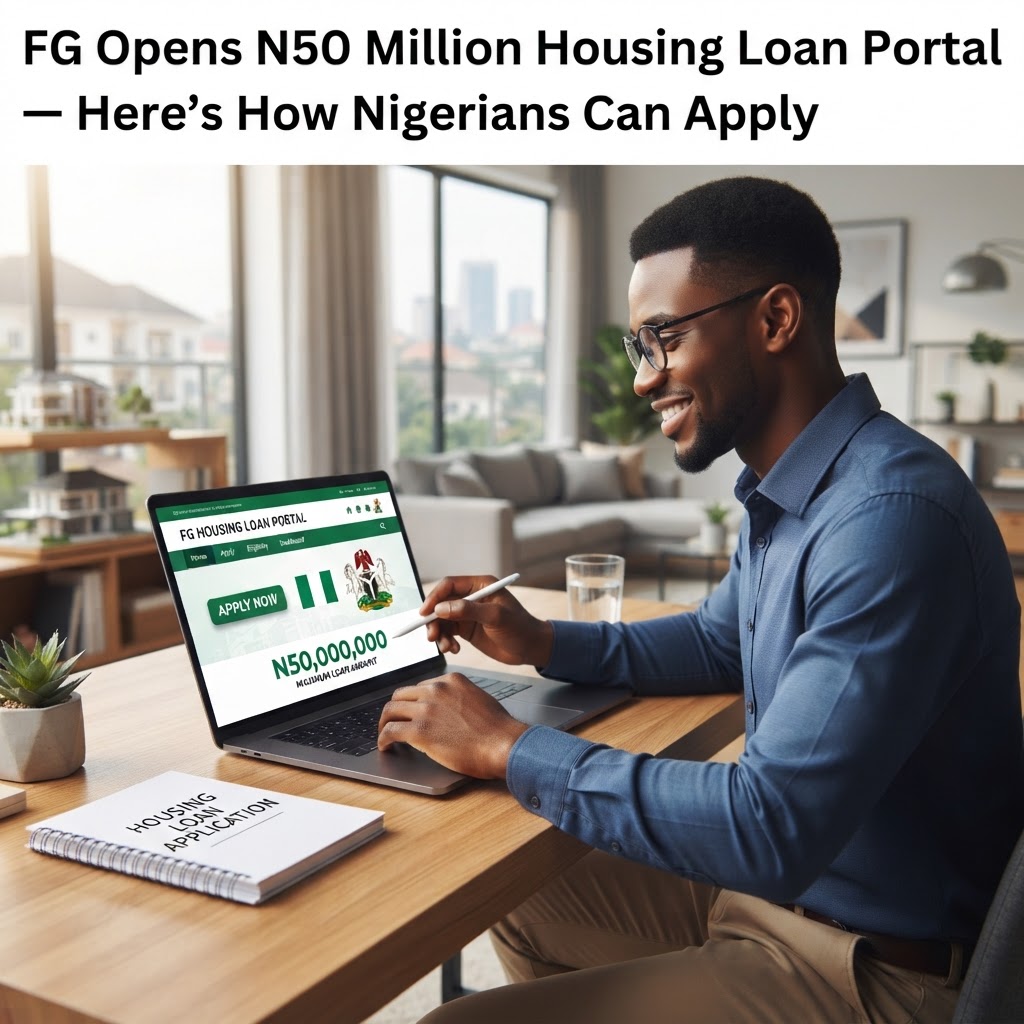
For millions of Nigerian families, owning a home has long felt like a distant dream — perpetually deferred by skyrocketing real estate prices, punishing commercial mortgage rates, and a chronic shortage of accessible long-term financing. That reality is now shifting. The Federal Government, through the Federal Mortgage Bank of Nigeria (FMBN), has reopened and expanded its National Housing Fund mortgage portal, raising the maximum loan ceiling to N50 million and streamlining the digital application process for eligible Nigerians across every employment sector.
This is not a rumour or a political promise. It is a live, operational financing scheme — backed by the Renewed Hope Housing mandate of the current administration — that offers a 6% fixed annual interest rate and repayment terms extending up to 30 years. For middle-class professionals, civil servants, entrepreneurs, and diaspora Nigerians planning a return home, this represents one of the most significant wealth-building opportunities available in the Nigerian market today.
This guide walks you through everything you need to know: what the scheme covers, who qualifies, how to apply on the portal, and why home ownership is not just a financial decision but a foundation for your family's health and community prosperity.
What Is the N50 Million Housing Loan?
Understanding the National Housing Fund (NHF) Framework
The Federal Mortgage Bank of Nigeria (FMBN) was established under Decree No. 82 of 1993 and serves as the apex institution for housing finance in Nigeria. It manages the National Housing Fund, a contributory savings scheme that pools resources from Nigerian workers to provide affordable long-term mortgages. Every employee earning ₦3,000 or more monthly is legally required to contribute 2.5% of their basic salary into the NHF.
In a significant policy upgrade, the FMBN has raised the maximum individual mortgage limit from ₦15 million to ₦50 million, a direct response to the dramatic escalation in Nigerian real estate costs over the past decade. This adjustment ensures the scheme remains relevant in urban markets like Lagos, Abuja, and Port Harcourt, where decent residential properties now command premium prices.
The core financial terms remain highly attractive: a fixed interest rate of 6% per annum — far below commercial market rates — and a repayment tenure of up to 30 years. This scheme is deeply integrated into the Renewed Hope Agenda, which targets the construction and delivery of 100,000 housing units across Nigeria's geopolitical zones, making affordable homeownership a national development priority rather than an elite privilege.
Who Can Access the NHF Mortgage?
Criteria for Individual and Professional Applicants
Eligibility for the National Housing Fund mortgage is deliberately broad, designed to capture the widest possible segment of Nigeria's working population. To qualify, an applicant must be a Nigerian citizen, aged 18 years or older, and actively registered with the NHF scheme. Citizenship verification is conducted through the NHF registration number issued upon enrolment with the FMBN.
A critical eligibility requirement is the mandatory contribution period. Applicants must have maintained at least six consecutive months of NHF contributions before submitting a loan application. This condition establishes a track record of financial commitment and confirms active participation in the scheme.
The mortgage is open to public servants at federal, state, and local government levels, private sector employees whose employers are registered for NHF remittances, and self-employed entrepreneurs who can demonstrate verifiable and consistent income streams. For informal sector workers and business owners, this is a particularly important opening — provided they can substantiate their income through bank statements, tax records, or audited accounts.
One constraint applicants must understand clearly: this is a one-time benefit under the NHF scheme. It is structured exclusively for first-time homeowners, and once accessed, the same borrower cannot apply again under the NHF framework.
What Housing Projects Can This Loan Finance?
From New Construction to Home Renovation
The N50 million NHF mortgage is not restricted to a single type of housing transaction. It covers four principal categories, giving applicants meaningful flexibility based on their circumstances and goals.
The Purchase option allows eligible Nigerians to buy a completed residential property from a licensed developer or a private seller. The property must be a residential dwelling and must comply with all applicable planning and documentation requirements.
The Construction facility is available to Nigerians who already own land with a valid Certificate of Occupancy (C of O) or equivalent statutory title. Under this category, the FMBN finances the construction of a new home on that titled plot, with funds disbursed in tranches tied to building milestones.
The Home Improvement and Renovation category recognises that many Nigerian families already own homes that require structural upgrades, expanded living spaces, or critical repairs. This facility allows existing homeowners to access financing for documented improvement works, improving living conditions without the need to relocate.
Across all three categories, a non-negotiable requirement applies: the property must satisfy legal, planning, and documentation standards sufficient for it to serve as collateral for the mortgage. Properties with disputed titles, incomplete approvals, or unregistered documentation will not pass the FMBN's due diligence process.
How Does the 6% Rate Build Your Wealth?
Comparing Government vs. Commercial Mortgages
The financial argument for the NHF mortgage becomes overwhelming when placed alongside commercial alternatives. Nigerian commercial banks currently offer mortgage products at interest rates ranging from 20% to as high as 30% per annum, subject to prevailing monetary policy conditions set by the Central Bank of Nigeria. Against this backdrop, the FMBN's fixed 6% rate is not merely competitive — it is transformative.
Consider a straightforward comparison on a ₦50 million loan over a 20-year term. At a 6% annual rate, total interest payments over the life of the loan amount to approximately ₦36 million, bringing the total repayment to roughly ₦86 million. At a commercial rate of 25%, the same ₦50 million loan would generate total interest exceeding ₦250 million — a staggering difference of over ₦214 million. That gap represents generational wealth that stays in your family rather than being transferred to a commercial lender.
The 30-year repayment window further reduces monthly financial burden. Spreading repayments over three decades lowers monthly instalments to manageable sums, reducing the pressure on household cash flow and allowing families to maintain savings, invest in education, and build parallel wealth streams.
This is the essence of what we champion at eziokwubundu.com as Practical Prosperity — not abstract financial theory, but concrete, actionable strategies that protect and grow your wealth within Nigeria's specific economic realities. As explored in our guide on solar home systems for Nigerian markets, smart infrastructure investment combined with affordable financing creates compounding long-term returns for Nigerian families.
What Documents Must You Prepare?
A Checklist for a Successful Submission
Preparing your documentation in advance is the single most effective way to avoid delays in the FMBN mortgage application process. Incomplete or inaccurate submissions are among the primary reasons applications stall or are rejected.
Personal documents required include: your NHF registration number (obtained from the FMBN or your employer's HR department), recent payslips covering the last three months, a valid government-issued photo identification (National ID, international passport, or driver's licence), and your Bank Verification Number (BVN).
Property-related documents include: the Title Document or Certificate of Occupancy (C of O) for the property or land, a current valuation report prepared by a licensed estate surveyor registered with the Nigerian Institution of Estate Surveyors and Valuers (NIESV), and approved building plans where construction is involved.
Featured Products
Chukwu Abiama Tee
Bold black-and-gold Igbo-pride T-shirt featuring 'Chukwu Abiama' in premium streetwear typography.
₦15,000
Buy NowReverse Type 2 Diabetes & other associated Metabolic Issues using Dr. Jason Fung's Evidence-Based Approach— FMD program for Type 2 Diabetes
A practical fasting and fasting-mimicking programme built on Dr Jason Fung's insulin-resistance principles and ow-glycemic recipes.
₦19,950
Join NowỤmụ Igbo Tee
Classic black T-shirt with bold white 'Ụmụ Igbo' typography — a proud statement of Igbo heritage.
₦15,000
Buy NowNwanne Tee
Washed khaki vintage tee with a faded rust-orange 'Nwanne' stamp badge and palm leaf motif — a nod to kinship and heritage.
₦18,000
Buy NowObodo Tee
Faded denim-blue washed tee with a cream 'Obodo' stamp badge and sun motif, celebrating community roots.
₦18,000
Buy NowEkwe Heritage Tee
Deep indigo tee featuring a fine line-art illustration of a traditional Igbo ekwe drum, inspired by Igbo-Ukwu bronze artistry.
₦18,000
Buy NowIkenga Figure Tee
Forest green tee with a fine line-art illustration of a stylized Ikenga figure.
₦18,000
Buy NowFor self-employed applicants, tax clearance certificates covering the last three years are mandatory, alongside evidence of consistent income such as certified bank statements, business registration documents, and audited financial accounts.
A vital safeguard: deal exclusively with FMBN-accredited Primary Mortgage Banks (PMBs). Nigeria's housing finance space has unfortunately attracted fraudulent intermediaries who charge illegal processing fees. Always verify any institution's accreditation status directly on the FMBN official website before engaging their services.
How Do You Apply on the Portal?
The Digital Path to Home Ownership
The FMBN has invested in digitalising its mortgage application process, reducing the need for physical visits to branch offices and enabling Nigerians in the diaspora and remote locations to initiate applications online.
Step 1: Create your profile. Visit the official FMBN portal at https://www.fmbn.gov.ng or the Renewed Hope Housing portal. Register your account using your NHF number, BVN, and personal details. Complete the identity verification process before proceeding.
Step 2: Select an accredited Primary Mortgage Bank (PMB). The FMBN does not lend directly to individuals. Instead, it operates through a network of licensed PMBs who act as intermediaries, process your application, and disburse approved funds. The portal provides a searchable directory of all accredited PMBs.
Step 3: Submit your application. Upload all required documents, complete the loan application form detailing the property details, loan amount requested, and repayment preference. Your selected PMB will then conduct a preliminary review.
Step 4: Property valuation and due diligence. The PMB commissions an independent property valuation. This stage typically takes two to four weeks depending on property location and documentation completeness.
Step 5: Approval and disbursement. Upon successful valuation and credit assessment, FMBN reviews the file for final approval. Approved funds are disbursed directly to property vendors or construction accounts.
Track your application status through the portal dashboard or by maintaining direct communication with your assigned PMB officer. Always request written confirmation of every stage.
How Is Your Loan Amount Calculated?
The 1/3 Income Rule and Equity Requirements
The FMBN uses a disciplined, income-linked methodology to determine the maximum loan amount available to each applicant — a framework that protects both borrowers and the integrity of the fund.
The cornerstone of this calculation is the Repayment Capacity Rule: your total monthly mortgage repayment instalment cannot exceed one-third (33.3%) of your verifiable gross monthly income. This threshold is applied rigidly to prevent over-borrowing and financial distress.
Equity contributions are also mandatory. Applicants requesting loans between ₦5 million and ₦50 million are typically required to contribute between 10% and 30% of the property's total value as equity upfront. Lower loan amounts attract lower equity requirements. The FMBN finances a maximum of 90% of the appraised property value under the scheme.
A practical illustration: consider a middle-class professional — a secondary school principal in Enugu earning a gross monthly salary of ₦600,000. Applying the one-third rule, their maximum monthly repayment capacity is ₦200,000. At a 6% interest rate over 25 years, this repayment capacity supports a mortgage of approximately ₦31 million. With a 10% equity contribution of ₦3.1 million, the total property value they can finance is approximately ₦34 million — a solidly achievable family home in most Nigerian cities outside of premium Lagos and Abuja corridors.
Understanding this formula before you apply eliminates guesswork and helps you target a property realistically aligned with your income profile. For broader context on how government economic interventions affect everyday Nigerians' finances, see our analysis of the Osun 2026 election result and its economic implications.
Why Does Home Ownership Matter for Your Family?
Housing, Health, and Community Strength
Home ownership is not merely a financial transaction. For Nigerian families, a secure, stable home is the bedrock upon which health, education, and community participation are built.
The psychological and medical evidence is consistent: housing instability is directly correlated with elevated stress hormones, poor sleep quality, reduced mental health outcomes, and compromised immune function. Families without secure tenure — living in rented accommodation under constant threat of eviction or irregular conditions — experience measurable declines in physical and mental well-being. A stable home eliminates this chronic stress, creating an environment in which children can study, adults can rest, and families can plan beyond the immediate.
At the community level, homeownership anchors people to their neighbourhoods. Homeowners participate more actively in local governance, traditional institutions, and social development initiatives. They invest in the appearance and security of their streets. They become stakeholders in the long-term prosperity of their communities — exactly the Community-First philosophy that drives everything we publish at eziokwubundu.com.
This aligns with the foundational Igbo worldview explored in our article on what Eziokwu Bu Ndu really means — the truth that real life, real prosperity, flows from integrity, rootedness, and collective well-being.
The N50 million NHF loan is not debt. Understood correctly, it is a strategic investment instrument — one that converts monthly rental expenditure (which builds no equity) into mortgage payments that accumulate ownership. For diaspora Nigerians building a return plan, this is particularly powerful. You can also explore how government economic support packages function as seen in our coverage of N300 million support for South Africa returnees from Imo State, which illustrates the growing government commitment to enabling Nigerians to put down permanent roots.
Take Action — Your Home Is Within Reach
The Federal Government's N50 million National Housing Fund mortgage scheme is a rare confluence of low interest rates, long repayment terms, and a functioning digital portal that makes homeownership genuinely accessible to Nigerian workers and entrepreneurs across every sector. The 6% fixed interest rate, the 30-year repayment window, and the expanded loan ceiling are not theoretical benefits — they translate into hundreds of millions of naira in long-term savings compared to any commercial mortgage product available in Nigeria today.
The pathway is clear: confirm your NHF registration status, begin or continue your six-month contribution period, gather your documentation, select an accredited PMB, and submit your application through the official FMBN portal at https://www.fmbn.gov.ng.
For further guidance on housing policy developments, wealth-building strategies, and community development news relevant to Nigerian families, continue exploring the resources available at eziokwubundu.com — your integrated platform for health, wealth, and community prosperity. A secure home is not the end of your journey. It is the starting point for everything your family can become.
Sources and further reading: Federal Mortgage Bank of Nigeria — Official Portal | Nigeria's Renewed Hope Housing Programme Overview | Central Bank of Nigeria — Monetary Policy Updates | Nigerian Institution of Estate Surveyors and Valuers
Stay Informed
Get New Articles in Your Inbox
Subscribe to receive the latest community development, health, and wealth insights from Eziokwubundu.
Newsletter
Practical insights on health, wealth, and community — delivered weekly.
Community Discussion(0)
Leave a Comment
More to Read
You May Also Like

Building Wealth with Ajo and Esusu
The journey to financial independence in Nigeria does not always require a bank loan or a complex stock portfolio. For centuries, our ancestors utilized communal structures to fund life’s greatest milestones. From the bustling markets of Lagos to the quiet villages of the southeast, Ajo and Esusu ha...

KoboTutor: How a Nigerian EdTech Platform Is Bringing Personalised Learning to Students
Nigeria's education sector stands at a crossroads. With over 13 million out-of-school children and chronic underfunding in public education, the pressure on students who do attend school is immense. For the millions sitting JAMB, WAEC, and NECO examinations each year, the stakes could not be higher....
112 Federal Unity Colleges Face Possible Shutdown
Nigeria's federal secondary school system stands at a critical crossroads. As the first term of the 2024/2025 academic year was set to commence, a dramatic standoff between the Federal Government and education workers erupted into a crisis threatening the academic futures of hundreds of thousands of...

Nigerian Stock Market Loses ₦1.9 Trillion to Profit-Taking
The Nigerian Exchange Limited (NGX) recorded one of its sharpest short-term contractions of the year as coordinated profit-taking wiped approximately ₦1.9 trillion from total equities market capitalisation across multiple trading sessions. For millions of Nigerian families, pension holders, and reta...

Dangote Refinery Share Offer: What Does It Mean for Ordinary Nigerian Investors?
For the first time in a generation, ordinary Nigerians have a genuine opportunity to own a direct stake in the country's most significant industrial asset. The Dangote Petroleum Refinery's N2.15 trillion public share offer is not merely a capital markets event — it is a defining moment for Nigerian ...

How to register land in Imo State Nigeria
Land is wealth. In Imo State, as across Nigeria, the family compound, the inherited plot, and the purchased parcel represent more than real estate — they represent generational security, family identity, and economic leverage. Yet thousands of Imo State residents hold land through informal customary...
How to apply for Imo State scholarships 2026
Securing educational funding in 2026 is one of the most decisive financial moves an Imo State family can make. With the cost of tertiary education continuing to rise across Nigerian universities and polytechnics, scholarship access is no longer a luxury reserved for the academically elite — it is a ...