Powered by Obi Mbieri Independent Media Ltd · eziokwubundu.com
$1 = ₦1,331€1 = ₦1,492£1 = ₦1,761₦12 Trillion Fuel Subsidy Question: APM Calls for EFCC Investigation Into Nigeria's Savings
When the Nigerian government removed the decades-old fuel subsidy in May 2023, ordinary Nigerians were promised a new era of fiscal discipline, infrastructure investment, and economic transformation. The pain of higher fuel prices, they were told, would be offset by the enormous savings that would f...
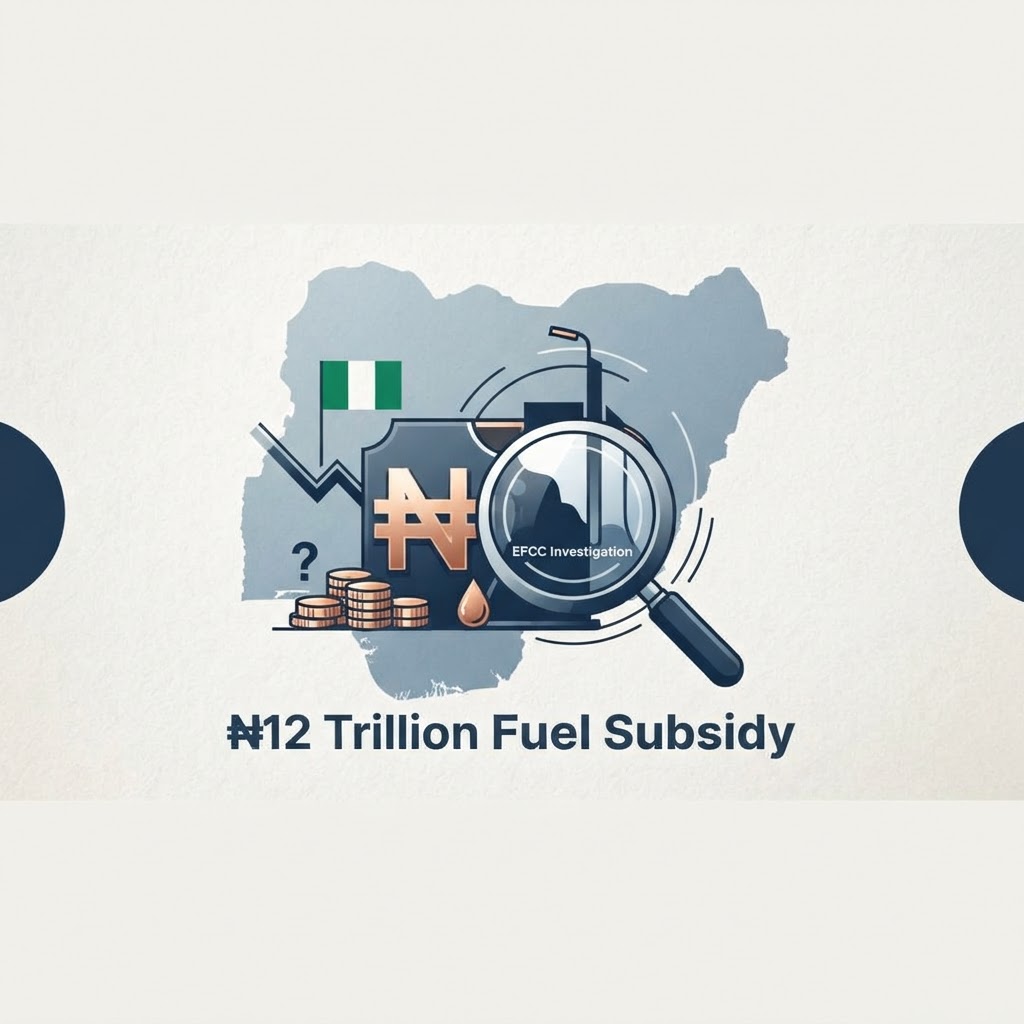
When the Nigerian government removed the decades-old fuel subsidy in May 2023, ordinary Nigerians were promised a new era of fiscal discipline, infrastructure investment, and economic transformation. The pain of higher fuel prices, they were told, would be offset by the enormous savings that would flow into national development. More than two years later, those promises are being scrutinized under a very uncomfortable spotlight. A political organization, the Allied Peoples Movement (APM), has formally petitioned the Economic and Financial Crimes Commission (EFCC) and the National Assembly, demanding answers about what appears to be a staggering ₦12 trillion discrepancy between what the government says it saved and what independent projections suggest should have been accumulated. For Nigerian families already stretched thin by inflation and rising costs, this is not an abstract accounting debate — it is a question about whether promised relief was real, and where the money has gone.
Why Is APM Demanding an EFCC Probe?
The Allied Peoples Movement's formal petition for financial accountability
The Allied Peoples Movement has submitted a formal petition to both the Economic and Financial Crimes Commission (EFCC) and the National Assembly, demanding an urgent and transparent investigation into what the organization describes as a massive discrepancy in the government's reported fuel subsidy savings. The core of the controversy, as reported by Vanguard Nigeria, is the gap between the ₦15.8 trillion figure recently cited by government officials as total savings from the subsidy removal, and earlier projections that suggested accumulated savings should have exceeded ₦27 trillion — or approximately $20 billion — by late 2024.
The APM argues that Nigerians, who have endured significant economic hardship since the May 2023 subsidy removal, deserve a full, transparent accounting of these funds. The organization emphasizes that the hardships were sold to the public as a necessary sacrifice for a brighter fiscal future, and that the claimed savings are the central justification for that policy. If ₦12 trillion cannot be accounted for, the entire reform narrative demands scrutiny.
The EFCC, established under the Economic and Financial Crimes Commission Act, has a clear mandate to investigate and prosecute financial crimes, including misappropriation, money laundering, and fraudulent misrepresentation of public funds. The APM's petition argues that the apparent discrepancy between projected and reported savings falls squarely within this mandate. The commission's mandate, as outlined on the EFCC official website, covers cases of economic and financial malpractice that undermine Nigeria's development — and a potential ₦12 trillion gap in national savings is precisely the category of case that institution was created to address.
How Did Savings Drop From ₦27 Trillion to ₦15.8 Trillion?
Analyzing the conflicting figures between current and former finance leadership
The arithmetic at the heart of this controversy is as troubling as it is straightforward. According to figures attributed to Taiwo Oyedele, Chairman of the Presidential Fiscal Policy and Tax Reforms Committee, total fuel subsidy savings stand at approximately ₦15.8 trillion. Yet earlier indications from offices associated with Minister of Finance Wale Edun suggested that the subsidy removal, from mid-2023 through late 2024, should have generated savings in the region of $20 billion — a figure that, at the prevailing exchange rates, translates to well above ₦27 trillion. Radio Nigeria's coverage of the APM's petition places this discrepancy directly at the center of public concern.
Complicating the picture further are the "Energy Security Expenses" reported by NNPC Limited. These figures — ₦4.84 trillion in 2023 and ₦7.13 trillion in 2024 — represent costs that NNPC incurred in maintaining domestic fuel supply and import operations. Critics argue that these expenses have been deducted before the "savings" figure was arrived at, effectively reducing the publicly declared surplus without a clear explanation of what these funds were spent on or how they were authorized. Ben Television's analysis notes that these shifting accounting terminologies have created widespread public confusion, with different government bodies using different baselines, different fiscal periods, and different expense categories to calculate what "savings" actually means.
This confusion is not incidental. Nigeria's 2012 fuel subsidy scandal — in which a National Assembly probe found approximately ₦1.7 trillion in questionable subsidy claims — demonstrated how deliberately opaque accounting can shield massive misappropriation from public view for years. That scandal, documented in detail by Historical Nigeria, remains the most instructive reference point for understanding why the current discrepancy triggers such acute alarm among civil society, opposition parties, and ordinary citizens alike. Nigerians have been here before. They know how these gaps begin, and they know how difficult they are to close once the money is dispersed.
What Roles Did Oyedele and Edun Play?
The call for questioning key economic architects and petroleum officials
Central to the APM's petition is a specific demand: that the EFCC formally invite both Minister of Finance Wale Edun and Taiwo Oyedele for questioning. The objective, as reported by the Tribune, is to require these officials to reconcile the conflicting figures they have each presented to the public and to account for the methodology behind their respective calculations. The APM also calls for the Ministry of Petroleum Resources to be included in this inquiry, given that operational petroleum costs appear to have been deducted before any savings were declared.
The role of the National Assembly is equally critical. The APM is calling for an open legislative inquest — not a closed committee session — that allows the public, civil society, and independent economists to scrutinize the federation account data in real time. This is a reasonable demand in a constitutional democracy where public funds are held in trust for citizens.
The political dimension of this controversy cannot be ignored. Former Vice President Atiku Abubakar has gone further, challenging the administration to account for what he characterizes as ₦30 trillion in total revenues, a figure that implies the subsidy savings discrepancy is merely one facet of a broader transparency deficit. As BusinessDay has reported, even households and middle-class Nigerians who supported the subsidy removal as a necessary reform are growing frustrated: the government claims economic success, but daily living costs continue to rise, and promised dividends remain invisible.
Could ₦12 Trillion Have Fixed Nigeria's Infrastructure?
The opportunity cost of missing funds for national infrastructure
Featured Products
Chukwu Abiama Tee
Bold black-and-gold Igbo-pride T-shirt featuring 'Chukwu Abiama' in premium streetwear typography.
₦15,000
Buy NowReverse Type 2 Diabetes & other associated Metabolic Issues using Dr. Jason Fung's Evidence-Based Approach— FMD program for Type 2 Diabetes
A practical fasting and fasting-mimicking programme built on Dr Jason Fung's insulin-resistance principles and ow-glycemic recipes.
₦19,950
Join NowỤmụ Igbo Tee
Classic black T-shirt with bold white 'Ụmụ Igbo' typography — a proud statement of Igbo heritage.
₦15,000
Buy NowNwanne Tee
Washed khaki vintage tee with a faded rust-orange 'Nwanne' stamp badge and palm leaf motif — a nod to kinship and heritage.
₦18,000
Buy NowObodo Tee
Faded denim-blue washed tee with a cream 'Obodo' stamp badge and sun motif, celebrating community roots.
₦18,000
Buy NowEkwe Heritage Tee
Deep indigo tee featuring a fine line-art illustration of a traditional Igbo ekwe drum, inspired by Igbo-Ukwu bronze artistry.
₦18,000
Buy NowIkenga Figure Tee
Forest green tee with a fine line-art illustration of a stylized Ikenga figure.
₦18,000
Buy NowTo understand the true cost of this alleged discrepancy, one must think not in abstract accounting terms but in concrete developmental outcomes. The APM has done exactly this. According to the organization's petition, ₦12 trillion — the alleged missing amount — would have been sufficient to construct a 250,000 to 300,000 barrels-per-day domestic refinery, a facility that would dramatically reduce Nigeria's dependence on imported refined petroleum and stabilize domestic fuel prices for decades. This single investment could have rendered the subsidy removal permanently irrelevant by solving the structural problem it was always meant to address.
The same ₦12 trillion could have funded approximately 1,000 kilometers of standard-gauge railway infrastructure connecting major commercial hubs like Lagos, Abuja, and Kano. Such a network would have reduced logistics costs for entrepreneurs, lowered the price of transported goods for families, and taken millions of heavy trucks off Nigeria's dangerously deteriorating roads — reducing maintenance costs and accident mortality simultaneously.
This is the "Practical Prosperity" reality that makes this story more than a political scandal. Every naira that disappears from public accounts is a naira that does not build a road, equip a hospital, or train a teacher. The jobs that a refinery or a rail network would have created — engineering roles, construction labor, operations and maintenance — represent livelihoods for thousands of Nigerian families. The current reality of persistent inflation, fuel scarcity cycles, and stagnant wages is not inevitable: it is the cost of developmental milestones that were funded in theory but never built in practice. Understanding how national resources connect to household wellbeing is something we explore in depth in our article on Health Is Wealth: Why Nigerians Are Rethinking Prosperity in 2026.
Why Does Government Transparency Affect Your Family?
Connecting macro-economic accountability to household wellness
For many readers, the connection between a ₦12 trillion accounting discrepancy and a family's ability to afford healthcare, food, and education may not be immediately obvious. At Eziokwubundu, we insist on making that connection explicit, because the "Health + Wealth + Community" triangle is not a slogan — it is the lived reality of every Nigerian household.
When public funds are unaccounted for, the immediate casualty is the public services those funds were meant to build. Nigeria's public healthcare infrastructure — underfunded for decades — was one of the primary sectors that subsidy savings were projected to support. Unaccounted trillions mean fewer primary health centers, fewer essential medicines, and weaker disease surveillance systems. For context on why this matters in practical terms, see our coverage of Malaria Prevention Tips Every Family Should Know.
Middle-class Nigerians and entrepreneurs are bearing the heaviest burden of the post-subsidy economy. As BusinessDay's reporting confirms, households are struggling with food affordability and transportation costs even as the government celebrates its savings figures. The psychological toll of this reality — the sense of betrayal when promised reforms produce no visible community improvements — is a genuine public mental health concern. Economic uncertainty, chronic financial stress, and food insecurity are well-established contributors to anxiety, depression, and hypertension. The connection between fiscal governance and population health outcomes is direct, measurable, and ignored at our collective peril. This economic pressure also compounds the nutritional challenges that our coverage of Why Imo State Has One of Nigeria's Most Expensive Healthy Diets addresses in detail.
For Nigerian families, the actionable response is threefold: stay informed through credible, evidence-based sources; join or support community organizations that monitor local government spending; and demand that ward and local government representatives account for how federation allocations are spent at the grassroots level.
What Steps Can Restore Public Trust in Reform?
Moving toward sustainable subsidy reform and grassroots accountability
Restoring public faith in Nigeria's economic reform agenda requires more than press releases and disputed accounting figures. Research from the Overseas Development Institute on sustainable fuel subsidy reform identifies three non-negotiable conditions: public acceptance of the reform, genuine confidence in government commitment to redistributing savings, and visible, verifiable evidence that the promised benefits are reaching communities. Currently, none of these three conditions is fully met in Nigeria.
The most credible path forward is a "Community-First" redistribution framework, in which a defined percentage of verified subsidy savings is ring-fenced for specific, locally-managed development projects — health centers, water systems, rural electrification — with project selection subject to community input and completion verified by independent monitors. This approach transforms abstract fiscal policy into tangible household benefits that communities can see, touch, and hold their representatives accountable for.
Grassroots journalism has an irreplaceable role in this process. When local reporters, community organizations, and platforms like Eziokwubundu hold both traditional institutions and federal agencies accountable through evidence-based reporting, the space for impunity shrinks. Encouraging, rather than criminalizing, civic dissent and independent scrutiny is itself a governance reform worth pursuing. The APM's petition, whatever its political motivations, performs a genuine civic function: it forces a public accounting of public money. Every Nigerian — whether a student, an entrepreneur, a parent, or a community leader — has both the right and the responsibility to demand that this accounting be thorough, transparent, and followed to its conclusion.
Stay informed. Ask questions. Demand evidence. That is the foundation of every genuine prosperity — personal, community, and national.
Sources: Vanguard Nigeria | Radio Nigeria | BusinessDay | EFCC | ODI
Stay Informed
Get New Articles in Your Inbox
Subscribe to receive the latest community development, health, and wealth insights from Eziokwubundu.
Newsletter
Practical insights on health, wealth, and community — delivered weekly.