Powered by Obi Mbieri Independent Media Ltd · eziokwubundu.com
NokVision: How a Nigerian Technology Company Is Transforming Estate Management and Security
Nigeria's residential estate sector is undergoing a quiet but consequential transformation. As gated communities multiply around Lagos, Abuja, Port Harcourt, and Enugu, the administrative systems holding them together are beginning to crack under pressure. Paper logbooks, fragmented WhatsApp communi...
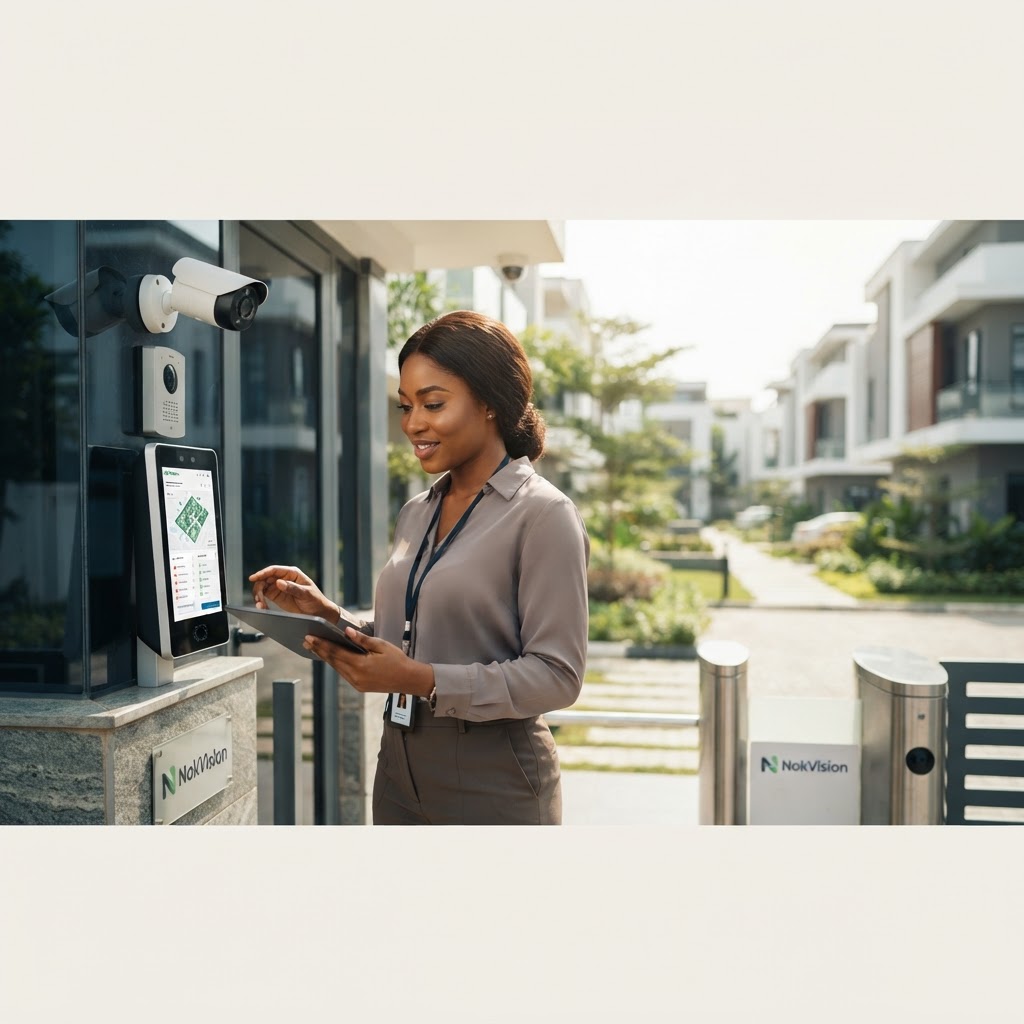
Nigeria's residential estate sector is undergoing a quiet but consequential transformation. As gated communities multiply around Lagos, Abuja, Port Harcourt, and Enugu, the administrative systems holding them together are beginning to crack under pressure. Paper logbooks, fragmented WhatsApp communications, and disconnected security installations were never designed to manage communities of hundreds of households. NokVision, a Nigerian property technology company, is building a platform that attempts to replace this patchwork of manual processes with a single, integrated digital operating environment. This article examines what NokVision is building, how it works, what it costs, and the critical governance questions every estate manager and resident must ask before implementation.
Why Is Traditional Estate Management Failing?
Manual Systems Break at Scale
The operational reality of managing a growing residential estate in Nigeria stretches well beyond what manual systems were ever designed to handle. A community of 30 households can function reasonably well with a handwritten visitor register, informal phone calls to residents, and a shared WhatsApp group for maintenance complaints. Scale that same community to 300 or 1,000 households, and every weakness in those informal systems is exposed simultaneously.
Handwritten gate registers become physically unmanageable. Paper archives cannot be searched when an estate security committee needs to verify who authorized a specific visitor three weeks ago. Service-charge ledgers maintained in spreadsheets become inconsistent when updated by multiple people across different devices. Maintenance complaints posted in WhatsApp groups get buried under unrelated conversation threads, leaving genuine facility faults — faulty streetlights, leaking pipes, electrical hazards — unresolved for weeks.
The security implications are equally serious. When visitor authorization relies entirely on a guard making a phone call to a resident, the process is vulnerable to miscommunication, social engineering, and simple fatigue. Security personnel managing high-traffic gates during peak hours cannot be expected to cross-reference handwritten records, verify identity documents, and simultaneously monitor perimeter activity. Blind spots emerge, both physical and administrative.
The concept of an integrated digital operating system for estate management represents a structural answer to this growing disorder — replacing fragmented, informal tools with a single measurable environment where every action is recorded, searchable, and reportable. This is precisely the problem NokVision is positioning itself to solve.
What Is NokVision's Estate Command Centre?
One Dashboard for All Operations
NokVision describes its platform as an "Estate Manager's Command Centre," and that framing is intentional. The core value proposition is consolidation: instead of maintaining separate tools for resident records, payment tracking, visitor management, CCTV monitoring, and maintenance coordination, estate managers access a single unified interface available across web browsers, iOS, and Android applications. Both management staff and residents interact with the system through role-appropriate interfaces, meaning the same platform serves different operational purposes depending on who is logged in.
The transition from piecemeal administration to end-to-end management is significant in practical terms. An estate manager onboarding a new resident does not need to update multiple separate systems. Resident records, unit assignments, service-charge status, and access privileges exist within the same data environment. When a resident's payment status changes, that change propagates through the relevant parts of the platform automatically.
Beyond day-to-day administration, the platform's reporting capability is an important operational asset. Estate executive committees and resident associations frequently struggle with accountability because the information they need to make decisions — outstanding debts, maintenance backlogs, visitor volumes, gate activity — is scattered across informal channels and never aggregated. NokVision's structured data environment enables the generation of operational reports that surface these metrics systematically. For communities increasingly demanding financial transparency from their management structures — a concern closely mirrored in public-sector accountability debates such as those documented in Mbaitoli LGA's ₦6.2 billion FAAC expenditure question — the availability of auditable digital records is genuinely transformative.
How Does QR Code Visitor Verification Work?
Replacing Paper Registers with Digital Passes
NokVision's visitor management module replaces the manual gate register with a QR-code-based digital pass system. The resident-side workflow begins within the application: a resident creates a visitor pass for an expected guest, specifying the visitor's name, the entry window, and any relevant authorization parameters. The system generates an encrypted QR code tied to that specific pass, which the resident can forward to the visitor directly.
At the gate, security personnel use the platform's scanning interface to verify the pass. The process is faster than a phone call — the guard scans the code, the system confirms authorization in real time, and the visitor's entry is logged with a timestamp. Exit is recorded through the same mechanism. The result is a searchable, time-stamped digital record of every authorized visitor movement, replacing logbooks that can be physically damaged, falsified, or simply lost.
The data security advantages extend beyond convenience. Paper visitor registers are accessible to anyone who can physically reach the gatehouse. A digital record, by contrast, is access-controlled. Searches can be conducted across months of data within seconds, providing estate security committees with audit trails that were previously impossible to maintain. When an incident investigation requires identifying everyone who entered an estate on a specific date, that query takes moments rather than hours of manual review. According to research on access control best practices from ASIS International, layered verification systems combining pre-authorization with physical credential checks represent the current standard for residential security operations worldwide.
How Does Linking Payments to Access Change Estate Economics?
Service Charges Meet Digital Enforcement
Perhaps the most commercially distinctive — and ethically complex — feature of NokVision's platform is its integration of service-charge administration with digital access control. The financial mechanics are straightforward. The platform maintains a service-charge ledger for each residential unit. Residents pay their outstanding charges online, and those payments route directly to the estate management's designated bank account through a Paystack subaccount. NokVision explicitly states that it does not hold resident funds at any point, which is an important operational assurance for estate associations concerned about fiduciary responsibility.
The enforcement mechanism, however, goes further. The platform allows estate managers to configure automatic restrictions on specific digital privileges — including the ability to generate visitor passes and access shared camera feeds — based on a resident's current payment status. This creates a direct chain: payment confirmation updates account status, which in turn restores or restricts digital access privileges.
For estates struggling with chronic service-charge delinquency, this automated enforcement mechanism has genuine administrative appeal. However, its implementation demands serious governance safeguards. What recourse does a resident have when an administrative error, a banking delay, or a disputed charge triggers an access restriction? How quickly can confirmed payments be reconciled and access restored? What constitutes adequate notice before enforcement is activated? These are not theoretical concerns — they are the practical governance questions that distinguish responsible technology deployment from automated harassment. This connects to broader issues of financial transparency and due process that Nigerians encounter across both private and public institutions, including concerns about how communities receive accountability on financial matters. Estate associations adopting this feature should establish clear dispute resolution protocols before enabling automated enforcement.
Featured Products
Chukwu Abiama Tee
Bold black-and-gold Igbo-pride T-shirt featuring 'Chukwu Abiama' in premium streetwear typography.
₦15,000
Buy NowReverse Type 2 Diabetes & other associated Metabolic Issues using Dr. Jason Fung's Evidence-Based Approach— FMD program for Type 2 Diabetes
A practical fasting and fasting-mimicking programme built on Dr Jason Fung's insulin-resistance principles and ow-glycemic recipes.
₦19,950
Join NowỤmụ Igbo Tee
Classic black T-shirt with bold white 'Ụmụ Igbo' typography — a proud statement of Igbo heritage.
₦15,000
Buy NowNwanne Tee
Washed khaki vintage tee with a faded rust-orange 'Nwanne' stamp badge and palm leaf motif — a nod to kinship and heritage.
₦18,000
Buy NowObodo Tee
Faded denim-blue washed tee with a cream 'Obodo' stamp badge and sun motif, celebrating community roots.
₦18,000
Buy NowEkwe Heritage Tee
Deep indigo tee featuring a fine line-art illustration of a traditional Igbo ekwe drum, inspired by Igbo-Ukwu bronze artistry.
₦18,000
Buy NowIkenga Figure Tee
Forest green tee with a fine line-art illustration of a stylized Ikenga figure.
₦18,000
Buy NowCan Estates Use Their Existing Security Hardware?
No Rip-and-Replace Required
One of the most pragmatic aspects of NokVision's platform design is its approach to hardware compatibility. Many Nigerian estates have already made capital expenditures on security infrastructure — boom barriers, turnstiles, and CCTV installations. The prospect of replacing all existing equipment to adopt a new management platform would be prohibitive for the majority of communities. NokVision addresses this by designing its system to integrate with existing hardware through standard protocols.
For gate control, the platform lists compatibility with major access-control hardware brands including Hikvision, ZKTeco, Nortek, CAME, and BFT, as well as support for custom webhook integrations. This means authorised users can trigger gate operations remotely through the application, and a valid visitor QR pass can be configured to automatically activate gate opening — without requiring estate associations to purchase proprietary NokVision hardware or replace functional existing equipment.
The CCTV integration module supports Hikvision and Dahua cameras alongside any device operating on the generic RTSP protocol, which covers a broad range of surveillance hardware commonly deployed in Nigerian residential developments. Camera feeds are accessible within the estate-management dashboard, with role-based viewing permissions ensuring that access to footage is controlled rather than open. Viewing activity is logged, creating an additional accountability layer that is important for data governance. This incremental modernization approach — connecting existing infrastructure to a digital management layer rather than mandating hardware replacement — significantly lowers the financial barrier to adoption for medium-scale Nigerian estates. The Nigeria Institution of Estate Surveyors and Valuers has long highlighted the need for cost-effective technology adoption frameworks in the Nigerian property sector, making this compatibility-first approach strategically well-aligned with market realities.
How Does Digital Maintenance Tracking Help Communities?
From WhatsApp Complaints to Auditable Tickets
Maintenance management is one of the most practically disruptive aspects of residential estate administration, and it is one where informal systems most visibly fail. NokVision's maintenance module transforms the informal complaint process into a structured digital ticket lifecycle. A resident reporting a faulty streetlight, a plumbing failure, or an electrical fault submits a formal request through the application. Management receives the request, assigns it to the appropriate staff member or contractor, and the system tracks progress through to resolution.
The operational metrics this generates are valuable beyond simple convenience. Digital ticketing captures mean time to repair (MTTR) for recurring facility types, creates vendor accountability records, and builds a historical maintenance log that informs future budget planning. When an estate's executive committee needs to evaluate whether a particular service contractor is performing adequately, the ticketing history provides objective data rather than relying on subjective recollection.
NokVision has also expanded into direct technical facility services, including generator and air-conditioning servicing, solar and inverter maintenance, electrical audits, plumbing, carpentry, fumigation, CCTV maintenance, and fire-safety checks. This vertical expansion suggests an ambition to become a comprehensive estate services ecosystem — providing not merely the software to manage vendors, but functioning as a direct service delivery channel for the technical needs that estate maintenance tickets reveal. For Nigerian families seeking better-managed, healthier living environments, the connection between reliable facility maintenance and community wellbeing is direct and important.
What Are the Real Costs and Implementation Risks?
Pricing, Connectivity, and Data Privacy
NokVision currently offers two principal subscription tiers for estate management. The Gated Community package is priced at ₦3,000 per building unit per month, while the Gated Estate package is priced at ₦4,500 per building unit per month. Live camera feed access is available as an add-on at ₦1,000 per building unit per month. Pricing is therefore calculated at the unit level rather than as a flat estate fee, meaning the total monthly cost scales directly with the size of the community.
For a 200-unit estate on the Gated Estate plan with camera feeds, the total monthly software expenditure would be approximately ₦1.1 million. Whether that figure represents good value depends on existing operational costs, administrative staff hours, security incidents, and how effectively service-charge collection improves under the automated system. Estates exploring financing options for technology infrastructure investment may find relevant context in resources on microfinance lending in southeast Nigeria.
Beyond pricing, implementation challenges are structural. The entire platform's functionality depends on consistent internet connectivity — a meaningful concern in a country where network reliability varies significantly by location. As documented in coverage of connectivity challenges in communities like Umuahia–Obi-Mbieri, infrastructure gaps can undermine digital platforms regardless of their technical quality. Power disruptions add a second layer of dependency risk. Offline contingency protocols are not optional; they are essential.
Human operational factors are equally critical. Technology does not replace trained security personnel, and no QR code reader can substitute for human judgement when a genuine security threat emerges. Data governance demands particular attention: residents should seek clarity on how long visitor data is retained, who can access CCTV footage, what data protection standards govern the platform, and how personal information is secured in compliance with the Nigeria Data Protection Act. Responsible implementation demands clear policies on each of these questions before any estate goes live.
Conclusion: Nigeria's Estates Are Going Digital
NokVision represents something genuinely significant in the Nigerian technology landscape: a company building not for the fintech mainstream, but for the specific, complex realities of residential estate management in rapidly urbanizing Nigerian communities. Its integrated approach — combining resident administration, visitor management, service-charge enforcement, CCTV integration, gate control, and maintenance tracking into a single platform — addresses a real operational gap that is only growing more acute as gated communities expand.
The platform's value is ultimately informational. When estate managers can instantly answer who entered the estate, who authorized a visitor, which service charges are outstanding, what maintenance issues are unresolved, and who opened the gate — the community becomes measurably more accountable and more secure. That accountability dividend is available to any estate willing to invest in responsible digital implementation.
The genuine tests ahead for NokVision involve reliability at scale, adequate customer support, data protection standards, and building sufficient trust among both managers and residents to sustain consistent adoption. Technology platforms succeed in Nigeria not by being technically sophisticated, but by being practically dependable. If NokVision can demonstrate sustained reliability across hundreds of estates and thousands of residents, it has the potential to establish a new operational standard for how Nigerian residential communities are managed — from a screen, with accountability built in.
For more community accountability journalism, governance analysis, and practical empowerment resources for Nigerian families, visit eziokwubundu.com.
Stay Informed
Get New Articles in Your Inbox
Subscribe to receive the latest community development, health, and wealth insights from Eziokwubundu.
Newsletter
Practical insights on health, wealth, and community — delivered weekly.