Powered by Obi Mbieri Independent Media Ltd · eziokwubundu.com
$1 = ₦1,324€1 = ₦1,538£1 = ₦1,790Imo’s ₦350 Million NBA Controversy: What Happened to the Money and What the Government Must Explain?
A reported ₦350 million financial intervention by the Imo State Government for lawyers attending the 2026 Nigerian Bar Association Annual General Conference has ignited one of the most significant public finance controversies in the state's recent history. What began as an apparent act of government...
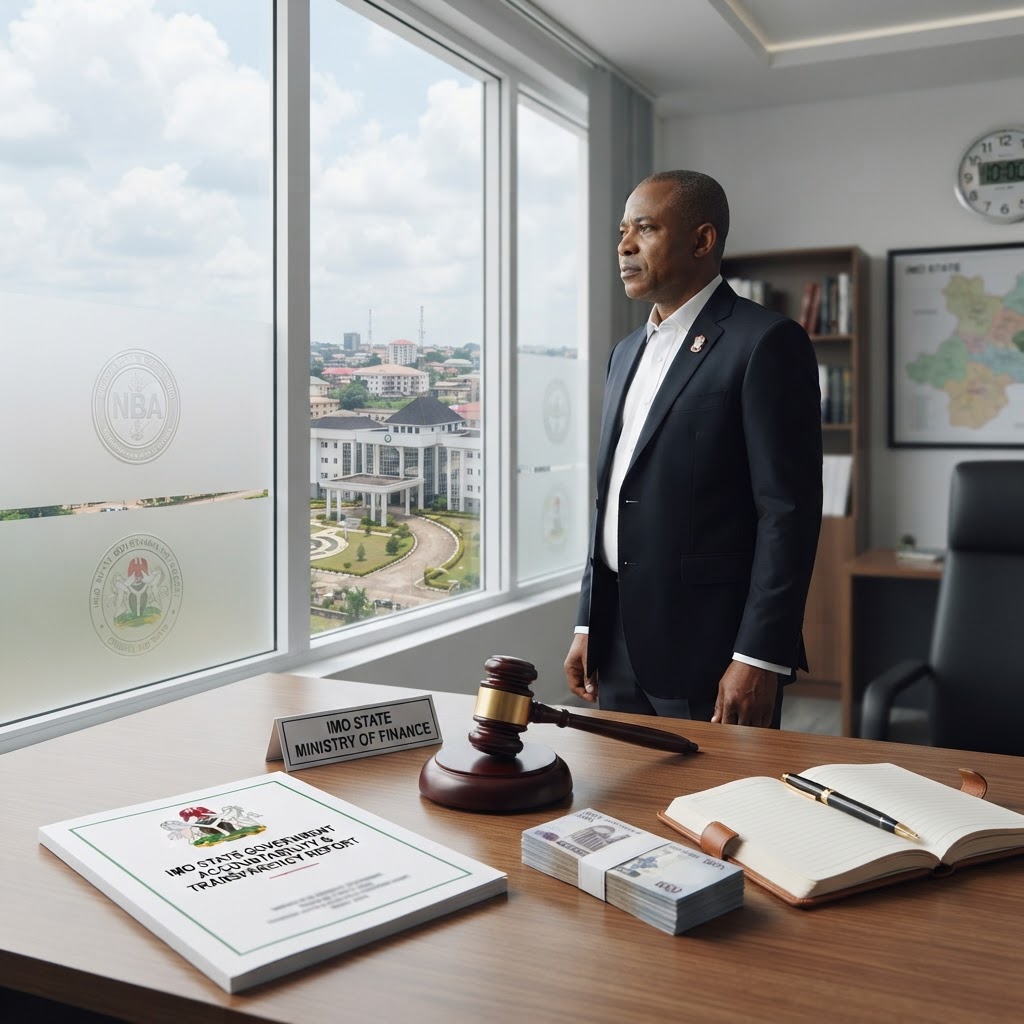
A reported ₦350 million financial intervention by the Imo State Government for lawyers attending the 2026 Nigerian Bar Association Annual General Conference has ignited one of the most significant public finance controversies in the state's recent history. What began as an apparent act of government goodwill toward legal professionals has rapidly evolved into a multi-layered accountability crisis touching on judicial independence, executive overreach, and the integrity of public expenditure. The questions now circulating across civil society are pointed, urgent, and demand answers grounded not in political rhetoric but in documented evidence.
For Nigerian families, community stakeholders, and anyone who relies on a functioning justice system, this controversy matters far beyond the legal profession. It cuts to the heart of how public money is managed, whether professional institutions can maintain independence in the face of executive patronage, and whether transparency is treated as an obligation or an inconvenience by those in power.
What Sparked the ₦350 Million Imo NBA Controversy?
The Origin of the State Allocation to Conference Delegates
The reported ₦350 million was structured as a specific disbursement to six Nigerian Bar Association branches across Imo State, purportedly to support lawyers attending the 2026 NBA Annual General Conference held in Port Harcourt, Rivers State. According to statements attributed to human-rights lawyer and former NBA Owerri Branch secretary Chinedu Agu, the allocation was divided as follows: ₦100 million designated for the NBA Owerri Branch, and ₦50 million each for five other branches — Orlu, Mbaise, Okigwe, Oru-Oguta, and Mbano-Etiti.
The announcement was reportedly made by the Imo State Attorney-General and Commissioner for Justice, a detail that immediately raised institutional questions given the Attorney-General's dual role as both a political appointee and the state's chief law officer.
Chinedu Agu was among the first voices to flag the unprecedented nature of this funding. His concern was informed by context: for approximately six years, Imo lawyers had funded their own attendance at the NBA Annual General Conference through personal resources, without any structural government support. The sudden emergence of a ₦350 million state-backed package — announced ahead of a conference widely expected to intersect with sensitive judicial appointment debates — struck Agu and others as deserving immediate scrutiny.
On its own terms, government support for professionals attending a national conference need not be controversial. But the scale of ₦350 million, the timing of the announcement, the identity of the announcing authority, and the circumstances surrounding certain branch allocations collectively transformed what might have been routine into something requiring full public explanation. The Imo public deserves to know precisely how this amount was authorised, through what budgetary process, and why now.
Was the Grant Tied to the Chief Judge Appointment?
Investigating Allegations of Conditional Executive Inducements
The ₦350 million controversy took on a far more serious constitutional dimension when allegations emerged that the financial support may have been linked to efforts to mobilise NBA branch chairmen to sign a petition letter addressed to the National Judicial Council, urging it to expedite the appointment of a substantive Chief Judge for Imo State.
According to the allegation, as reported by Sahara Reporters, the proposed arrangement involved the branch chairman who allegedly led the signature drive receiving ₦100 million, with the remaining five branches each receiving ₦50 million for their participation in the letter-writing initiative.
The constitutional architecture governing this process is important. The appointment of a substantive Chief Judge in any Nigerian state is a matter within the jurisdiction of the State Judicial Service Commission, subject to confirmation by the State House of Assembly and the oversight of the National Judicial Council. It is emphatically not a matter on which the executive arm of government — let alone a body acting in apparent coordination with the executive — ought to be exerting financial leverage over the organised legal profession.
There is a critical distinction that must be maintained throughout any analysis of this controversy. There is a meaningful difference between government approving legitimate conference assistance, government making those payments conditional on professional compliance, and government using public money to influence an institutional position of the NBA on a matter touching the judiciary. These are not equivalent scenarios. Only documentary evidence — payment records, correspondence, internal memoranda, and formal approvals — can conclusively establish which scenario applies here.
The allegation of a financial inducement has not been independently verified. Nevertheless, its seriousness demands investigation rather than dismissal.
Why Was NBA Mbaise Initially Denied Its Allocation?
The Standoff Between Branch Leadership and State Intermediaries
The most concrete and specific claim to emerge from this controversy involves the NBA Mbaise Branch. According to reports, including coverage by The News Chronicle, the Mbaise Branch was initially withheld its reported ₦50 million allocation after its chairman, Chief J. N. Nwawudu, allegedly declined to endorse the letter directed at the National Judicial Council concerning the Chief Judge appointment.
Chief Nwawudu's on-the-record position was that he was unwilling to affix his signature to a document whose purpose he considered inappropriate for the independent professional judgment of an NBA branch executive. That refusal reportedly triggered a withholding of the branch's allocation — a sequence of events that, if verified, would constitute a deeply troubling use of discretionary state funding as an instrument of professional compliance.
The reported sequel is equally significant. Following intense public exposure and internal pressure within legal and civil society circles, the ₦50 million share was reportedly released to the NBA Mbaise Branch on September 1, 2026. That release, if confirmed, raises its own questions. If the payment was originally delayed because the branch chairman declined to sign the letter, what changed? Was the condition withdrawn? Was the letter abandoned? Or was the money simply released to manage the emerging public relations crisis?
The legal and institutional implications of withholding discretionary grants — or grants with any governmental backing — on the basis of professional compliance are severe. Such a practice, if established, would represent a fundamental assault on the institutional independence that the NBA has historically guarded. It would also raise questions about the integrity of public financial management across all government-professional relationships in the state.
Why Is CEHRAWS Demanding Full Public Accountability?
Civil Society Pushes on Budgetary Integrity
The Centre for Human Rights Advocacy and Wholesome Society (CEHRAWS) has formally entered the public debate with a structured demand for transparency. The organisation identified ten fundamental accountability questions that it has directed at the Imo State Government, covering the full chain of documentary evidence that should underpin any legitimate public expenditure of this magnitude.
Among the most pressing questions raised by CEHRAWS are: What was the legal and budgetary authority for the ₦350 million? Under which appropriation head in the 2026 Imo State budget was it provided? Was the expenditure subjected to the standard government approval process? Were payment vouchers raised? Were the funds paid directly to NBA branches or routed through an intermediary? Were conditions attached to the funding, and if so, what were they? And most critically, was the funding in any way connected to the debate over the appointment of a substantive Chief Judge?
Featured Products
Chukwu Abiama Tee
Bold black-and-gold Igbo-pride T-shirt featuring 'Chukwu Abiama' in premium streetwear typography.
₦15,000
Buy NowReverse Type 2 Diabetes & other associated Metabolic Issues using Dr. Jason Fung's Evidence-Based Approach— FMD program for Type 2 Diabetes
A practical fasting and fasting-mimicking programme built on Dr Jason Fung's insulin-resistance principles and ow-glycemic recipes.
₦19,950
Join NowỤmụ Igbo Tee
Classic black T-shirt with bold white 'Ụmụ Igbo' typography — a proud statement of Igbo heritage.
₦15,000
Buy NowNwanne Tee
Washed khaki vintage tee with a faded rust-orange 'Nwanne' stamp badge and palm leaf motif — a nod to kinship and heritage.
₦18,000
Buy NowObodo Tee
Faded denim-blue washed tee with a cream 'Obodo' stamp badge and sun motif, celebrating community roots.
₦18,000
Buy NowEkwe Heritage Tee
Deep indigo tee featuring a fine line-art illustration of a traditional Igbo ekwe drum, inspired by Igbo-Ukwu bronze artistry.
₦18,000
Buy NowIkenga Figure Tee
Forest green tee with a fine line-art illustration of a stylized Ikenga figure.
₦18,000
Buy NowThese are not adversarial questions. They are the standard accountability instruments that any citizen or civil society body is entitled to deploy when substantial public money is in question. The legal imperative is equally clear: public expenditure in Nigeria must follow a defined appropriation process under the Appropriation Act. Discretionary executive patronage — the deployment of public money outside a clear legislative mandate and budgetary approval — is not a legitimate basis for spending ₦350 million of taxpayer funds.
CEHRAWS also demanded published audit trails, verifiable banking transaction records, and explicit terms of reference for the professional sponsorship. These demands mirror the accountability standards applied to all government spending, and they provide a constructive roadmap for the Imo State Government to resolve the controversy through document disclosure rather than political counter-narrative.
This situation is not unlike questions raised about public fund disbursements in other Imo contexts. Our earlier investigation into ₦6.2 Billion in FAAC allocations received by Mbaitoli LGA demonstrated precisely what happens when public funds flow without transparent accountability mechanisms.
Could ₦350 Million Have Rescued Imo's Justice Infrastructure?
Evaluating Public Spending Priorities Through the Practical Prosperity Lens
Even setting aside the allegations of conditional funding, the reported ₦350 million allocation deserves scrutiny on the straightforward basis of public expenditure priority. CEHRAWS made this argument explicitly: if government can mobilise ₦350 million for professional conference attendance, citizens are entitled to ask why comparable resources are not being channelled into the deteriorating physical infrastructure of Imo's justice system.
The state of Magistrate Courts and Customary Courts across Imo is well-documented among legal practitioners. Many courtrooms operate without reliable electricity, suffer from leaking roofs, lack basic furniture, and are without transportation support for presiding magistrates. The human cost of this infrastructure deficit falls disproportionately on ordinary Nigerians — market traders, farmers, and community members who depend on local courts for the resolution of land, family, and commercial disputes.
The opportunity cost arithmetic is instructive. At ₦350 million, the state government could have funded sustainable solar power installations across dozens of courtrooms, procured utility vehicles for more than twenty presiding magistrates currently operating without reliable transport, or established a dedicated court digitisation fund. Considered on a per-lawyer basis, the ₦100 million reportedly allocated to the Owerri Branch would yield approximately ₦142,000 per lawyer in that branch — a one-time conference subsidy that produces no lasting institutional infrastructure.
The argument is not that lawyers are undeserving of professional development support. It is that sustainable institutional investment — in the physical, technological, and human infrastructure of justice delivery — produces enduring community benefits that dwarf the value of conference attendance subsidies. A community that cannot access functioning local courts is a community whose economic and social development is structurally constrained.
Just as community neglect manifests physically in institutions such as the Imo School for the Deaf, the state's justice infrastructure failures reflect the same pattern of systemic under-prioritisation that citizens continue to pay for in daily life.
What Must the Imo Government and NBA Branches Disclose Next?
A Document-Based Roadmap to Safeguard Public Trust
The path forward for the Imo State Government is clear, accessible, and requires no prolonged political negotiation. Five specific documentary disclosures would substantially resolve the core accountability questions now in public circulation.
First, the government must confirm whether the ₦350 million expenditure occurred and, if it did, publish the full payment records including treasury vouchers and the relevant appropriation law reference. Second, the legal authority for the expenditure must be clearly identified — including the specific budget head under the 2026 Imo State Appropriation Act. Third, a complete payment schedule must be disclosed, naming each NBA branch, the exact amount disbursed to each, and the dates of payment. Fourth, the government must explicitly state whether any institutional or political conditions were attached to the funding. Fifth, and most urgently, the government must directly address the allegation that the funding was connected to the Chief Judge controversy, rather than allowing speculation to substitute for documented fact.
The six NBA branch executive committees carry an equivalent responsibility. Each branch should disclose publicly whether it received an allocation, the exact amount and date received, the stated purpose communicated by the disbursing authority, how the funds were utilised on behalf of members, and whether any branch leadership was asked to endorse a governmental or judicial position as a condition of receiving the funds. Voluntary disclosure of this nature would protect the professional reputation of branch executives far more effectively than silence.
At Eziokwubundu.com, our community-first perspective holds that an independent Bar and transparent public finance are not abstract legal values — they are the practical foundation on which community development, local enterprise, and equitable access to justice are built. The same accountability principles that we apply to tracking FAAC allocations in Mbaitoli LGA apply with equal force here. When public money moves, the public has a right to follow it.
Conclusion: Transparency Is the Only Acceptable Answer
The ₦350 million NBA controversy in Imo State is not simply a dispute about conference funding. It is a test of the state's commitment to transparent governance, judicial independence, and the accountability standards that Nigerian families and community stakeholders have every right to expect from elected officials and professional institutions alike.
The allegations currently circulating — that government funding was made conditional on NBA branch chairmen endorsing a position on the Chief Judge appointment — must not be treated as proven without evidence. But neither can they be dismissed without investigation. The only credible path to resolution is documentary: publish the appropriation authority, release the payment records, and let the evidence settle the question.
Eziokwubundu.com will continue to track this story as documents become available. Our commitment is to evidence-based community journalism that connects public finance accountability to the practical prosperity and wellbeing of Nigerian families. When public institutions operate transparently, communities thrive. When they do not, the cost is borne by ordinary citizens — in courtrooms without power, in justice delayed, and in public trust eroded one unexplained expenditure at a time.
The Imo State Government has both the opportunity and the obligation to answer these questions. The public is waiting.
Stay Informed
Get New Articles in Your Inbox
Subscribe to receive the latest community development, health, and wealth insights from Eziokwubundu.
Newsletter
Practical insights on health, wealth, and community — delivered weekly.