Powered by Obi Mbieri Independent Media Ltd · eziokwubundu.com
Primary Healthcare in Mbaitoli: Clinics on Paper, Services on the Ground?
For the hundreds of thousands of families living across Mbaitoli Local Government Area in Imo State, the phrase "primary healthcare" carries a particular, painful irony. Government directories, state agency websites, and official budget lines paint a picture of a well-served rural population — ward-...
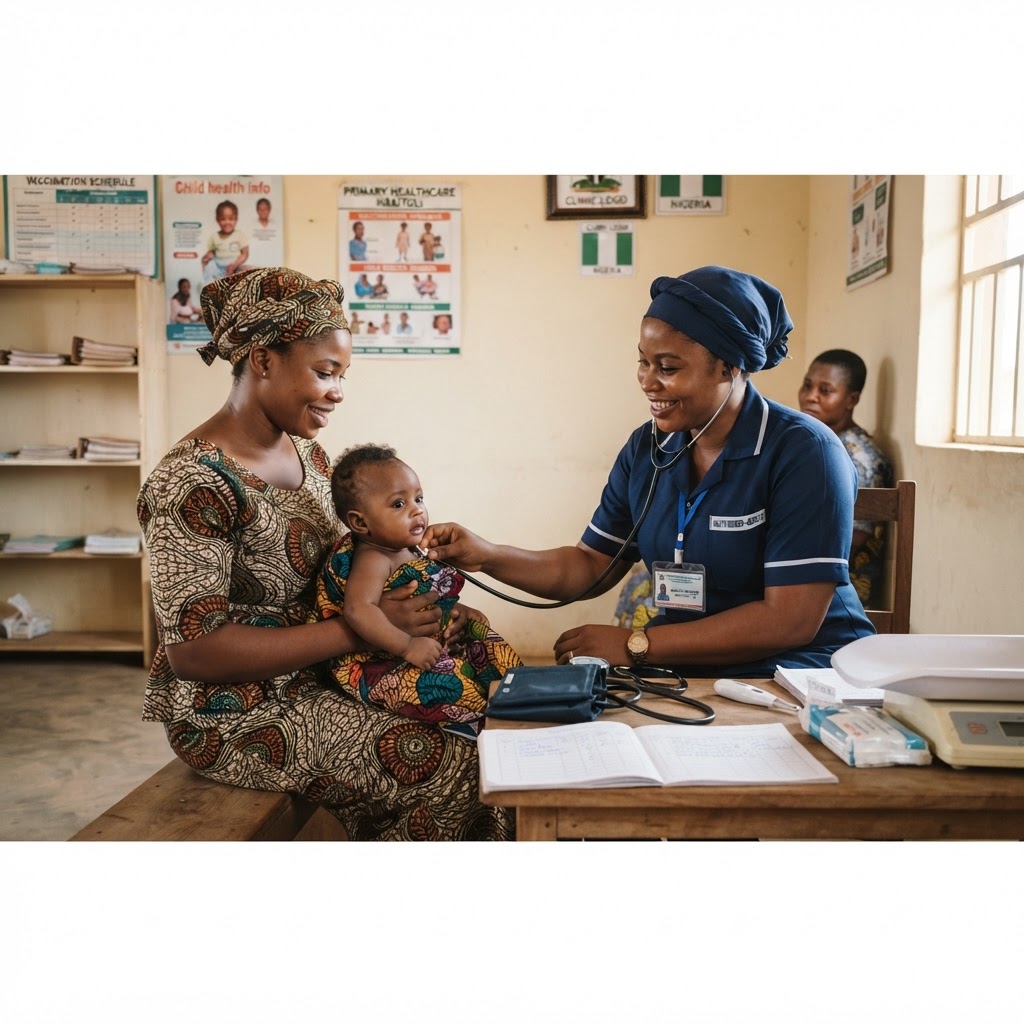
For the hundreds of thousands of families living across Mbaitoli Local Government Area in Imo State, the phrase "primary healthcare" carries a particular, painful irony. Government directories, state agency websites, and official budget lines paint a picture of a well-served rural population — ward-level clinics, immunization outreach, maternal care, and basic medicine supply. Yet the lived reality for a mother in Ohohia, a subsistence farmer in Umuduru, or a young family in Orie Mbieri is often something else entirely: locked clinic doors, absent nurses, empty medicine shelves, and a forced choice between an unregulated roadside chemist and an expensive, exhausting journey to Owerri.
This investigation asks the hard question behind those contradictions: when the state spends public funds to establish and maintain primary healthcare centres across Mbaitoli, why do communities still go without care? And why does that gap matter not just medically, but economically and developmentally, for one of Imo State's most populous and strategically important local government areas?
Why Does Mbaitoli's Healthcare Divide Matter?
Health, wealth, and community are inseparable
Mbaitoli LGA is not a small, peripheral corridor. Spanning approximately 204 square kilometres and encompassing nine major towns, over 20 autonomous communities, and a conservative population estimate of more than 327,000 residents, it represents a significant portion of Imo State's human capital. The Imo State Primary Healthcare Development Agency (ISPHCDA) formally lists ward-level primary healthcare centres across the LGA, suggesting structured geographic coverage aligned with Nigeria's national PHC policy framework under the National Primary Health Care Development Agency (NPHCDA).
The gap between those institutional listings and the everyday clinical realities of Mbaitoli families is not a minor administrative discrepancy. It is a structural failure with cascading economic consequences. Untreated chronic ailments — hypertension, malaria, diabetes, respiratory infections — do not remain medical problems for long. They become financial catastrophes. A rural agrarian household that loses its primary earner to a preventable illness, or one that spends its entire seasonal income on an emergency transfer to a private hospital in Owerri, does not simply suffer a health shock. It loses capital it may not recover for years.
This is the core logic of the "Health + Wealth + Community" triangle that should inform every local governance decision in Mbaitoli. When primary preventive care fails at the ward level, the economic mobility of thousands of households is sabotaged before it begins. Maternal complications that go unmanaged at PHC level result in emergency costs that can exceed ₦150,000 at private facilities — a sum that can equal or exceed a small farmer's annual income. The downstream effects ripple through school enrolment, food security, and community savings structures.
The overarching paradox remains: PHCs that appear fully funded in government directories force local families to choose between predatory informal patent medicine vendors, traditional healers of variable quality, or unaffordable specialist care. Resolving that paradox is not optional — it is a prerequisite for Mbaitoli's broader development.
What Do Field Assessments Find Inside Rural Clinics?
Infrastructure gaps behind renovated facades
Independent civil society monitoring in Mbaitoli and surrounding Imo corridors has produced a consistent and damning picture. Organizations including Tracka Nigeria — a civic tracking platform that monitors constituency and government project delivery — have documented significant disparities between what is officially reported and what exists structurally on the ground. Community audits at facilities serving the Orie Mbieri, Ohohia, and Umuduru corridors reveal a familiar pattern: exterior renovation work that satisfies contractor completion criteria while masking substandard structural execution. Roofing blown away during seasonal rains, wall cracking due to poor cement ratios, and drainage systems that collapse within months of commissioning are recurring findings.
Beyond structural aesthetics, the infrastructure deficits crippling basic care delivery are severe. Chronic water shortages at clinic facilities render basic hygiene protocols impossible to maintain — a critical failure in facilities expected to conduct deliveries, wound management, and intravenous treatment. Electrification is either intermittent or entirely absent in several ward-level centres, creating a catastrophic cold chain problem. Without reliable electricity, vaccine refrigeration fails. Without cold chain integrity, immunization programs lose their medical validity. According to data from the NPHCDA's national immunization coverage assessments, consistent cold chain failure is one of the leading causes of low effective vaccine coverage in rural LGAs across Nigeria's South-East geopolitical zone.
Perhaps the most viscerally revealing finding from community monitoring efforts is the routine absence of basic medical consumables. Patients presenting at facilities arrive to discover that syringes, examination gloves, antimalarial medications, oral rehydration salts, and even basic wound dressings are unavailable — despite state declarations of free or subsidized primary healthcare. Community members are verbally directed by health workers to purchase their own supplies from nearby roadside pharmacies before treatment can proceed. This practice effectively privatizes the cost of what is nominally a public service, transferring state failure directly onto the household budgets of Mbaitoli's poorest families.
For detailed data on how many facilities across the LGA are operationally viable, read our companion investigation: Mbaitoli's Health Centres: How Many Are Actually Functional?
How Severe Is the Staffing and Cost Crisis?
Burnout, bias, and broken pricing regimes
The staffing crisis across Mbaitoli's primary healthcare system is not a secondary problem — it is the central operational failure from which most other deficiencies flow. Community health extension workers (CHEWs), midwives, and registered nurses are the functional backbone of any viable PHC system. In multiple Mbaitoli wards, community monitors have documented single health workers attempting to serve catchment populations of 3,000 to 6,000 residents. These solitary staff members manage antenatal clinics, outpatient consultations, immunization rounds, and emergency triage — frequently across double-shifts and unmonitored overnight periods. The inevitable result is burnout, clinical error, and institutional abandonment, with trained staff eventually seeking placements in Owerri, Lagos, or abroad.
Featured Products
Chukwu Abiama Tee
Bold black-and-gold Igbo-pride T-shirt featuring 'Chukwu Abiama' in premium streetwear typography.
₦15,000
Buy NowReverse Type 2 Diabetes & other associated Metabolic Issues using Dr. Jason Fung's Evidence-Based Approach— FMD program for Type 2 Diabetes
A practical fasting and fasting-mimicking programme built on Dr Jason Fung's insulin-resistance principles and ow-glycemic recipes.
₦19,950
Join NowỤmụ Igbo Tee
Classic black T-shirt with bold white 'Ụmụ Igbo' typography — a proud statement of Igbo heritage.
₦15,000
Buy NowNwanne Tee
Washed khaki vintage tee with a faded rust-orange 'Nwanne' stamp badge and palm leaf motif — a nod to kinship and heritage.
₦18,000
Buy NowObodo Tee
Faded denim-blue washed tee with a cream 'Obodo' stamp badge and sun motif, celebrating community roots.
₦18,000
Buy NowEkwe Heritage Tee
Deep indigo tee featuring a fine line-art illustration of a traditional Igbo ekwe drum, inspired by Igbo-Ukwu bronze artistry.
₦18,000
Buy NowIkenga Figure Tee
Forest green tee with a fine line-art illustration of a stylized Ikenga figure.
₦18,000
Buy NowThe human resource shortage problem is not unique to Mbaitoli — it reflects a systemic national pattern documented in the World Health Organization's Nigeria Health Workforce Report, which identifies South-East rural LGAs as critically understaffed relative to national minimum staffing norms. What makes Mbaitoli's situation particularly acute is the combination of population density and geographic dispersion: many communities are accessible only by poorly maintained rural roads, making emergency referrals dangerous and time-consuming.
Compounding the structural staffing failure is the emergence of informal and arbitrary pricing regimes within PHC facilities. Community monitors have documented differential delivery fees that expose an exploitative internal culture — with reports of charges as high as ₦25,000 for the delivery of a male child versus ₦20,000 for a female child. Such pricing is not only legally indefensible under Nigeria's Basic Health Care Provision Fund (BHCPF) guidelines, which mandate free or heavily subsidized maternal and child health services — it is a direct disincentive for low-income mothers to seek formal institutional delivery. The economic penalty compounds the clinical risk.
When formal facilities fail, Mbaitoli families turn predictably to unregulated alternatives — roadside patent medicine stores staffed by untrained vendors, and traditional birth attendants (TBAs) operating without obstetric emergency capacity. The clinical consequence is late-stage emergency presentations: women arriving at referral hospitals after prolonged obstructed labor, children with severe malaria dehydration, and hypertensive crises that have gone unmanaged for months. These are preventable emergencies that overwhelm secondary health facilities while also generating catastrophic household expenditures. For a detailed breakdown of what these costs look like, see our investigation into how much it costs to give birth in Imo in 2026.
Why Does the Knowledge-to-Utilization Gap Persist?
Awareness without action among Mbaitoli women
One of the most counterintuitive findings from community health research in Mbaitoli is the simultaneous presence of high awareness and low utilization. Cross-sectional studies conducted in Mbaitoli localities — including data gathered from Ogbaku and Ihitte-Mbieri communities — indicate that general awareness of PHC facilities approaches 90% among adult women. Most mothers know the clinic exists. Most can identify its location. What they lack is comprehensive functional knowledge of the preventive services available there, and the institutional trust required to act on that knowledge.
Research findings suggest that comprehensive knowledge of primary preventive services — including antenatal care timing, routine maternal immunization schedules, deworming protocols, vitamin A supplementation, and human papillomavirus (HPV) vaccination — hovers between just 20% and 30% among the same population that reports near-universal facility awareness. This is the knowledge-to-utilization gap in its most damaging form: communities that know a service point exists but remain uninformed or mistrustful of what it offers.
The socio-cultural drivers behind this gap are multiple and reinforcing. Social media misinformation campaigns — particularly those targeting routine immunization and HPV vaccination — have achieved significant penetration in Mbaitoli's semi-urban and rural communities. Rumors linking vaccines to infertility, chronic illness, or covert population control circulate through WhatsApp networks and gain credibility in the absence of authoritative counter-messaging. The institutional distrust that makes these rumors credible is itself a product of the service delivery failures described in previous sections: when a family arrives at a clinic and finds it empty, supplies absent, and staff absent, they become susceptible to narratives that frame formal healthcare as a threat rather than a resource.
Reversing this dynamic requires targeted, culturally grounded health communication that meets communities where they already congregate and trust. Village town meetings, church health forums, and women's cooperative gatherings represent underutilized platforms for structured preventive health literacy campaigns. The WHO's community engagement framework for immunization programs specifically identifies trusted community intermediaries — traditional rulers, pastors, women's group leaders — as essential vectors for correcting vaccine misinformation in low-trust environments. In Mbaitoli's context, this approach is not optional — it is the primary mechanism through which knowledge can be converted into life-saving preventive action.
How Can Communities and Government Reform the System?
From paper clinics to genuine community lifelines
Reforming primary healthcare in Mbaitoli is not an insurmountable challenge — it is a governance, accountability, and investment problem with documented, replicable solutions. The path forward requires simultaneous action at three levels: community-led monitoring, diaspora co-investment, and state-level policy reform.
At the community level, Ward Development Committees (WDCs) and traditional rulers — particularly Ezes whose authority carries genuine institutional weight in Mbaitoli's autonomous community structure — must be formally empowered as civic accountability actors. This means establishing structured quarterly clinic performance reviews open to community members, demanding transparent budget disclosure from the ISPHCDA, and creating documented escalation channels when facilities fail to meet basic operational benchmarks. Where public funds have been misappropriated in facility contracts — a pattern the Auditor-General has flagged in contract irregularities worth ₦124.12 billion across federal agencies — traditional institutions must be equipped to challenge those findings directly with state authorities.
Mbaitoli's prosperous diaspora networks and town union structures — particularly the aladimma organizations that have historically funded community infrastructure across Imo State — represent a largely untapped co-investment resource. Structured diaspora health endowment funds, coordinated through verifiable community trusts, could finance solar mini-grid installations that resolve the electrification and cold chain crisis, borehole water systems that restore basic clinic hygiene, and competitive performance stipends for health workers willing to serve in underserved wards. Nigeria's Diaspora Direct Investment (DDI) framework provides legal structures through which such investment can be formalized, monitored, and incentivized.
At the state policy level, Imo State authorities must institutionalize digital budget tracking for all PHC capital and recurrent expenditures — making facility-level spending publicly accessible and auditable. Harmonizing frontline healthcare workers' salary packages with federal benchmarks is essential to stemming the brain drain that strips Mbaitoli's clinics of qualified staff. Equally important is the integration of preventive health literacy programming into autonomous community town hall calendars — creating a regular, institutionalized rhythm of health education that reaches populations without requiring them to visit a clinic they distrust.
Primary healthcare in Mbaitoli cannot remain a line item in a state budget that produces no measurable service delivery outcome. The families living across Ohohia, Mbieri, Ogbaku, and Umuduru deserve clinics that are open when needed, staffed by qualified workers, stocked with basic medicines, and powered by reliable electricity. Converting paper clinics into genuine community lifelines is not charity — it is the foundational investment that determines whether Mbaitoli's human capital grows or erodes over the next generation. The accountability infrastructure, investment models, and policy frameworks to achieve that transformation already exist. What remains is the political will to apply them.
Stay Informed
Get New Articles in Your Inbox
Subscribe to receive the latest community development, health, and wealth insights from Eziokwubundu.
Newsletter
Practical insights on health, wealth, and community — delivered weekly.