Powered by Obi Mbieri Independent Media Ltd · eziokwubundu.com
$1 = ₦1,332€1 = ₦1,498£1 = ₦1,775Nigerian Prosperity: Health, Wealth, Community Decoded
Every Nigerian — at home or in the diaspora — carries an unspoken ambition: to live well, build wealth, and leave a thriving community behind. This pillar guide breaks down the interconnected pillars of health, wealth creation, and community development into actionable, culturally grounded strategie...
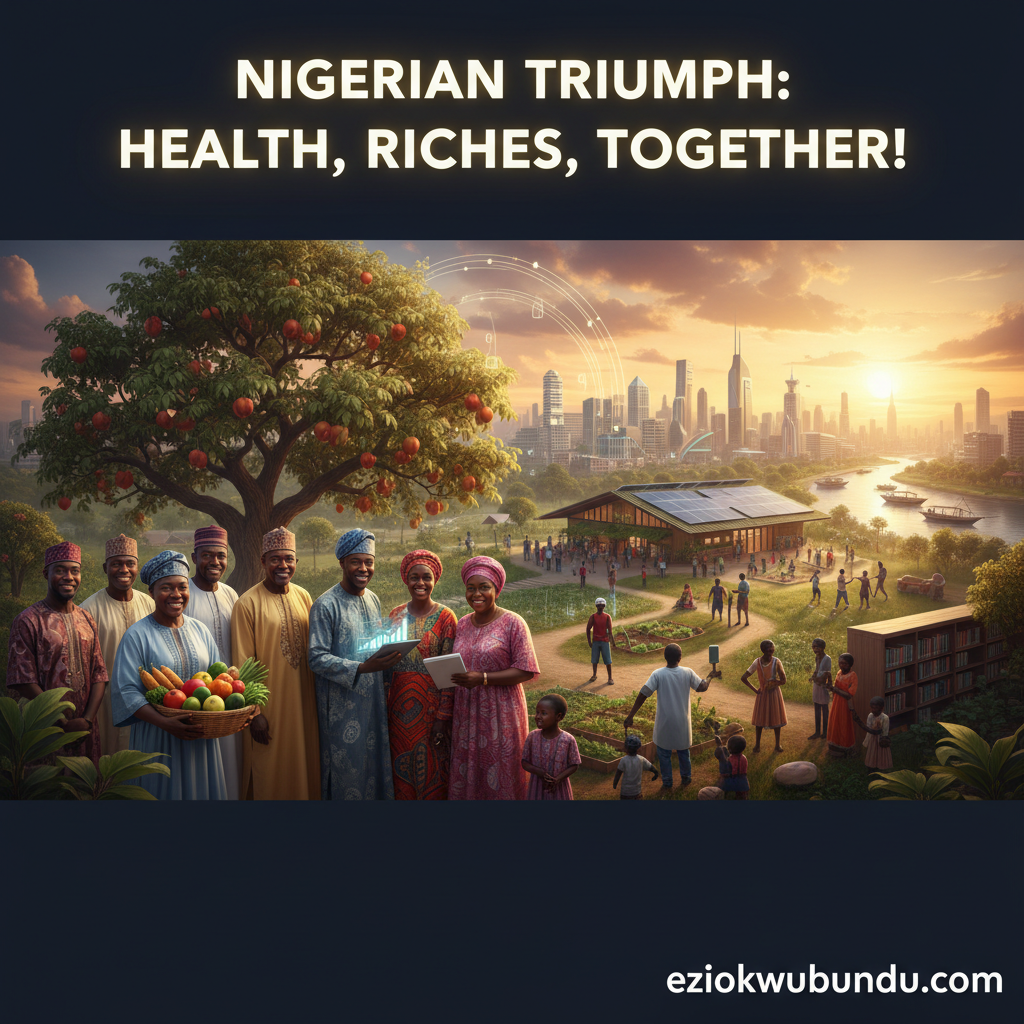
Every Nigerian — at home or in the diaspora — carries an unspoken ambition: to live well, build wealth, and leave a thriving community behind. This pillar guide breaks down the interconnected pillars of health, wealth creation, and community development into actionable, culturally grounded strategies you can start using today.
Health as the Root of All Achievement
You cannot build wealth from a sickbed, and communities cannot grow without healthy citizens. This section explores how prioritising physical and mental health creates the foundation for every other gain.
Nature's Pharmacy in Nigerian Kitchens
Nigeria is blessed with some of the world's most potent medicinal plants, many already sitting in everyday kitchens. Ingredients like moringa, turmeric, bitter leaf, and ginger are not just culinary staples — they are evidence-backed tools for disease prevention and immune support.
Moringa (Moringa oleifera), widely studied by the World Health Organization, contains more vitamin C than oranges and more calcium than milk. Regular consumption has been linked to reduced blood pressure, improved blood sugar control, and stronger immunity — outcomes that matter deeply for Nigerians managing hypertension and diabetes.
Bitter leaf (Vernonia amygdalina) has long been used in traditional Igbo and Yoruba medicine to support liver health and manage malaria symptoms. Modern pharmacological studies published by institutions like PubMed Central increasingly validate these traditional uses, encouraging their integration into modern wellness routines.
A practical daily ritual for natural health can include:
- Start mornings with warm water, lemon, and a pinch of turmeric
- Incorporate bitter leaf soup at least twice weekly
- Drink moringa leaf tea as an afternoon energy booster
- Add ginger and garlic to evening meals for anti-inflammatory benefit
Preventing Nigeria's Biggest Health Killers
Hypertension, diabetes, and malaria remain the top causes of preventable death among Nigerians. The Nigeria Centre for Disease Control (NCDC) consistently highlights that lifestyle modification — not medication alone — is the most cost-effective intervention.
Reducing processed food consumption, increasing physical activity to at least 30 minutes daily, and prioritising sleep are non-negotiable habits. These changes cost nothing but discipline, yet they dramatically reduce the risk of cardiovascular disease — the leading killer of Nigerians over 40.
For Nigerians in the diaspora, the shift toward Western diets high in sodium and refined sugars creates compounded risk. Consciously maintaining traditional Nigerian dietary patterns — rich in whole grains, legumes, vegetables, and lean proteins — is both a cultural act and a powerful health strategy.
Sleep, Stress, and the Nigerian Hustle
The culture of overwork is celebrated in Nigerian communities, but chronic stress and poor sleep silently erode health and cognitive function. Elevated cortisol from sustained stress disrupts insulin sensitivity, impairs memory, and increases the risk of burnout.
Building a sleep routine, practising mindfulness or prayer, and carving out deliberate rest periods are not signs of weakness — they are performance strategies. High achievers from Lagos to London who sustain long-term productivity invariably protect their recovery time.
Wealth Creation Strategies That Actually Work
Wealth creation for Nigerians requires strategies calibrated to both local realities and global opportunities. These are proven pathways — not get-rich-quick schemes — grounded in discipline, community leverage, and long-term thinking.
Diaspora Remittances as Strategic Capital
Nigeria receives over $20 billion in annual remittances, making it one of the largest remittance-receiving nations in Africa, according to World Bank data. Yet most of this money is spent on consumption rather than invested for growth.
Shifting even 20% of remittance flows into productive investments — farmland, real estate, small business equity, or education — can transform family financial trajectories within a single generation. This requires intentionality: setting investment goals before sending money home, working with trusted local partners, and tracking returns annually.
For Nigerians in diaspora, establishing a dedicated remittance-to-investment account is a practical first step. Many Nigerian fintech platforms now offer structured investment products linked to real-sector assets, making participation easier than ever before.
Agricultural Investment for Long-Term Passive Income
Nigeria's agricultural sector remains vastly underinvested relative to its potential, creating significant opportunities for diaspora and domestic investors alike. Cassava, poultry, aquaculture, and horticulture are among the highest-return agricultural subsectors accessible with modest startup capital.
Crowdfunded agribusiness platforms now allow Nigerians abroad to invest in verified farms and receive returns without managing operations directly. This model bridges the capital gap at home while giving diaspora investors diversified exposure to Nigeria's growing food economy.
Successful agricultural investors follow four key principles:
- Invest in sectors with proven local demand
- Partner with registered cooperatives or agribusiness platforms
- Diversify across at least two agricultural product categories
- Reinvest at least 30% of returns for compound growth
Digital Entrepreneurship and Export-Ready Products
The digital economy has democratised access to global markets for Nigerian entrepreneurs. Freelancers in tech, design, writing, and digital marketing now earn in foreign currency while living in Nigeria — effectively arbitraging the naira-dollar gap to build substantial local wealth.
Beyond services, Nigerian artisans, fashion designers, and food producers are finding export markets through platforms like Etsy, Amazon Handmade, and specialist African goods retailers in the UK and US. Authentic Nigerian craftsmanship commands premium pricing in international markets hungry for genuine cultural products.
Building an export-ready product or service requires consistent quality standards, credible packaging, and active digital marketing. Nigerians who invest in these business fundamentals are creating income streams that compound far faster than traditional employment alone.
Financial Discipline and Emergency Reserves
Wealth creation without financial discipline is a leaking bucket — income grows but so does lifestyle inflation. Before pursuing any investment, every Nigerian household should establish a three-to-six-month emergency fund held in a high-yield savings account or money market instrument.
The discipline of automating savings — transferring a fixed percentage of income on payday before discretionary spending begins — is the single most impactful financial habit research identifies. Nigerians who automate savings consistently build wealth faster than higher earners who save what is left over.
Featured Products
Chukwu Abiama Tee
Bold black-and-gold Igbo-pride T-shirt featuring 'Chukwu Abiama' in premium streetwear typography.
₦15,000
Buy NowReverse Type 2 Diabetes & other associated Metabolic Issues using Dr. Jason Fung's Evidence-Based Approach— FMD program for Type 2 Diabetes
A practical fasting and fasting-mimicking programme built on Dr Jason Fung's insulin-resistance principles and ow-glycemic recipes.
₦19,950
Join NowỤmụ Igbo Tee
Classic black T-shirt with bold white 'Ụmụ Igbo' typography — a proud statement of Igbo heritage.
₦15,000
Buy NowNwanne Tee
Washed khaki vintage tee with a faded rust-orange 'Nwanne' stamp badge and palm leaf motif — a nod to kinship and heritage.
₦18,000
Buy NowObodo Tee
Faded denim-blue washed tee with a cream 'Obodo' stamp badge and sun motif, celebrating community roots.
₦18,000
Buy NowEkwe Heritage Tee
Deep indigo tee featuring a fine line-art illustration of a traditional Igbo ekwe drum, inspired by Igbo-Ukwu bronze artistry.
₦18,000
Buy NowIkenga Figure Tee
Forest green tee with a fine line-art illustration of a stylized Ikenga figure.
₦18,000
Buy NowFor more grounded strategies on combining financial discipline with holistic living, explore Synergizing Wellness Financial Growth and Local Action, which integrates wealth principles with community and health practices.
Community Development as Shared Prosperity
No Nigerian gets rich alone — community networks are both the safety net and the springboard for individual success. Investing in community development is not charity; it is enlightened self-interest that compounds returns across generations.
Hometown Associations as Investment Networks
Hometown associations (HTAs) represent one of Nigeria's most underutilised development vehicles. When structured well, HTAs pool collective resources to fund infrastructure, scholarships, healthcare, and small business loans — delivering impact no single family could achieve independently.
Diaspora HTAs in the UK, US, and Canada have financed hospitals, roads, and boreholes across Nigerian villages. These projects raise property values, improve health outcomes, attract further investment, and strengthen the social fabric — creating a multiplier effect that benefits every member family.
Activating your HTA's investment potential starts with governance reform. Associations that adopt transparent financial reporting, annual general meetings, and professional project management consistently deliver better outcomes and attract higher member contributions.
Youth Skills and Mentorship Pipelines
Nigeria's population is among the world's youngest, with over 60% of citizens under 25 years old. This demographic dividend only pays off if young Nigerians are equipped with market-relevant skills — and that responsibility falls on both government and community leaders.
Mentorship programmes run by diaspora professionals — whether virtual or in person — have proven highly effective at accelerating career development for Nigerian youth. A single experienced mentor can influence dozens of young people through structured guidance, network introductions, and skills coaching.
Community members looking to contribute should focus on:
- Digital skills training for unemployed youth aged 18–30
- Vocational apprenticeships in trades with strong local demand
- Financial literacy workshops integrated into secondary school curricula
- Annual community entrepreneurship competitions with seed funding prizes
Healthcare Infrastructure at the Grassroots
Access to quality primary healthcare remains deeply unequal across Nigeria, with rural communities bearing the heaviest burden. Community-funded health centres, mobile clinics, and drug revolving funds are proven models that diaspora communities have successfully implemented across multiple states.
Investing in community health is directly tied to wealth creation outcomes: healthy workers are more productive, healthy children stay in school longer, and communities with functioning healthcare attract business investment. The health-wealth link is not theoretical — it is visible in every thriving Nigerian community.
For a deeper exploration of how community investment integrates with personal financial growth, the article Synergistic Development for Nigerian Families Worldwide provides a compelling framework grounded in real Nigerian family dynamics.
Civic Engagement and Policy Participation
Community development does not stop at local projects — it extends to influencing the policies that govern Nigerian lives. Diaspora Nigerians who engage with Nigerian government processes, support good governance advocacy, and vote in elections are exercising a form of community investment with potentially enormous returns.
Organisations like the Nigerian Diaspora Commission actively encourage diaspora participation in national development planning. Showing up — whether at town hall meetings, policy consultation forums, or through funding civic society organisations — multiplies the impact of individual community action.
Integrating All Three Pillars Daily
Health, wealth, and community are not separate goals to be tackled in sequence — they are mutually reinforcing systems that grow strongest when pursued simultaneously. The most prosperous Nigerians, both at home and abroad, intuitively integrate all three into their daily routines.
A Daily Rhythm That Builds All Three
Creating a structured daily rhythm is the practical bridge between aspiration and achievement. A morning routine that includes physical movement, nutritious breakfast, and a brief review of financial goals primes the mind and body for productive action.
Evening routines that include community connection — whether a phone call with a hometown association colleague, a mentorship check-in, or reading community development news — reinforce the relational wealth that underpins long-term Nigerian prosperity.
Measuring Progress Across All Dimensions
What gets measured gets managed. Tracking health markers (blood pressure, weight, energy levels), financial metrics (savings rate, investment returns, debt ratio), and community engagement (volunteer hours, contributions made) creates accountability and reveals where attention is needed most.
Simple monthly check-ins — even a 15-minute journaling session reviewing each pillar — are enough to course-correct before small deviations become costly detours. Nigerians who build this reflective habit consistently outperform those who move through life reactively.
For a comprehensive integrated framework that ties all these pillars together for Nigerian families specifically, Nigerian Blueprint: Health, Wealth, and Community offers a structured roadmap worth bookmarking.
Long-Term Vision for Nigerian Generational Wealth
The ultimate goal is not personal prosperity alone — it is building systems that outlast the individual. Generational wealth in the Nigerian context means children who inherit not just assets, but financial literacy, strong health practices, and a culture of community investment.
This vision requires deliberate estate planning, consistent health education within families, and active community legacy building. Every action taken today — the moringa tea brewed, the savings automated, the scholarship funded — is a deposit into a generational account that compounds silently but powerfully.
Nigeria's greatest resource has never been oil — it has always been the ambition, resilience, and communal spirit of its people. Channelling those qualities through informed health choices, disciplined wealth strategies, and deliberate community investment is the formula for a transformed Nigeria, at home and across the globe. For further reading on sustaining this transformation over time, explore Sustaining Wellness and Financial Freedom Globally — a resource built for Nigerians committed to the long game.
Stay Informed
Get New Articles in Your Inbox
Subscribe to receive the latest community development, health, and wealth insights from Eziokwubundu.
Newsletter
Practical insights on health, wealth, and community — delivered weekly.