Powered by Obi Mbieri Independent Media Ltd · eziokwubundu.com
$1 = ₦1,327€1 = ₦1,539£1 = ₦1,795Mbaitoli’s Health Centres: How Many Are Actually Functional?
By eziokwubundu.com | Community Health & Development --- Mbaitoli Local Government Area in Imo State is home to over 327,000 residents spread across nine principal towns, including Mbieri, Orodo, Ubomiri, and Ogwa. On paper, the LGA maintains a network of primary healthcare centres (PHCs) designed t...
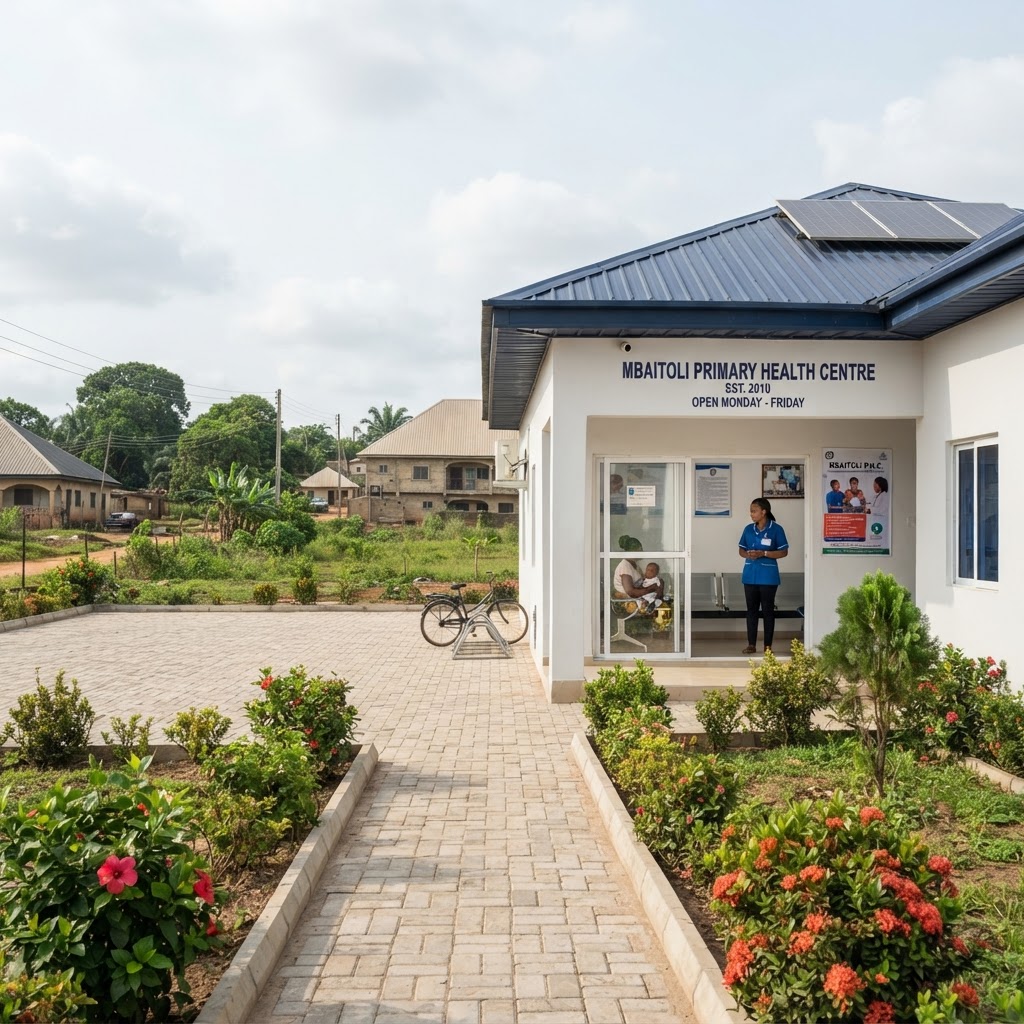
By eziokwubundu.com | Community Health & Development
Mbaitoli Local Government Area in Imo State is home to over 327,000 residents spread across nine principal towns, including Mbieri, Orodo, Ubomiri, and Ogwa. On paper, the LGA maintains a network of primary healthcare centres (PHCs) designed to serve every ward and community. In reality, the gap between what is listed in government directories and what is actually functioning on the ground is vast — and the consequences for ordinary families are severe.
This investigation draws on field data, civil society tracking reports, and community testimonies to answer one of the most pressing questions facing Mbaitoli's residents: how many of their health centres are genuinely operational? Beyond the structural crisis, this article offers a practical roadmap — grounded in the Eziokwubundu Health + Wealth + Community framework — for how diaspora Nigerians, town unions, and youth professionals can help reverse decades of neglect.
What Is Mbaitoli's True PHC Network State?
The Directory vs. the Ground Reality
Official records maintained by the Imo State Primary Health Care Management Board list dozens of designated health facilities across Mbaitoli LGA's wards. But health workers, community leaders, and civil society monitors consistently report that the operational picture is far grimmer. A facility being "listed" means little when its roof has caved in, its borehole is dry, or its sole nurse was redeployed three years ago and never replaced.
The distinction between a designated facility and a functional one is not administrative pedantry — it is a matter of life and death. A functional PHC, by any credible benchmark, must be capable of providing round-the-clock emergency response, safe maternal delivery, childhood immunization, basic diagnostic services, and antenatal care. Assessed against these standards, independent monitoring suggests that fewer than 40% of Mbaitoli's listed PHCs meet minimum operational thresholds.
For a population exceeding 327,000, that shortfall translates directly into preventable maternal deaths, unvaccinated children, and families pushed toward catastrophic out-of-pocket health expenditures. Research by the Nigerian health financing advocacy group BudgIT consistently shows that dysfunctional public health infrastructure drives rural households deeper into poverty — a direct link between community health and household economic resilience.
This reality is precisely why eziokwubundu.com frames rural healthcare not as a welfare issue alone, but as a foundational wealth and community development concern. A community whose members cannot access reliable primary care is a community whose economic productivity is perpetually undermined. Understanding how much it costs to give birth in Imo in 2026 is one dimension of this; understanding why public facilities fail to absorb that burden is the deeper structural question.
Which Facilities Are Delivering Real Care?
Ohohia PHC: A Model Worth Studying
Amid the widespread dysfunction, Ohohia Primary Health Care Centre stands out as one of Mbaitoli's clearer success stories — and its relative functionality is not accidental. Ohohia PHC has been a beneficiary of the Basic Health Care Provision Fund (BHCPF), the federal intervention mechanism established under the National Health Act to channel funding directly to primary care facilities. Simultaneously, enrollment drives under the National Health Insurance Authority (NHIA) indigent scheme have extended subsidized coverage to some of the LGA's most economically vulnerable residents.
The practical impact is visible. Ohohia's maternal delivery room, which had been non-functional for several years, was restored and is now recording supervised deliveries. Free childhood immunization schedules — covering BCG, OPV, pentavalent, and measles vaccines — are running on a consistent monthly cadence. Routine antenatal care clinics are operational, and the facility has restored basic in-house laboratory diagnostics, including malaria RDT testing and haemoglobin screening, which are critical for managing pregnancy complications in a malaria-endemic zone.
Perhaps the most telling indicator of Ohohia's restored credibility is cross-community utilization. Patients are now travelling from neighboring Orodo, Awo, and surrounding villages specifically to access Ohohia's subsidized services — a grassroots vote of confidence that no government report can manufacture. This migration pattern also reflects the scarcity of alternatives; when one facility works, demand from a broad geographic catchment concentrates there immediately.
The BHCPF model, when properly administered, demonstrates that functional public PHCs are achievable without extraordinary expenditure. The World Health Organization's primary health care framework identifies consistent funding, trained staff retention, and community engagement as the three non-negotiable pillars of PHC functionality — and Ohohia, however imperfectly, currently satisfies more of those criteria than most of its counterparts in Mbaitoli.
The lesson for community stakeholders and diaspora investors is clear: targeted, accountable investment in specific facilities produces measurable outcomes. Broad, unmonitored capital infusions do not.
Why Are So Many Rural Clinics Failing?
Infrastructure Collapse at Òrìè Mbieri and Ishi-Ogwa
The contrast with Ohohia becomes stark when field findings from civic monitoring platforms are examined. Organizations including Tracka and MonITNG — both of which deploy grassroots monitors to verify the physical status of publicly funded projects — have documented alarming conditions at PHC Òrìè Mbieri and Umunneato Ishi-Ogwa PHC.
At Òrìè Mbieri, monitors found a facility without reliable borehole water, no functioning power supply, and sanitation infrastructure in visible disrepair. The practical consequence is that clinical staff cannot maintain basic infection control — hand-washing stations are non-operational, and sterilization of basic instruments is compromised. Thousands of villagers in the Mbieri axis are effectively left without accessible public healthcare.
Featured Products
Chukwu Abiama Tee
Bold black-and-gold Igbo-pride T-shirt featuring 'Chukwu Abiama' in premium streetwear typography.
₦15,000
Buy NowReverse Type 2 Diabetes & other associated Metabolic Issues using Dr. Jason Fung's Evidence-Based Approach— FMD program for Type 2 Diabetes
A practical fasting and fasting-mimicking programme built on Dr Jason Fung's insulin-resistance principles and ow-glycemic recipes.
₦19,950
Join NowỤmụ Igbo Tee
Classic black T-shirt with bold white 'Ụmụ Igbo' typography — a proud statement of Igbo heritage.
₦15,000
Buy NowNwanne Tee
Washed khaki vintage tee with a faded rust-orange 'Nwanne' stamp badge and palm leaf motif — a nod to kinship and heritage.
₦18,000
Buy NowObodo Tee
Faded denim-blue washed tee with a cream 'Obodo' stamp badge and sun motif, celebrating community roots.
₦18,000
Buy NowEkwe Heritage Tee
Deep indigo tee featuring a fine line-art illustration of a traditional Igbo ekwe drum, inspired by Igbo-Ukwu bronze artistry.
₦18,000
Buy NowIkenga Figure Tee
Forest green tee with a fine line-art illustration of a stylized Ikenga figure.
₦18,000
Buy NowIshi-Ogwa's situation illustrates a different but equally damaging failure mode: poor contractor execution of renovation projects. Community members reported that newly installed roofing materials were blown off within weeks of completion during early rains. Solar inverter batteries, installed as part of a power-supply upgrade, were found to be of substandard specification and failed within months, plunging the facility back into darkness. These are not isolated incidents — they are symptomatic of a procurement environment where contracts are awarded without adequate quality assurance, supervision, or accountability. The Auditor-General's recent report flagging ₦124.12 billion in contract irregularities at the federal level reflects a culture of impunity in public infrastructure spending that cascades directly down to local facilities like these.
The medical risk profile of non-functional centres is severe. When the nearest public PHC is unusable, rural families default to unregulated patent medicine vendors — locally called chemists — who frequently dispense prescription antibiotics and antimalarials without diagnosis. Unmonitored herbal treatment homes absorb maternal emergencies that should be managed in clinical settings. Both pathways carry significant mortality risk, and the financial cost of complications from delayed or inappropriate treatment routinely exceeds what a functional public PHC visit would have cost.
What Bottlenecks Cripple Grassroots Health Workers?
Staffing, Pay, and the Weight of Solo Service
Even where physical infrastructure is adequate, Mbaitoli's PHCs face a debilitating human resource crisis. Officers-in-charge (OiCs) — typically senior community health extension workers or nurses posted to rural facilities — frequently operate as the sole clinical presence in their facilities. Interviews with health workers across Imo State reveal a common and deeply troubling pattern: OiCs sleeping inside consultation wards or drug stores to maintain overnight emergency cover, because there is no second staff member to share overnight duty.
The remuneration structure compounds this exploitation. Multiple OiCs at Level 13 on the Consolidated Health Salary Structure — a grade that reflects significant clinical experience and management responsibility — report being paid at entry-level scales due to state-level salary table anomalies and irregular promotion processing. These individuals are absorbing full facility operational costs, including personal expenditure on cleaning supplies and basic consumables, while receiving inadequate pay. The demoralizing effect on retention is predictable and severe.
Beyond pay, frontline workers in Mbaitoli face a trust deficit that makes their work significantly harder. Vaccine skepticism — amplified by social media misinformation and historical grievances about government service delivery — is actively reducing immunization uptake in several communities. OiCs and community health workers describe conducting outreach at town union meetings, village assemblies, and church services to counter specific local rumors about childhood vaccines. This community engagement work is essential and largely uncompensated, performed on the personal initiative of health workers who understand that a healthy community is also a more economically stable one.
How Can Communities and Diaspora Fix This?
Practical Steps Toward Community-Owned Healthcare
The structural failures of Mbaitoli's health centres will not be resolved by waiting for government action alone. Community-led stewardship, diaspora investment, and civic accountability systems are the practical levers available to Mbaitoli's stakeholders right now.
Town unions and autonomous community leadership can begin immediately by organizing facility maintenance committees at every PHC within their jurisdiction. These committees need not be large or expensive to be effective. Purchasing replacement bed linens, funding borehole pump repairs, and ensuring perimeter security are all achievable through community levies and donations. The cost of maintaining a functional borehole — approximately ₦150,000 to ₦300,000 for a pump overhaul — is vastly lower than the health expenditure burden a non-functional water supply imposes on the surrounding population.
Diaspora Nigerians and business leaders hold particular potential. Rather than channeling philanthropic capital into cosmetic repainting of buildings — a visible but low-impact gesture — structured investment in NHIA premium sponsorships for indigent community members and procurement of durable solar energy systems produces lasting clinical outcomes. An off-grid solar installation sufficient for a PHC's lighting, vaccine cold chain, and diagnostic equipment costs between ₦2.5 million and ₦4 million — a figure well within the reach of coordinated diaspora giving from a single town union chapter abroad.
Civic tracking and accountability is the third pillar. Youth professionals and local vigilante committees can be trained to monitor BHCPF quarterly allocations, verify contractor deliverables against project specifications, and formally report irregularities to state-level oversight bodies and civil society organizations like Tracka. Linking this grassroots monitoring to digital reporting platforms ensures that evidence of malfeasance reaches audiences who can apply pressure. Accountability journalism — of the kind being practiced by platforms like eziokwubundu.com — plays a direct role in closing the loop between community observation and institutional response.
The path toward functional healthcare in Mbaitoli is not mysterious. It requires organized community will, targeted investment, and persistent civic monitoring. Each of those assets exists within Mbaitoli and its diaspora. What has been missing is the coordination to deploy them systematically.
Conclusion
Mbaitoli's health crisis is not a secret. It is visible in every community that has lost a mother to a preventable delivery complication, every child who went unvaccinated because the nearest PHC had no power, and every family that spent its savings at a private clinic after the public one failed them. The question "how many are actually functional?" deserves an honest answer — and that answer demands honest action.
The Eziokwubundu Health + Wealth + Community framework is built on a foundational truth: community health is inseparable from community prosperity. When Mbaitoli's PHCs work, families stay healthier, productivity rises, household savings are preserved, and the community's collective capacity to build wealth expands. The reverse is equally true.
For community leaders, diaspora investors, youth professionals, and local organizations reading this: the infrastructure exists. The funding mechanisms — BHCPF, NHIA, community levies — exist. What Mbaitoli needs now is organized, accountable, and sustained community engagement to bridge the gap between what is listed and what actually works.
For more coverage of health access, community development, and practical prosperity in Imo State and beyond, visit eziokwubundu.com.
Stay Informed
Get New Articles in Your Inbox
Subscribe to receive the latest community development, health, and wealth insights from Eziokwubundu.
Newsletter
Practical insights on health, wealth, and community — delivered weekly.